The Friday Briefing 16 (2 November 2018)

The Garden of Eden: a Biblical-theological framework Dr David Schrock writes, “. . . in any study of Genesis and in any study of the Bible, we must understand the way in which Eden is more than an ancient garden. It is the place where God put his royal priests to cultivate and keep the earth he gave them to subdue and rule. Though framed in ancient language and imagery, it is vital modern Christians understand these original designs—for they have impact on the way we conceive of God, the world, and mankind’s place in the world.”

Exodus in 1 Kings Dr Alastair Roberts explores how the narrative of Solomon and the division of the kingdom is linked to Adam in the Garden of Eden and to the Exodus.

Old Testament word studies: ‘Abba’, “Father” Dr Allen Ross comments, “This Aramaic word ’Abba’,”Father,” has always been a significant word in the spiritual life of believers. It was used in the Old Testament to describe the spiritual relationship between believers and God; but it became more pronounced in the New Testament in the light of Jesus’ instructions on prayer and the apostolic teachings. But today there is little clear understanding of what the description means; moreover, it is being defined and used in a way that was not intended. The word, then, calls for closer scrutiny.”

Seeing the Iranian church grow . . . in Serbia Here’s a remarkable story of how Iranian refugees in Serbia are turning to Christ.

”Speak, O Lord” – a hymn by Keith Getty and Stuart Townend The words and music of this superb hymn are by Keith Getty and Stuart Townend. Here’s a recording of it being sung congregationally at the 2012 Together for the Gospel Conference.

The Garden of Eden: a Biblical-theological framework.

David Schrock writes, “God’s people dwelling in God’s place under God’s rule: This tripartite division, outlined by Graeme Goldsworthy in his book According to Plan, well articulates the relationship of Adam and Eve to God in the Garden. Yet, often when Christians read the creation account in Genesis 1–2 they miss the royal and priestly themes in those two chapters. . . . . So, in what follows, I hope to provide a brief summary of the biblical evidence for seeing the first image-bearers (imago Dei) as royal priests commissioned by God to have priestly dominion over the earth—a commission later restored in type to Israel (see Exodus 19:5–6), fulfilled in Christ (see, e.g., Hebrews 5), and shared with all those who are in Christ (see 1 Peter 2:5, 9–10). In these sections, we will focus on the temple and by extension to the purpose and work of mankind in that original garden-sanctuary.”

He then explores the theme of the garden in the Bible, focusing on the garden’s role as a priestly and a royal sanctuary. He notes how the Garden is clearly seen as a sacred temple when comparing it to Moses’ tabernacle and Solomon’s temple.

He concludes,“Therefore, in any study of Genesis and in any study of the Bible, we must understand the way in which Eden is more than an ancient garden. It is the place where God put his royal priests to cultivate and keep the earth he gave them to subdue and rule. Though framed in ancient language and imagery, it is vital modern Christians understand these original designs—for they have impact on the way we conceive of God, the world, and mankind’s place in the world.”

To help show the biblical basis for this approach to Eden, Dr Schrock very helpfully lists a number of Bible passages relating to the theme of the garden.

Read the whole article HERE. Much of the research behind this article stems from Dr. Schrock’s dissertation, A Biblical-Theological Investigation of Christ’s Priesthood and Covenant Mediation with respect to the Extent of the Atonement, which can be downloaded free of charge HERE.

Click here to go back to table of contents

Exodus in 1 Kings.

Dr Alastair Roberts writes, “In the four hundred and eightieth year after the Exodus, Solomon began to build the temple of the Lord in Jerusalem. That the author of Kings should date the start of the building of the temple from the Exodus is noteworthy. . . . . The building of the temple on the mountain in Jerusalem is, in many respects, the climax and the completion of the process begun in the Exodus. . . . . Since its construction, the tabernacle had functioned as a sort of portable Mount Sinai, an architectural extension of the theophany that occurred there. It was also a new Eden and microcosmic representation of the wider creation . . . . Solomon’s Temple introduces a new stage of history and, once again, there are echoes of the original creation and of Eden.”

And, as Dr Roberts tells us, “Within this world, Solomon is like a glorious new Adam. He is the wise ruler of the world, who is able to name the trees and the animals (4:29-34). Indeed, when the Queen of Sheba comes to him, it is akin to Eve being brought to Adam, the moment when the story of the first creation arrived at its zenith of glory. Unfortunately, just as in the account of the original creation, it is at this point that things all start to crumble. The rest of the story of Solomon is a tragic story of the fall of the new Adam and of being removed from the peace and rest of the new Eden.”

Dr Roberts traces the sorry story of Solomon’s fall through the division of the kingdom to the day when Ahijah the prophet prophesied the doom of the northern kingdom of Israel in 1 Kings 14.7-16. In Dr Roberts’ words, “There would be a great reversal of the Exodus as Israel once again found itself in captivity. The Red Sea Crossing would be undone, as Israel would find itself cast on the far side of the great River.”

Read the whole of this fascinating exposition HERE.

Click here to go back to table of contents

Old Testament word studies: ‘Abba’, “Father”.

Dr Allen Ross comments, “This Aramaic word ’Abba’, “Father,” has always been a significant word in the spiritual life of believers. It was used in the Old Testament to describe the spiritual relationship between believers and God; but it became more pronounced in the New Testament in the light of Jesus’ instructions on prayer and the apostolic teachings. But today there is little clear understanding of what the description means; moreover, it is being defined and used in a way that was not intended.”

Dr Ross then explores the origin and meaning of the word, and the significance of calling God “Father”. He concludes, ”What, then, does the term “Father” for God mean for use? First, to call God Father is to speak of him as the absolutely sovereign God of creation. . . . . Second, to call God “Father” is to use covenant language. In all of God’s covenants, the people are “sons” or “children” by their adoption into the covenant. . . . . Third, for us to call God “Father” is indeed to acknowledge a close personal relationship with him; it is after all a family term. It is fair to say that in Jesus’ time the word was colloquial but respectful, even in human families; but it was not a childish expression like “daddy”. To call God “Father” is to affirm that we have been born into the family of God, . . . . But he is still the sovereign and holy Lord God; and the significance of the word “Father” is one of a reverent, respectful and solemn adult address of God.”

Read the whole article HERE.

As a postscript to Dr Ross’s article, my own personal attempt to translate ‘Abba’ – in order to bring out the intimacy and the respect that is inherent in the term – is “dearest Father”.

Click here to go back to table of contents

Seeing the Iranian church grow . . . in Serbia.

A friend of mine, Nicky Andrews, tells of a remarkable turning to Christ among Iranian refugees in Serbia. She writes, “The OM field leader of the Balkan region, Volker Sachse, doesn’t cry easily. But in the past three or four years, he has often been moved to tears by the plight of refugees he has met in Serbia; OM has played a significant humanitarian role in one of the government-run camps there since the ‘refugee crisis’ in Europe escalated in 2015. Today, however, it is tears of joy that brighten Volker’s eyes, as he describes how many refugees from Iran are turning to Jesus during a worldwide move of God amongst Iranians. “It’s a privilege for me to witness the Lord touching so many Iranians in Serbia, including in the camp where OM works,” he shares.”

There is now a need to disciple these new believers. Nicky writes, “[Volker] shares, though, that there is ongoing need to nurture the young believers towards greater maturity. “So, I’m very excited by the possibility of running an intensive discipleship training course for up to eight Iranian believers over five days, which would then be repeated for a second group of eight.” says Volker. . . . . The training would be aimed at equipping Christians to launch a church plant in the camp.”

More information about how to be involved, including how to contribute financially to the discipleship programme, is available HERE.

Read the whole article HERE.

Click here to go back to table of contents

”Speak, O Lord” – a hymn by Keith Getty and Stuart Townend

The words and music of this superb hymn are by Keith Getty and Stuart Townend. This particular recording is part of an album recorded live from the 2012 Together for the Gospel Conference in Louisville, Kentucky.

The lyrics are available HERE.

Click here to go back to table of contents

‘The House of God’ by L. Michael Morales

Image © Steve Creitz, Creitz Illustration Studio

An artist’s impression of the camp of Israel in the wilderness. The Tabernacle is in the centre of the camp. Above the Tabernacle is the pillar of cloud, which was the visible manifestation of God’s presence.

L. Michael Morales writes, “When the fiery cloud of God moved from the summit of Mount Sinai to the newly constructed tabernacle, covering God’s house with smoke and filling it with His glory (Exodus 40.34), a pinnacle in God’s dealings with humanity was realized. In this majestic scene, the book of Exodus ends with a resolution, albeit temporary and intermediate, to the story of humanity’s exile from Eden narrated in Genesis 3. Moreover, the glory-filled tabernacle also foreshadowed God’s ultimate solution to that primal expulsion through the person and work of Jesus Christ.”

Dr Morales continues, “As we consider the significance of the tabernacle (and later temple) in Scripture, it will be helpful to keep two points in mind. First, the tabernacle was the house of God, the place of His dwelling. . . . . Second, the tabernacle was also the way to God, its sacrificial rituals providing the atonement and cleansing needed to dwell with God. . . . . In sum, Israel’s relationship with God was preserved and cultivated by the sacrificial system of the tabernacle, enabling the Maker of heaven and earth to dwell with His people in fellowship. To understand the depth and wonder of such a purpose, we will reflect upon the meaning of the tabernacle first within God’s goal for creation and then as the heart of God’s covenant with His people—a purpose taken up and fulfilled by Jesus Christ.”

Read the whole article HERE.

Dr. L. Michael Morales is professor of biblical studies at Greenville Presbyterian Theological Seminary in Taylors, South Carolina, and adjunct professor at Reformed Theological Seminary (Orlando/Dallas). He is author of Who Shall Ascend the Mountain of the Lord?: a Biblical Theology of the Book of Leviticus. You can read the publishers details for this book, which I can thoroughly recommend, HERE.

‘Preaching Christ from the Old Testament’ by Sinclair B. Ferguson

Image from Lightstock

Dr Sinclair B. Ferguson asks, “. . . how do we legitimately preach the text of the Old Testament as those who stand on this side of Pentecost? What difference does it make to expound Genesis or Psalms as believers in Jesus Christ? Or, to put it in a more graphic way, how can we reconstruct the principles of Jesus’ conversation in Luke 24.25-27,45, and learn to follow his example of showing how all the Scriptures point to him so that hearts are ‘strangely warmed’ and begin to burn? . . . . Yet we must also preach the Scriptures without denuding them of the genuine historical events they record and the reality of the personal experiences they describe or to which they were originally addressed. How, then, do we preach Christ, and him crucified without leapfrogging over these historical realities as though the Old Testament Scriptures had no real significance for their own historical context?”

He explains, “. . . there are . . . very important principles that help us to develop Christ-centred expository skills. As we work with them, and as they percolate through our thinking and our approach to the Bible, they will help us develop the instinct to point people to Christ from the Old Testament Scriptures. The most general principle is one for which we might coin the expression fillfulment. Christ fulfils or ‘fills full’ the Old Testament. He came ‘not to abolish the Law or the Prophets but to fulfil them’ (Matthew 5.17). As Christians standing within the light of New Testament revelation and looking back on the Old Testament, Christ himself acts as a hermeneutical prism. Looking back through him, we see the white light of the unity of the truth of Jesus Christ broken down into its constituent colours in the pages of the Old Testament. Then, looking forwards we see how the multi-coloured strands of Old Testament revelation converge in him.  . . . . We want to develop an instinct to preach Christ. This is the general principle. But it can be broken down into at least four subordinate principles . . . .”

Dr Ferguson then explains these four principles. In his conclusion, he comments, “These are general principles; they do not constitute a simple formula, an elixir to be sprinkled on our sermons to transform them into the preaching of Christ. There is no formula that will do that. . . . . But as we come to know the Scriptures more intimately, as we see these patterns deeply embedded in the Bible, and—just as crucially—as we come to know Christ himself more intimately and to love him better, we shall surely develop the instinct to reason, explain and prove from all the Scriptures the riches of grace which are proclaimed in Jesus, the Christ, the Saviour of the world.”

Dr Ferguson’s article is instructive and stimulating, and worth taking time to read and to digest – and to apply.

It’s available in 10 parts from website of The Proclamation Trust. For part 1, click HERE; for part 2, click HERE; for part 3, click HERE; for part 4, click HERE; for part 5, click HERE; for part 6, click HERE; for part 7, click HERE; for part 8, click HERE; for part 9, click HERE; and for part 10, click HERE.

An earlier version of this article is available as a single webpage HERE (the online version in 10 parts available above is a later edited version).

‘Even Better than Eden: Nine Ways the Bible’s Story Changes Everything About Your Story’ by Nancy Guthrie

In her new book, Even Better than Eden: Nine Ways the Bible’s Story Changes Everything About Your Story, Nancy Guthrie traces nine themes through the Bible – the wilderness, the tree, God’s image, clothing, the Bridegroom, the Sabbath, the offspring, the dwelling place, and the city. Essentially, what she gives us is a series of nine mini-overviews of the Bible story, each one tracing the story from the point of view of one of these key themes. Each of these nine mini-overviews is just a chapter in length (in fact, the main text of the book is only 150 pages in length). Guthrie succeeds in her task brilliantly. Her writing is clear and engaging. Yet the book – despite the fact that it’s so accessible and easy to read – is also theologically rich.

Guthrie’s overall thrust is that God’s plan for His world is not simply to restore what was lost in Eden before the Fall. The new creation we read about on the final two chapters of Revelation will be far more glorious than the creation we see in the opening chapters of Genesis.

There’s a discussion guide at the end of the book, which gives questions for discussing the themes presented in each chapter. There are also endnotes to explain further and to support some of what she writes.

In the introduction, after talking a little about her own personal story, Guthrie writes, “There’s another story, a story that is found in the pages of the Bible—from the book of Genesis through the book of Revelation—that shapes and defines where I came from, why I am the way I am, what my life is like day to day, and what is ahead for me in the future. It is this story that explains my deepest joys as well as the empty places where contentment can be elusive. It is this story that explains my drive to be somebody and my sensitivity to feeling like a nobody. It explains what makes me cry and why I can laugh. This story explains my desire to look good, my craving for the good life, my longing for home and security, and much more.”Guthrie continues: “And whether you know it or not, this same grand story—the story found in the sixty-six books of the Bible—shapes the world you live in, who you are, and what you want too. That’s why you and I need to know this story. It is where we find the answers to our questions about what really matters now and into eternity. This story has the power to change everything about our stories.”

Scott R. Swain, President and James Woodrow Hassell Professor of Systematic Theology, Reformed Theological Seminary, Orlando, writes, “One of the weaknesses of much popular Christian teaching on the Bible is the tendency to read the story of the Bible in a circular manner, as if Jesus Christ came into the world to bring us back to Eden. Nancy Guthrie charts a better course in her book. In a manner that is profoundly biblical and deeply practical, she traces nine biblical themes along a common trajectory, from their beginning in God’s good creation, through their destruction and devastation by Adam’s sin, to the ways Christ perfects, consummates, and crowns each theme by means of his suffering and glory. Let Guthrie take you by the hand and lead you through the Bible to Jesus Christ, in whom we find a better provision, a better life, a better identity, a better rest, a better wardrobe, a better spouse, a better savior, a better sanctuary, and a better city than this world in its present state could or would afford.”

Read the publisher’s description HERE. Download an excerpt HERE.

Nancy’s website page for this book is available HERE. Reproducible personal Bible study questions for personal or small group use (not the same as the discussion guide in the book itself) and a leader’s guide are available for purchase as downloads from this page.

A nine-session video version of Even Better Than Eden is also available – click HERE for more information and to view one of the sessions free of charge.

This workshop on Even Better Than Eden: How the Bible’s Story Changes Everything About Your Story with Nancy Guthrie was recorded at The Gospel Coalition’s 2018 Women’s Conference in Indianapolis, Indiana:

Nancy Guthrie teaches the Bible at her church, Cornerstone Presbyterian Church in Franklin, Tennessee, and at conferences worldwide. She is the author or editor of a number of books, together with some video resources. She is also the host of Help Me Teach the Bible, a podcast of the Gospel Coalition.

The Friday Briefing 15 (5 October 2018)

Every story casts His shadow Watch this brief video and see how the whole Old Testament points to Jesus Christ. It is inspirational.

From beelines to plotlines: typology that follows the covenantal topography of Scripture Dr David Schrock writes, “Perhaps you have heard or repeated Charles Spurgeon’s famous axiom, “I take my text and make a beeline to the cross.” The trouble is Charles Spurgeon probably never said it. Worse, the simplistic axiom fails to account for the textual shape and biblical contours of the Bible, not to mention the infelicitous way it misjudges the course of honeybees.” Focusing on the office of priesthood as an example, Dr Schrock guides us to a better understanding of how the types found in the Bible story point us to Jesus and His Church.

What did Jesus have against goats? Ian Paul throws some clear Biblical light on the well-known but often misunderstood illustration of the sheep and the goats (Matthew 25.31-46)

A society without Psalms Mark Loughridge comments: “. . . the loss of biblical literacy is not merely an issue for the church and for our proclamation of the gospel, but is a felt absence by our world, a void which our culture must sense and will try to fill. This stirred my own thinking about a society without Psalms, . . . .”

At What Price Awakening? Examining the Theology and Practice of the Bethel Movement Stephen Tan calls attention to grave errors in the theology and their practices of the hyper-charismatic ‘Signs and Wonders’ movement with its epicentre at Bethel Church in Redding, California, and concerns about The Passion Translation of the Bible , which Bill Johnson, leader of the Bethel Church, enthusiastically endorses.

Every story casts His shadow.

Watch this brief video (a trailer for The Gospel Project) and see how the Old Testament points to Jesus Christ. Trevin Wax comments: “I get chills every time I watch this . . . .” From the video’s narrator: “Sixty six books. Dozens of authors. A holy canon thousands of years in the making. Consider the works…accounts of history and law. Prophecy and poetry. Verses of wisdom and letters from friends. Now. Look again. What do you see? . . . . Every story casts His shadow. Every word, every verse, bears His testimony — the Holy Messiah. Jesus Christ. Eternal King.”

https://vimeo.com/121265107

The video is a trailer for The Gospel Project, published by LifeWay. The Gospel Project, provides, in their own words, “a chronological, Christ-centered Bible study plan for every age group in your church: preschoolers through adults. These studies are age-appropriate, easy to teach, and aligned by Scripture to help your entire church grow in the gospel together.” The Gospel Project’s home page is HERE.

Details of their upcoming 3-year study plan (from Fall 2021 to Summer 2024 is available for download HERE.

Read Trevin Wax’s article HERE.

Click here to go back to table of contents

From beelines to plotlines: typology that follows the covenantal topography of Scripture.

Dr David Schrock comments, “Perhaps you have heard or repeated Charles Spurgeon’s famous axiom, “I take my text and make a beeline to the cross.” The trouble is Charles Spurgeon probably never said it. Worse, the simplistic axiom fails to account for the textual shape and biblical contours of the Bible, not to mention the infelicitous way it misjudges the course of honeybees.”

Dr. Schrock explains: “. . . this essay will argue for a thicker reading of Scripture. It will argue that standing underneath any legitimate type is a covenantal topography, a biblical terrain that rises and falls throughout Israel’s covenant history, which all types follow in their own unique way as they run toward Christ and his Church. Therefore, in addition to the standard ‘tests’ for valid types, I will demonstrate how biblical types follow this covenantal topography from historical prototype, through covenantal ectypes, to their intended antitype — namely, the person and work of Christ. From there, by union with Christ, typology experiences a new birth, as supratypes share covenantal attributes with and carry out the offices assigned by Jesus Christ. . . . . Typology, therefore, must be understood in relationship to the biblical covenants that unify and organize the Bible. But biblical types must also, as I will argue, be seen in relationship with creation, fall, and process of redemption found in God’s covenant history.”

In demonstrating his understanding of Biblical typology, Dr Schrock takes one concrete example – that of the priesthood. He writes, “. . . in what follows, I will show how the priesthood follows this covenantal topography moving from Adam to Christ through the peaks and valleys of Israel’s history. By following this one concrete example, my hope is to demonstrate a covenantal topography that all types follow as they move from the shadows of the old covenant to the substance of the new.”

Dr Schrock first present the Biblical texts and then shows the priestly office develops through the different periods of Bible history. He explains, “To give a sense of where we are going, I will first present in chart-form the biblical texts that serve as milestones for the priestly type. These priestly milestones will be accompanied by two other lines of personal milestones for the biblical offices of prophet and king. . . . . Second, I will provide hermeneutical commentary on each phase of covenant history that helps explain how the priestly office develops across the canon. These stages of development are: (1) Creation, (2) Patriarchs, (3) Law, (4) Prophets including (a) historical formation, (b) covenant-breaking deformation and (c) eschatological reformation, (5) Christ, and (6) the Church. It is the formation, deformation, and reformation in the period of the Prophets that I believe is most original to this article.”

Read the whole article HERE.

Click here to go back to table of contents

What did Jesus have against goats?.

Ian Paul brings fresh insight into Jesus’s illustration of the sheep and the goats (Matthew 25.31-46), in which he describes the Last Judgment. He writes, “The most common interpretation of the narrative allocates the people groups in the following way. The ‘least of these’ are the poor in general; the sheep are those (probably followers of Jesus, obeying his teaching here) who care for the poor rather than just having a theoretical faith; and the goats are those who neglect Jesus’ teaching. Thus this becomes a general argument of the importance of caring for the poor. But this interpretation has only been around since around 1850 (which raises issues about how we should response to ‘novel’ interpretations…) and in fact has some serious obstacles to it.”

Dr Paul lights up our understanding of the illustration of the sheep and the goats. He does this especially by taking us back to the Biblical art of shepherding that he recently heard explained by Richard Goode, of Newman University in Birmingham, at the British New Testament Conference. Dr Goode’s paper was entitled, What did Jesus have against goats? Setting Matthew 25:32-33 within the context of caprid husbandry of Roman Palestine. (You can see an abstract of this paper HERE – it’s the third paper of session 1; just click the  View abstract  button to see it.)

Read the whole article HERE.

Click here to go back to table of contents

A society without Psalms.

Mark Loughridge writes, “When contemporary poet Edward Clarke turned 40, he set himself the task of reading through the Authorised Version of the Bible in one year . . . . As Clarke spent time in the Bible he shared that ‘one does feel enthralled to something greater’, and that while he is not a regular church goer, there was an element of spiritual catharsis in trying to think and write from the space the Scriptures provide. This, however, was no mere exercise in subjectivity, but the outcome of convictions which Clarke has developed about the 21st century and biblical literature.”

Loughridge comments: “. . . the loss of biblical literacy is not merely an issue for the church and for our proclamation of the gospel, but is a felt absence by our world, a void which our culture must sense and will try to fill. This stirred my own thinking about a society without Psalms, what our secular nation will look like without the bedrock of biblical categories through which to see the world, understand themselves, and articulate the things which most matter.”

Read the whole article HERE.

Click here to go back to table of contents

At What Price Awakening? Examining the Theology and Practice of the Bethel Movement.

Stephen Tan, pastor of Regeneration Church, a new church in Clayton, Melbourne, Australia, writes: “”Australia for Jesus” is the motto of Awakening Australia, an event that seeks to unite every denomination under one mission: to bring revival to Australia. . . . . While revival, unity and nationwide prayer are good goals for Christians to have, I am unable to support Awakening Australia. . . . . My main contention with Awakening Australia is that it is part of a hyper-charismatic ‘Signs and Wonders’ movement with its epicentre at Bethel Church in Redding, California. In fact, the leader of Bethel Church, Bill Johnson, is the main speaker at Awakening Australia.”

Pastor Tan tells us: “If you log onto Bethel’s website (bethelredding.com), their mission is clear: to bring revival to Redding and to the whole world. They see themselves as having “a global impact” as “a revival resource and equipping centre”. They run “revival” conferences and rallies all over the world. Kingdom Invasion in Singapore draws thousands, as will Awakening Australia later this year. Bethel also runs their own ‘Bethel School of Supernatural Ministry (BSSM)’ which teaches people to perform miracles and bring revival. BSSM spawns hundreds of similar schools around the world, including in Melbourne and in other cities in Australia. But what exactly does Bethel mean by revival?”

Pastor Tan calls attention to grave errors in their theology and their practices. He also voices his concerns about the Passion Translation, which Bill Johnson enthusiastically endorses. Tan comments: “What makes the Bethel movement dangerous is that their reach is extended through their music ministry. Jesus Culture and Bethel Music have created a brand of worship music that can genuinely compete with Hillsong. . . . . I fear Jesus Culture serves as a gateway drug that draws young and inexperienced Christians into a world of false teaching, unbiblical practices and spiritual disaster.”

He comments, “I am concerned that the upcoming ‘Awakening Australia’ event also fits the description and has the potential to cause much confusion and spiritual damage to thousands of unsuspecting Australians. To those who are supporting this event in the name of revival, may I ask this question: “At what price, awakening?” Is it worth pursuing awakening if it means that the gospel is compromised and that false teaching is promoted?”

Read the whole article HERE.

Click here to go back to table of contents

The Friday Briefing 11 (1 June 2018)

The Friday Briefing is now appearing monthly rather than weekly, on the first Friday of each month. This will allow more time for revision of some existing material on this site, and for further writing projects.

10 things you should know about being reconciled to God Sam Storms asks, “What does it mean when we appeal to non-believers to be reconciled to God?”

The New Testament, the ring of truth, and the difference with mythological legends J.B. Phillips (1906-1982) produced a translation of the New Testament, entitled New Testament in Modern English. In a memoir, Phillips wrote : “I found again and again that the material under my hands was strangely alive; it spoke to my condition in the most uncanny way. I say ‘uncanny’ for want of a better word, but it was a very strange experience to sense, not occasionally but almost continually, the living quality of those rather strangely assorted books.”

The local church as a counterculture Brett McCracken comments, “The local church was never meant to be a cultural, comfortable, bourgeois social club . . . . On the contrary, it was meant to be a counterculture, a set-apart community embodying a radically different vision for human flourishing. What would it mean for local churches to embrace their countercultural identity?”

How history’s revivals teach us to pray David R. Thomas writes, “From 1949 to 1952, . . . . . . . a spiritual awakening swept across the islands of Lewis and Harris, . . . . . . . I met 11 eyewitnesses—in their 80s now—who agreed to interviews in the sanctuary of the very church where the awakening began. . . . . They told of the attitude of brokenness and desperation that stirred Christians in that day, a spirit of necessity and audacity, a manner of prayer that could be daring and agonizing. . . . . A stream of this manner of praying flows from the early church all the way through the Reformation. . . . . But travailing prayer finally found a widespread voice at the dawn of the Great Awakenings in America, . . . .”

Rescuing Christian masculinity Alastair Roberts writes, “It is profoundly depressing to witness the tendency to respond to the Church’s failures to engage men with some puerile masculine rebranding exercise. . . . . Behind all of these things, it seems to me, there lies a deep crisis in contemporary masculinity, which in turn is a symptom of a crisis of contemporary society. Unfortunately, few people have put their finger upon this.”

10 things you should know about being reconciled to God.

Sam Storms writes, “We hear and say much about redemption justification and adoption and forgiveness of sins. But when was the last time you heard a sermon about the doctrine of reconciliation? What does it mean to say we are reconciled to God? What does it mean when we appeal to non-believers to be reconciled to God? In this post we’ll look at ten things we all should know about this glorious truth.”

Read the whole article HERE.

Click here to go back to table of contents

The New Testament, the ring of truth, and the difference with mythological legends.

Justin Taylor writes, “J. B. Phillips (1906-1982) . . . was . . . a periphrastic Bible translator, working from the Greek text to put the New Testament into a breezy, British, mid-20th-century vernacular. . . . . In 1958 he published the entire New Testament in Modern English with revisions in 1961 and 1972. In 1967 he wrote a memoir describing the experience, entitled Ring of Truth: A Translator’s Testimony. In it he [wrote] “. . . for years I had viewed the Greek of the New Testament with a rather snobbish disdain. I had read the best of Classical Greek both at school and Cambridge for over ten years. . . . Although I did my utmost to preserve an emotional detachment, I found again and again that the material under my hands was strangely alive; it spoke to my condition in the most uncanny way. I say ‘uncanny’ for want of a better word, but it was a very strange experience to sense, not occasionally but almost continually, the living quality of those rather strangely assorted books. To me it is the more remarkable because I had no fundamentalist upbringing, and although as a priest of the Anglican Church I had a great respect for Holy Scripture, this very close contact of several years of translation produced an effect of ‘inspiration’ which I have never experienced, even in the remotest degree, in any other work.””

Read the whole article HERE.

Click here to go back to table of contents

The local church as a counterculture.

Brett McCracken writes, “Friedrich Nietzsche was perhaps the most towering figure among 19th century philosophers and thinkers, those whom Richard Lints has called “secular prophets.” . . . Neitzsche leveled new critiques against religion and positioned Christianity as a sort of idolatry—a made-in-man’s-own-image mythology to cope with the challenges of existence. . . . . He called Christianity the “religion of pity”—or, worse, the “religion of comfortableness.” . . . . Certainly we must admit that in many times and places in history—like in his own 19th century European context—Christianity has been rather comfortable, uncourageous, and unwilling to truly embrace the costly call of Jesus Christ. And for many in the American church today, Christianity is indeed a religion of escape and comfort, a faith that doesn’t ask much and doesn’t cost anything. It’s a religion of Moralistic Therapeutic Deism. So in that sense, perhaps Nietzsche’s critique is right. But Nietzsche is wrong to suggest there’s something inherently comfortable about Christianity, that it in its very essence Christianity is a convenient, disingenuous system of consolation for the weak people of the world. . . . .”

McCracken comments, “The local church was never meant to be a cultural, comfortable, bourgeois social club that affirms people in their idolatry and helps them along on a journey to their “best life now.” On the contrary, it was meant to be a counterculture, a set-apart community embodying a radically different vision for human flourishing. What would it mean for local churches to embrace their countercultural identity?”

Read the whole article HERE.

Click here to go back to table of contents

How history’s revivals teach us to pray.

David R. Thomas writes, “From 1949 to 1952, the unthinkable unfolded on Scottish islands known as the Hebrides: revival! Seemingly out of nowhere, a spiritual awakening swept across the islands of Lewis and Harris, . . . . Some historians believe this was the last genuine awakening in the western world. When I came across a book detailing the Hebridian Revival, I wanted to know how a community was transformed from spiritual freefall to stunning renewal. So I booked a flight to Scotland, hoping to meet anyone who might remember what happened in those days. To my amazement, I met 11 eyewitnesses—in their 80s now—who agreed to interviews in the sanctuary of the very church where the awakening began. . . . . While they admitted strong preaching and other measures had played a role in the revival, to a person they described something more essential when God moved: a kind of spiritual posture among those at the core of the awakening. They told of the attitude of brokenness and desperation that stirred Christians in that day, a spirit of necessity and audacity, a manner of prayer that could be daring and agonizing. . . . .”

“A stream of this manner of praying flows from the early church all the way through the Reformation. . . . . But travailing prayer finally found a widespread voice at the dawn of the Great Awakenings in America, introduced primarily by Jonathan Edwards, colonial America’s greatest thinker. . . . . The First and Second Great Awakenings overflowed with stories of an agony in prayer, of petitioners becoming unrelenting in their heart cries. . . . . Most important to the leaders of awakenings was that none of this audacity and determination in prayer could be self-generated. An outpouring of the “spirit of prayer” was to them the key spiritual gift, the essential charism, of awakening: God himself, by his Spirit, providing the discernment and faith, the energy and language and very breath of awakening. . . . .”

Thomas comments, “I must admit that all this has occasionally left me feeling guilty about my own praying. Who of us, if we’re honest, doesn’t deep down feel like we could be praying more, that we should in one way or another be praying better? . . . . My encounter with travailing prayer moved me closer to what I believe God is looking for.”

Read the whole article HERE.

Click here to go back to table of contents

Rescuing Christian masculinity.

Alastair Roberts writes, “It is profoundly depressing to witness the tendency to respond to the Church’s failures to engage men with some puerile masculine rebranding exercise. We are told that we need MAN hymns and MAN faith, just as we need MAN crisps, or MAN chocolate bars, . . . . Behind all of these things, it seems to me, there lies a deep crisis in contemporary masculinity, which in turn is a symptom of a crisis of contemporary society. Unfortunately, few people have put their finger upon this. . . . .”

“It is important to see, I believe, that the malaise of masculinity is a symptom of a deeper and more profound contemporary social and existential malaise, a malaise that affects everyone. It is one of the principal effects of a maternalistic society . . . . This society infantilizes us in many ways. . . . . In order to sustain this social order, masculinity must be domesticated and infantilized. . . . . Any masculine urge for world-engaging and world-changing action must be expended in the ersatz realities of sports, entertainment, games, and porn, thereby reduced to impotence. . . . .”

Dr Roberts concludes, “This spiritual malaise in the Church, just as in the wider cultural order, depends in large measure upon the emasculation and domestication of men. As I have argued in the past, a strong male—and masculine—pastorate can have the salutary effect of bringing to light spiritual realities that the modern order seeks to exclude from our vision.  . . . . In our concern to recover a lost masculinity, we easily forget that masculinity will only ever be recovered indirectly—as we recover the reality that masculinity was about. The recovery of Christian masculinity will only occur as we commit ourselves to the restoration of biblical Christianity and the recovery of the weight and stakes of its moral universe. It is only within this moral universe that a healthy Christian masculinity—far from the macho posturing of many contemporary parodies—will thrive.”

This is a penetrating commentary on this pressing issue.

Read the whole article HERE.

Click here to go back to table of contents

The Friday Briefing 10 (11 May 2018)

The Friday Briefing will now appear monthly rather than weekly, on the first Friday of each month, starting Friday 1st June. This will allow more time for revision of some existing material on this site, and for adding further material to this site.

What we miss when we skip the prophets Ryan Higginbottom writes, “Aside from missing out on a fifth of God’s word, here are five specific treasures we miss when we consistently neglect the reading and study of the prophets. (These are not all features exclusive to the prophets, but they appear in most of the prophetic books.)”

The Gospel of John and the (re)creation of the cosmos Leo Smits writes, “. . . ‘creation’ is an important theme for the apostle of the Gospel of John. . . . . More and more I am convinced that the gospel of John is built up from the structure of the creation story of Genesis 1 and 2.”

This world is not my home Thomas Smith writes, “It sure feels like home. From the air we breathe to the reassuring pull of the earth’s gravity, from the delight we take in the perfect harmony between the colors of nature to the pleasure given by the sound of rain on leaves or the sight of snowflakes the size of goose feathers, we feel at home here. This is our home, our place. . . . . All of which leads us to investigate further just what the relationship of the Christian, as a human being and as a saint, is to this present creation.”

Reading together, early Church style New historical research by Brian J. Wright shows that early Christians were surprisingly bookish. He asks, “So instead of reading little and gathering infrequently, what might happen today if Christians read a great deal in community like they did in the first century?

“We are living in the midst of the greatest turning of Muslims to Christ in history” Lucinda Borkett-Jones reports on the story of the growing numbers of Muslims around the world who are becoming Christians.

What we miss when we skip the prophets.

Ryan Higginbottom asks, “From what Biblical book is your pastor preaching? What are you reading in your devotional times? What book of the Bible are you studying in your small group? Let me guess: An epistle? A gospel? An Old Testament historical book? Some of the Wisdom literature (Psalms, Proverbs, etc.)? I’d bet very few of you would answer Ezekiel, or Micah, or Zechariah. . . . .”

“Aside from missing out on a fifth of God’s word, here are five specific treasures we miss when we consistently neglect the reading and study of the prophets. (These are not all features exclusive to the prophets, but they appear in most of the prophetic books.)”

Read the whole article HERE.

Click here to go back to table of contents

The Gospel of John and the (re)creation of the cosmos.

Leo Smits writes, “It is well known that there are references in the Gospels, that are an allusion to the Old Testament. . . . . This is also the case in the gospel of John. . . . . Various New Testament scholars have already seen a reference to the creation story in Genesis 1 and 2 in various parts in the Gospel.” He then gives some examples and continues, “These examples show that ‘creation’ is an important theme for the apostle of the Gospel of John. But could it not be that the writer in his gospel not [only] occasionally returns to this theme in his gospel, but that whole gospel encompasses this? After long and thorough examination, I am of the opinion that this is the case. More and more I am convinced that the gospel of John is built up from the structure of the creation story of Genesis 1 and 2. . . . .”

In his conclusion, he says, “John sees Jesus as the Re-creator, and at the same time as the second Adam, who recreates the world (and especially humans) in (initially) the six days of creation, and subsequently, by his death, to enter the Sabbath and on the new first day (eighth day) to stand . . . as a new creation.”

Read the whole article HERE.

Click here to go back to table of contents

This world is not my home.

Thomas Smith writes, “It sure feels like home. From the air we breathe to the reassuring pull of the earth’s gravity, from the delight we take in the perfect harmony between the colors of nature to the pleasure given by the sound of rain on leaves or the sight of snowflakes the size of goose feathers, we feel at home here. This is our home, our place. . . . . All of which leads us to investigate further just what the relationship of the Christian, as a human being and as a saint, is to this present creation. . . . .”

“Paul, in 1 Timothy 4:1-5, speaks clearly to this matter. . . . Paul affirms the goodness of the fallen creation (v. 4), the purpose of God in creating these things to be “received with gratitude” (v. 3), and the propriety of Christian believers using these gifts “by those who believe and know the truth” (v. 3). . . . . But there is more to it than this. There is a priestly activity involved in the believer’s use of the everyday blessings of this creation. Because he receives these gifts of God with thanksgiving and in the knowledge that they have come from Him, even these common things become holy. It is consecrated (sanctified) by the Word of God and prayer. . . . . The only valid category which remains for the Christian is the lawful/unlawful one. If God has permitted it, it is lawful; if He has forbidden it, it is ‘off-limits’.”

Smith concludes, “What a wonderful door to life is opened with this truth! I am now free to live, free to obey, free to use this world, free to give thanks to the Giver of every good and perfect gift. I am, in a word, free to be human in the fullest sense of the word! So, while we look for a new heaven and earth where righteousness dwells, we live out the days of our pilgrimage here in training and anticipation of this, and we live as priests, acknowledging God in the whole· of our existence. . . . . Let us, then, replace “This World Is Not My Home” with something finer.”

Read the whole article HERE.

Click here to go back to table of contents

Reading together, early Church style. New historical research by Brian J. Wright shows that early Christians were surprisingly bookish.

Caleb Lindgren interviews Brian J. Wright, who has recently published Communal Reading in the Time of Jesus. Lindgren writes, “Brian J. Wright first experienced communal reading more than 15 years ago, which led him into the field of textual criticism . . . . . . . . But when he began PhD work, Wright wanted to step back and ask who was reading what in the first century. . . . his research revealed a vibrant and active culture of communal reading in the first-century Greco-Roman world. . . . .”

Wright explains, “It would have occurred in many different ways. It could have been friends sharing literature. It could have been public figures actually having something at a theater or auditorium. They happened in both formal and informal venues: apartments, temples, synagogues. They were happening everywhere, courtrooms, private homes, schools. . . . . Also notable is the type of reader, that it’s not just the elite. All sorts of people were reading.” Christians, too, were reading communally. Wright says, “. . . Christians encouraged communal reading not as an end in itself but as a way of comprehending the text, promoting unity, of forming spiritually, of becoming like Christ. . . . .”

Wright comments, “Christians are no longer bookish, like the earliest Christian communities. Christians are more self-focused than communally focused, unlike the earliest Christian communities. And so I hear people saying all the time, “I don’t need to go to church.” I think my book provides yet another way of countering that argument because there was extensive interaction among Christians in the first century. There was a broad circulation of Christian writings. . . . . I mention in the book a few communities like that in Jude or in 1 Peter. These would have been bookish communities that were reading literature outside of the Bible, apocryphal literature, Enoch and others.”

Wright asks, “So instead of reading little and gathering infrequently, what might happen today if Christians read a great deal in community like they did in the first century? As I was doing my research, I saw that communal reading was a powerful discipleship tool because it aided understanding. It fostered community. It promoted a healthy interactive discussion of our common confession.”

Read the whole article HERE.

Click here to go back to table of contents

‘We are living in the midst of the greatest turning of Muslims to Christ in history’.

Lucinda Borkett-Jones wrote (in 2015), “Despite the daily news of the persecution of Christians around the world by Islamist groups, there is another, lesser-known story of growing numbers of Muslims around the world who are turning to Christ as Lord. Missionary David Garrison’s book, A Wind in the House of Islam, charts this phenomenon, which he says demonstrates that “we are living in the midst of the greatest turning of Muslims to Christ in history”. The book is the result of two and a half years of research and involved travelling more than 250,000 miles to conduct interviews with more than 1,000 people around the Muslim world. In the study, a ‘movement’ of believers is defined as a group of more than 1,000 baptised believers or 100 new churches within a Muslim community. In total he found 69 movements that had started in the first 12 years of the 21st century, in comparison with virtually no voluntary movements of converts to Christianity in the first 12 centuries of Islam. . . . . So why is this turning to Christ happening now?” Read the whole article HERE.

Click HERE to access David Garrison’s website, A Wind in the House.

Click here to go back to table of contents

The Friday Briefing 9 (4 May 2018)

Christ Ascended for Us Jesus’s ascension will be celebrated in a few days’ time – on Ascension Day, Thursday 10th May. His ascension is not a subject we perhaps think about very much. If we do, we may perhaps think of it as a postscript to His incarnation, life, crucifixion and resurrection. Yet, as Nick Needham makes clear in this article, Jesus’s ascension is hugely important.

The Ascension: Humanity in the Presence of God by Tim Chester and Jonny Woodrow This remarkable little book can transform the way you think of Jesus’s ascension.

Gerrit Dawson: Jesus is still a Human Mike Feazell interviews Dr. Gerrit Dawson about the importance of Jesus being human even after His Ascension. As well as teaching about the Ascension, Dr. Gerrit – himself a pastor – also brings a pastoral perspective on what Jesus’s Ascension means for us.

The True Tabernacle In John 1.14, we read, “And the Word became flesh and dwelt among us, and we have seen his glory, glory as of the only Son from the Father, full of grace and truth.” The word “dwelt” can be literally translated “lived in a tent” or “tabernacled’. Mike Moore writes, ”In his Gospel, John reveals the glory of the Word by showing how every piece of furniture in the Tabernacle corresponded to a glorious quality in Jesus.”

Wanted: people to lead us in the way of wonder Trevin Wax writes, “In an age of disenchantment, a world in which people are starved by superficiality, we need . . . .  . . . theologians and pastors who combine their desire for theological accuracy with the desire to showcase biblical beauty, until we stand in awe—of this world in all of its haunted goodness and of the gospel in all of its long-awaited surprise.”

The film you have been waiting for: Puritan A new documentary, PURITAN: All of Life to the Glory of God, is due for release early next year. This release includes, as well as the documentary, up to thirty short lessons on Puritan people and Puritan themes, a workbook, and another book introducing the Puritans authored by Michael Reeves and Joel Beeke. Joel writes, “Why would we do this, and why should you be interested? The answer is that, in the providence of God, the Puritans are colossuses in church history. . . . . By the Spirit’s grace, the Puritans will enrich your life as a Christian in many ways . . . .”

Christ Ascended for Us by Nick Needham.

Jesus’s ascension will be celebrated in a few days’ time – on Ascension Day, Thursday 10th May. His ascension is not a subject we perhaps think about very much. If we do, we may perhaps think of it as a postscript to His incarnation, life, crucifixion and resurrection.

Yet, as Nick Needham makes clear in this article (which I reviewed some while ago) Jesus’s ascension is hugely important. When He returned to His Father at His ascension He didn’t stop being a Man. Being human wasn’t just a temporary condition that He assumed whilst on Earth and divested Himself of on His return to Heaven. He is still a Man, and will remain so for all eternity. There is now a Man – a Member of our own human race – in heaven. And Jesus still has a physical body. His body is glorious, incorruptible, perfect. But it is a true physical body nonetheless. This has staggering implications for each of us individually, and for our human race as a whole – as Dr Needham brings out so well in his article.

Dr Needham’s original article is available HERE. My review is available HERE.

Click here to go back to table of contents

The Ascension: Humanity in the Presence of God by Tim Chester and Jonny Woodrow.

This remarkable little book can transform the way you think of Jesus’s ascension. His ascension may simply seem like a postscript to His life here on Earth. But it’s a vital part of His saving work for us. As the authors point out, “Atonement was not complete until Jesus stood before God on our behalf.” Jesus is our ascended Priest and King, our ‘Man in Heaven’ at our Father’s right hand, enthroned in absolute authority over Heaven and Earth!

Our calling and destiny as God’s people is to be His royal family, made in His image to rule over His creation. The authors explain that the ascended Jesus has realised this destiny: “The ascension of Jesus is the foretaste of the ascension of a new humanity to our royal status.” And through His ascension, He has secured that destiny for every one of God’s people: “Those in Christ will . . . be what we were meant to be and what we were born to be.”

Perhaps the authors’ greatest achievement is to set Jesus’s ascension squarely into its context in the whole of God’s redemptive plan from creation to the new creation.

And Jesus’s ascension inevitably raises questions. Where exactly is Jesus now? Jesus is in heaven, yet He’s present with His people. We live here on Earth, yet we’re seated with Him in the heavenly realms. How does this all work in our universe of space and time? Where exactly is heaven and how does it relate to our own world? And what happens when Jesus returns to Earth at the end of the age? The authors guide us through this mysterious terrain.

Read the publishers description of the book HERE.

Read my original review HERE.

Click here to go back to table of contents

Gerrit Dawson: Jesus is still a Human.

Mike Feazell interviews Dr. Gerrit Dawson about the importance of Jesus being human even after His Ascension.

Mike Feazell begins the interview by asking: “Let’s begin by talking about Jesus’ incarnation and especially, his incarnation after his death and resurrection – a lot of people think of Jesus as being God in the flesh while he’s here on earth walking and talking and breathing, but once he’s crucified and resurrected and ascended and at the right hand of God, we don’t think of it quite the same way. We think of him, now he is fully God again, but not fully human as well. What’s wrong with that?”

You can see the interview, or read the transcript HERE (read the transcript by clicking ► Program Transcript (click to view): lower down the page). Gerrit Scott Dawson received his D.Min. degree in 2002 from Reformed Theological Seminary. He is currently senior pastor of First Presbyterian Church in Baton Rouge, Louisiana. As well as the theology of Jesus’s Ascension, Dr. Gerrit also brings a pastoral perspective on what Jesus’s Ascension means for us.

Click here to go back to table of contents

The True Tabernacle.

“The only building ever constructed upon this earth which was perfect from its very beginning and outset in every detail, and never again needed attention, alteration, was the tabernacle in the wilderness … Every single detail was designed by Almighty God, every part had a prophetic, redemptive and typical significance.” (M.R. DeHaan, quoted by Philip Graham Ryken in his commentary on Exodus, Crossway Books, page 813). Mike Moore writes, “The Tabernacle was the house of God. It was the meeting place of heaven and earth. In Exodus 40, as the Tabernacle was raised and dedicated, the glory of God descended and entered the Holy of Holies.”

“In John 1:14, John tells us, “The Word was made flesh, and dwelt [literally, “tabernacled”] among us, (and we beheld his glory, the glory as of the only begotten of the Father,) full of grace and truth.” John chose his words carefully. “The Word became flesh and tabernacled” among his people. John intended to show us in his Gospel that the tabernacle was a foreshadowing of Jesus, the Word of God, and that Jesus is in fact the true tabernacle in whom the glory of God shines. In his Gospel, John reveals the glory of the Word by showing how every piece of furniture in the Tabernacle corresponded to a glorious quality in Jesus.”

Read the whole article HERE. A formatted PDF version of this sermon is available HERE.

Click here to go back to table of contents

Wanted: people to lead us in the way of wonder.

Trevin Wax writes, “In an age of disenchantment, a world in which people are starved by superficiality, we need writers and pastors and artists who can feed us with the wonder of existence. . . . . We need theologians and pastors who combine their desire for theological accuracy with the desire to showcase biblical beauty, until we stand in awe—of this world in all of its haunted goodness and of the gospel in all of its long-awaited surprise.” Read the whole article HERE.

Click here to go back to table of contents

The film you have been waiting for: Puritan.

Joel Beeke writes, “I am excited to announce that Puritan Reformed Theological Seminary, Reformation Heritage Books, Media Gratiae, and Stephen McCaskell are together creating PURITAN: All of Life to the Glory of God. This includes a feature documentary, up to thirty short lessons on Puritan people and Puritan themes, a workbook, and another book introducing the Puritans authored by Michael Reeves and me. Why would we do this, and why should you be interested? The answer is that, in the providence of God, the Puritans are colossuses in church history. . . . . They were imperfect, largely seventeenth-century men seeking to live faithfully in and through very difficult circumstances.”

”By the Spirit’s grace, the Puritans will enrich your life as a Christian in many ways as they open the Scriptures and apply them practically, probing your conscience, indicting your sins, leading you to repentance, shaping your faith, augmenting your prayer life and meditation, guiding your conduct, comforting you in Christ and conforming you to Him, teaching you how to live through affliction to God’s glory, rebuking your pride, increasing your reliance on the Holy Spirit, and bringing you into a more robust assurance of salvation and a lifestyle of gratitude to the triune God for His great salvation.”

Read the whole article HERE.

Click here to go back to table of contents

Unless otherwise indicated, all Scripture quotations (apart from those in direct quotations) are from The Holy Bible, English Standard Version, published by HarperCollins Publishers. © 2001 by Crossway Bibles, a division of Good News Publishers. Used by permission. All rights reserved.

The Friday Briefing 7 (20 April 2018)

Why we must understand the covenants to understand the Bible Thomas R. Schreiner writes, “If we don’t understand the covenants, we will not and cannot understand the Bible because we won’t understand how the story fits together. The best way to see this is by quickly surveying the covenants in the Scriptures.

Why churches and church leaders need curiosity Barnabas Piper writes, “In order to represent God to the world we must know Him, and to do that we must learn. We must search for truth about His nature, His character, and His work. We must explore both His Word and His world. We absolutely must be curious if we are Christians. Without it we cease to grow and we become incapable of fulfilling our purpose in life.”

Why do some pastors deliberately avoid teaching doctrine? Jim Eliff writes, ”. . . I’ve watched an unintentional doctrinal imprecision on the part of many pastors become intentional. . . . . Simply stated it is the “wisdom” of attempting to circle in more people for our churches by unashamedly minimizing, or perhaps nearly eradicating, the restricting influences of doctrine.

The Weight of Glory: C. S. Lewis’s remarkable (and surprising) sermon On 8th June, 1941, in the University Church of St Mary the Virgin in Oxford, C.S. Lewis delivered one of the most famous sermons of the twentieth century. Justin Taylor writes, “Do we know that Lewis takes some surprising turns in this address, . . . . But if you could use some motivation or guidance, or simply want a substantial overview of the whole thing, I’ve tried my best to summarize the whole thing, tracing the various places Lewis takes us in this profoundly and edifying meditation.”

Book review: A Meal with Jesus: Discovering Grace, Community, and Mission around the Table by Tim Chester Right through the Bible we find God Himself inviting people to feast at His table. It’s no coincidence that there’s a meal at the very beginning and the very end of the Bible. In this book, Tim Chester picks up this theme of the meal and takes us through Luke’s Gospel. He opens up the meaning of the meal for Jesus and for us, and places this theme in the context of the whole Bible story. And, as Arthur Sido comments: “Tim is calling the church back to a place where deliberate, intentional sharing of our food, our home and our time takes priority in the life of the church . . . .”

He’s still risen What would it be like today if the followers of Jesus suddenly heard – for the very first time – that He had risen from the dead? This video imagines the scene.

Why we must understand the covenants to understand the Bible..

Thomas R. Schreiner writes, “The Bible isn’t a random collection of laws, moral principles, and stories. It is a story that goes somewhere; it is the story of redemption, the story of God’s kingdom. And the story unfolds and advances through the covenants God made with his people. If we don’t understand the covenants, we will not and cannot understand the Bible because we won’t understand how the story fits together. The best way to see this is by quickly surveying the covenants in the Scriptures.” Dr Schreiner then briefly overviews these covenants: the covenant of creation, the covenants with Noah, Abraham, Israel, and David, and the New Covenant. Read the whole article HERE. Dr Schreiner also overviews these Bible covenants in his book Covenant and God’s Purpose for the World: read the publisher’s description HERE.

Click here to go back to table of contents

Why churches and church leaders need curiosity.

Barnabas Piper writes, “Humans are unique. God did not make anything else in His image. . . . . Author Joe Rigney explains the most significant implication this way: “Being made in God’s image is a vocation, something that we are called by God to do and to be.” A vocation, a calling, a work we are to dedicate out lives to. That means it is on purpose and with a purpose, not just a state of being. . . . . We must reflect God intentionally each day.”

“What this means for the Church, and for churches, is profound. We are a community of image-bearers, each uniquely gifted and tasked to reflect something particular of God. . . . . . . our reflection of God is not passive. . . . . We reflect on purpose, with intention, by taking action. One of those actions is discovery – about God Himself. In order to represent God to the world we must know Him, and to do that we must learn. We must search for truth about His nature, His character, and His work. We must explore both His Word and His world. We absolutely must be curious if we are Christians. Without it we cease to grow and we become incapable of fulfilling our purpose in life. . . . . We need someone to teach us and show us what it means to live in godly curiosity. That is the job of church leaders.”

Read the whole article HERE.

Click here to go back to table of contents

Why do some pastors deliberately avoid teaching doctrine?

Jim Eliff writes, ”I have been involved in leading churches for four decades, with an emphasis on church planting in the last few years. I’ve also visited and addressed hundreds of churches around the world and have had the privilege of meeting thousands of Christian leaders. Through this time I’ve watched an unintentional doctrinal imprecision on the part of many pastors become intentional. . . . . Simply stated it is the ‘wisdom’ of attempting to circle in more people for our churches by unashamedly minimizing, or perhaps nearly eradicating, the restricting influences of doctrine. . . . . The problem is, it works.”

He comments, “In all of this acceptance of doctrinal sloppiness and miasma of beliefs, I find that many have totally disregarded a tenet that should be obvious to any Bible reader. I mean this: The apostles began churches with the intent to grow them as solidly as possible by means of a steady and meticulous interest in doctrine. The biblical data is overwhelmingly in line with this conclusion.”

He concludes: “We must be loving and comforting, praying and available, transparent and visionary, but as leaders we cannot dismiss what God insists on. . . . . Therefore give yourself to sound doctrine and make much of it from now on. If you cannot do this, resign. And if you are not a pastor, but a listener, go to those responsible for dispensing the truth with a sincere appeal for them to teach you doctrine without compromise. Tell them you cannot grow without it.”

Read the whole article HERE

Click here to go back to table of contents

The Weight of Glory: C. S. Lewis’s remarkable (and surprising) sermon.

On 8th June, 1941, in the University Church of St Mary the Virgin in Oxford, C.S. Lewis delivered one of the most famous sermons of the twentieth century. Justin Taylor, of the Gospel Coalition, writes, “I suspect that this celebrated address is more ‘sampled’ than read straight through and understood in full. Many of us know the famous opening, where Lewis observes that we have settled for mud pies in the slum, ignorant of a holiday at the sea, and that we are far too easily pleased. Or we might know his section observing that we have never met a mere mortal. But what is the argument of the piece as a whole? Do we know that Lewis takes some surprising turns in this address, . . . . But if you could use some motivation or guidance, or simply want a substantial overview of the whole thing, I’ve tried my best to summarize the whole thing, tracing the various places Lewis takes us in this profoundly and edifying meditation.”

Here are two well-known passages in Lewis’s sermon – (passages that have been quoted, in full or in part, innumerable times):

“. . . if we consider the unblushing promises of reward and the staggering nature of the rewards promised in the Gospels, it would seem that Our Lord finds our desires, not too strong, but too weak. We are half-hearted creatures, fooling about with drink and sex and ambition when infinite joy is offered us, like an ignorant child who wants to go on making mud pies in a slum because he cannot imagine what is meant by the offer of a holiday at the sea. We are far too easily pleased.”

“It may be possible for each to think too much of his own potential glory hereafter; it is hardly possible for him to think too often or too deeply about that of his neighbour. . . . . It is a serious thing to live in a society of possible gods and goddesses, to remember that the dullest and most uninteresting person you talk to may one day be a creature which, if you saw it now, you would be strongly tempted to worship, or else a horror and a corruption such as you now meet, if at all, only in a nightmare. All day long we are, in some degree, helping each other to one or other of these destinations. It is in the light of these overwhelming possibilities, it is with the awe and the circumspection proper to them, that we should conduct all our dealings with one another, all friendships, all loves, all play, all politics. There are no ordinary people. You have never talked to a mere mortal. Nations, cultures, arts, civilization—these are mortal, and their life is to ours as the life of a gnat. But it is immortals whom we joke with, work with, marry, snub, and exploit—immortal horrors or everlasting splendours.”

Read Justin Taylor’s whole article HERE. Justin also gives a historical overview of that sermon and tells us about this sermon’s subsequent influence HERE. Read the original sermon HERE.

Click here to go back to table of contents

Tim Chester, A Meal with Jesus, meals, covenants, eating, church, fellowship

A Meal with Jesus: Discovering Grace, Community, and Mission around the Table by Tim Chester.

Right through the Bible we find God Himself inviting people to feast at His table. He invites them to enjoy fellowship with Him, to enter His ‘family circle’. It’s no coincidence that there’s a meal at the very beginning and the very end of the Bible. God offered Adam and Eve the fruit of the Tree of Life (Genesis 2.9,16-17). But they ate from another tree; they refused fellowship with God. From that moment, God wanted to bring mankind back to His table – back into fellowship with Him.

So we find God inviting people to His table. In the Old Testament, there’s the annual Passover meal. When God made a covenant with Israel through Moses, chosen representatives of Israel banqueted with God on Mount Sinai (Exodus 24.9-11). And among the various sacrifices there was the fellowship offering – the sacrifice that the offerer and his companions ate together in God’s presence. Before His crucifixion, Jesus shared a meal with His disciples – the Last Supper. We celebrate the Lord’s Supper with our brothers and sisters at the central act of our life together as God’s people.

And when God’s Kingdom arrives in its final glory, God’s people will enjoy “the marriage supper of the Lamb” (Revelation 19.9). They will feast with Jesus for eternity – they’ll enjoy eternal fellowship with Him in the new heaven and Earth.

In this book (which I reviewed earlier HERE) Tim Chester picks up this theme of the meal and takes us through Luke’s Gospel. He opens up the meaning of the meal for Jesus and for us, and places this theme in the context of the whole Bible story. And, as one reviewer on Amazon.com, Arthur Sido, comments: “Tim is calling the church back to a place where deliberate, intentional sharing of our food, our home and our time takes priority in the life of the church . . . .”

This book is published by IVP and Crossway. Read IVP’s description HERE and Crossway’s HERE. Read the introduction HERE. Tim Challies reviews it HERE.

Click here to go back to table of contents

What would it be like today if the followers of Jesus suddenly heard – for the very first time – that He had risen from the dead? This brief video imagines the scene.

See the publisher’s page HERE.

Click here to go back to table of contents

Unless otherwise indicated, all Scripture quotations (apart from those in direct quotations) are from The Holy Bible, English Standard Version, published by HarperCollins Publishers. © 2001 by Crossway Bibles, a division of Good News Publishers. Used by permission. All rights reserved.

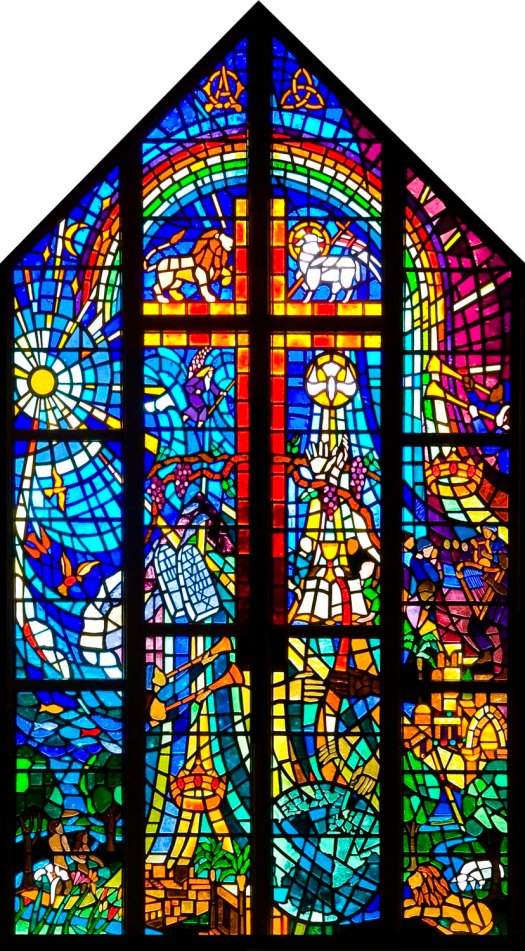
The Bible story captured in stained glass

Peninsula Bible Church, Cupertino, in California, USA, installed the stained glass window, shown below, in 2007. It is 23 feet high, and dominates the auditorium of the church. This window is not only a breathtaking piece of art. It’s also a wonderful teaching tool, telling the Bible story in a series of images through the window. At the centre, and dominating the window, is a cross. Another striking element is the rainbow that flows around the top of the cross, from the first vertical panel on the left, right through and into the final vertical panel on the right. The window was designed by Bernard Bell, a pastor of that church, who called it The Big Picture. He hopes that the window will form and shape an understanding of the great story told in the Bible in both adults and children.

Shortly after its installation, Bernard Bell preached a sermon explaining the window. He said, “Our service today is shaped around our new window. You’ve had a couple of weeks to look at this window, to figure out what is in it. It has been fun to watch you reading the window, especially to see you reading it with your kids. This window is indeed designed to be read, just like the stained glass windows of the old cathedrals in Europe. The Bible is a story, the great story of God’s involvement with the world and of human response to him. This window tells that story pictorially; it is to be read as a story. The window is structurally designed in four vertical bays, but thematically designed as five acts with a prelude. The prelude is God himself. The five acts are the five major stages in his dealings with the world: creation, Israel, Christ, church, and consummation.” Click HERE to read the rest of this sermon; it’s also available as a PDF HERE.

Bernard preached two other sermons relating to this window. A sermon entitled A Window on Advent is available in audio and written formats (including a PDF version) HERE. A sermon entitled Stories and the Story is available in audio and written formats (including a PDF version) HERE.

The window was featured in the local newspaper, the Cupertino Courier. Read the journal’s article HERE.