In this, the final part of our journey through the Book of Revelation, we see the glorious new Heaven and Earth. God’s plan of redemption is complete. God’s people dwell in God’s paradise in God’s presence for ever. And an angel shows John―and us―the wonderful city of God. This city is the Bride of Christ, New Jerusalem―God’s garden-city, the place of God’s dwelling, and our eternal home. Then the glorious vision of New Jerusalem fades from view. Three times in the closing verses, Jesus says “I am coming soon” (22:7,12,20). John responds, ”Amen. Come, Lord Jesus!” (22:20). That’s the cry of all God’s faithful people through the ages. Come, Lord Jesus! Click HERE to read more, and to download the 4-page introduction and the 16-page reader’s guide to this final section of Revelation.
In this part― the penultimate part of this reader’s guide―we cover chapters 17 to 20. We see how God destroys, step by step, all the structures and forces of evil: firstly Babylon (symbolising mankind’s godless civilisation under Satan’s domination), then the beast and the false prophet, and finally Satan himself. But alongside these scenes of judgment and destruction, we see God’s people, ready to marry Jesus Christ, and coming to life and reigning with Him for a thousand years. Click HERE to read more, and to download the 4-page introduction and the 16-page reader’s guide to this section of Revelation.
The decisive event of God’s plan of salvation is the Cross―see Revelation 12:7-12. Through His death and resurrection, Jesus defeated Satan and all the forces of evil.
This is part 5 of a 7-part reader’s guide to the Book of Revelation. For parts 1 to 4, click HERE and follow the links given there. Parts 6 and 7 will be published in the next few weeks.
Victory over the dragon
Revelation 12:1 to 15:4 is ‘a story within the story’. It leads us through the whole Bible story from before the birth of Jesus to His coming again at the end of this age and the great Day of Judgment. This section is the heart of the whole book.
A “great sign” appears in heaven―“a woman clothed with the sun, with the moon under her feet, and on her head a crown of twelve stars” (12:1). This woman cries out “in birth pains” (12:2). Who is this woman? She seems to symbolise the nation of Israel, from which Jesus the Messiah was born.
Another sign appears in heaven. To our shock, it’s “a great red dragon, with seven heads and ten horns”. It bears ”seven crowns” on its heads (12:3 NIV). This dragon is none other than “that ancient serpent, who is called . . . Satan, the deceiver of the whole world” (12:9). With a great swish of its tail this dragon sweeps down “a third of the stars of heaven” and casts them ”to the earth” (12:4). Then the murderous dragon waits, ready to devour the woman’s child. Tragedy seems inevitable.
ClickHEREto read more, and to download the 4-page introduction and the 16-page reader’s guide to this section of Revelation.
The Lamb is the Lord, part 4: Crashing Waves of Judgment Introduction and Questions
This is part 4 of a 7-part reader’s guide to the Book of Revelation. For parts 1 to 3, click HERE and follow the links given there. Parts 5 to 7 will be published in the next few weeks.
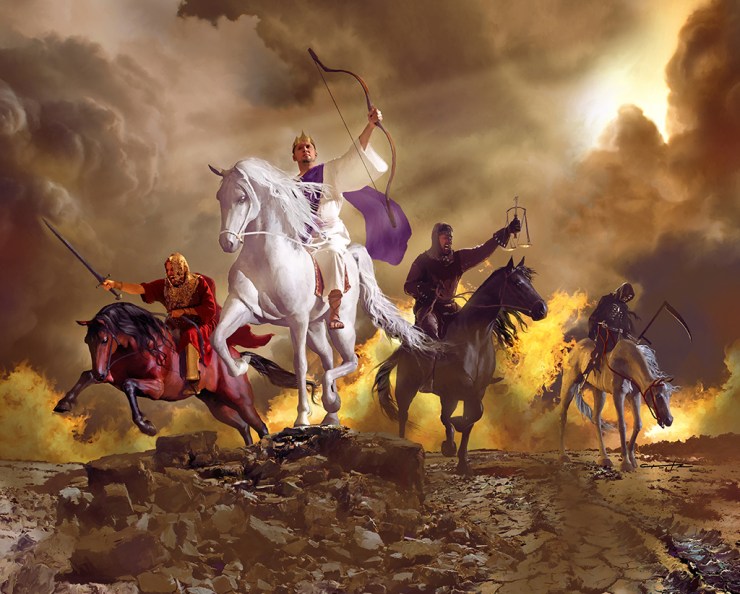
An artist’s depiction of the four horsemen who bring the judgments unleashed by the opening of the first four seals of the scroll (Revelation 5:1-8)―the ‘four horsemen of the apocalypse’.
Click the icon below to download a 4-page PDF of this page.
Click the icon below to download a 16-page Reader’s Guide This explores Revelation 6:1-11:19, 15:1 and 15:5-16:21 in more detail.
Three sets of seven judgments
We now arrive at perhaps the most challenging―and at times, disturbing―section of Revelation. Perhaps this is the section of the course you’ve been anticipating most!
The Lamb begins to open the scroll―the scroll He took “from the right hand of him who was seated on the throne” (Revelation 5:7). Three series of seven judgments sweep across the Earth. The first set is heralded by the opening of the seals (6:1-17, 8:1,3-5); the second by the blowing of seven trumpets (8:2, 8:6-9:21), and the third by the emptying of seven bowls (15:1, 15:5-16:21).
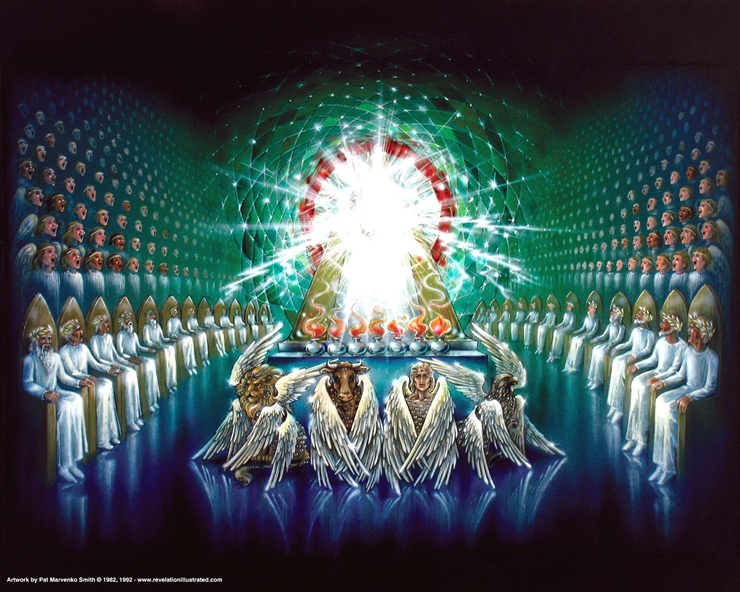
An artist’s impression of the awesome scene portrayed in Revelation 4:1-11.
Click the icon below to download a 4-page PDF version of this page.
Click the icon below to download a 12-page Reader’s Guide in PDF format. This explores Revelation 4:1-5:14 in more detail.
“One seated on the throne”
John writes, “I looked, and behold, a door standing open in heaven!” (4:1). A voice―probably the voice of Jesus―says “Come up here, and I will show you what must take place after this.” (4:1). John, in the Spirit, sees “a throne . . . in heaven, with one seated on the throne” (4:2). In this vision, he sees the heavenly throne-room of the Lord God Almighty.
This description of God as “one seated on the throne” (with variations) is the name of God most often used in Revelation. And here in this vision, God’s throne is the centre and focus of everything that John sees. Look at verses 3 to 10 and count how many times “the throne” is mentioned. From now on, throughout the book, we’ll be seeing everything from the perspective of God’s throne. Continue reading “The Lamb is the Lord, part 3: The Throne at the Centre of Everything”
Two: Lampstands in a Darkened World Introduction and Questions
Click the icon below to download a 4-page PDF version of this page.
Click the icon below to download a 16-page Reader’s Guide This introduces the Book of Revelation and explores Revelation 2:1-3:22 in more detail.
Introduction
The year is probably around 90-95AD. The mighty Roman Empire is almost at its greatest power and extent. At this moment in history, Almighty God speaks to an old man in exile on a little island in the Mediterranean. That man is John the Apostle. John writes, “I was in the Spirit on the Lord’s day, and I heard behind me a loud voice like a trumpet saying, ‘Write what you see in a book and send it to the seven churches, to Ephesus and to Smyrna and to Pergamum and to Thyatira and to Sardis and to Philadelphia and to Laodicea’” (1:10-11).
Click the icon below to download a 4-page PDF of this page.
Click the icon below to download a 16-page Reader’s Guide This introduces the Book of Revelation and explores Revelation 1:1-20 in more detail.
Introduction
This is the first of a seven-part series on the Book of Revelation. We’ll trace Revelation’s storyline and themes. We’ll explore its symbolism and imagery. And we’ll see what God is saying to us believers as we follow Jesus day by day.
The word ‘Revelation’ is apocalupsis in Greek―from which we get our word ‘apocalyptic’. This Greek word means ‘an uncovering’, ‘an unveiling’. In the Book of Revelation, Jesus unveils what’s really going on in Heaven and on Earth, and where human history is heading.
God’s perspective on history
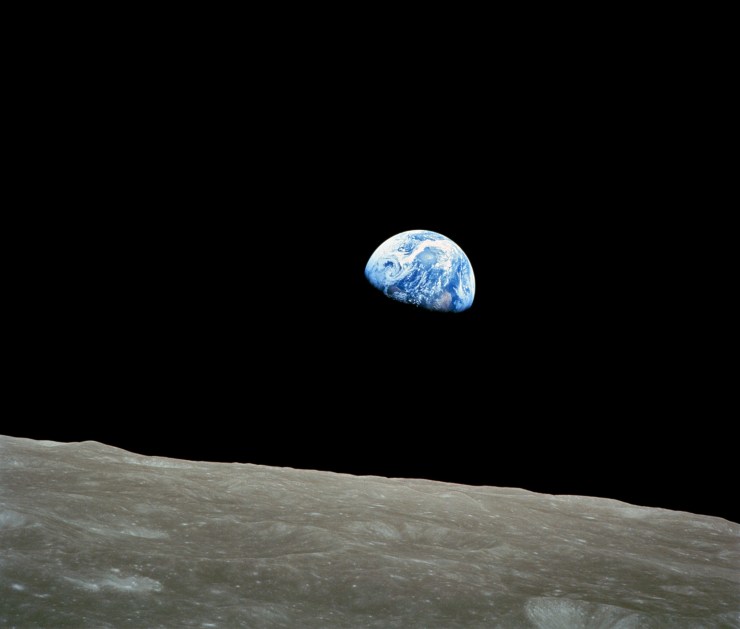
There’s a famous photograph that’s entitled ‘Earthrise’ (see above). It was taken by an Apollo 8 crewmember in 1968, while in orbit around the Moon. These men were the very first humans who saw Earth as viewed from the Moon. It gave them―and all humanity―a completely new perspective on our planet.
‘Earthrise’―Earth above the lunar horizon. This image was taken by Apollo 8 crewmember Bill Anders on December 24, 1968, while in orbit around the Moon.
Likewise, in Revelation, God gives us a new perspective―a heavenly perspective, God’s perspective. Christ is seated “in the heavenly places” (Ephesians 1:20). We’re seated there with Him (Ephesians 2:6). We need to view everything from that viewpoint―a heavenly viewpoint. And that’s the perspective Revelation gives us.