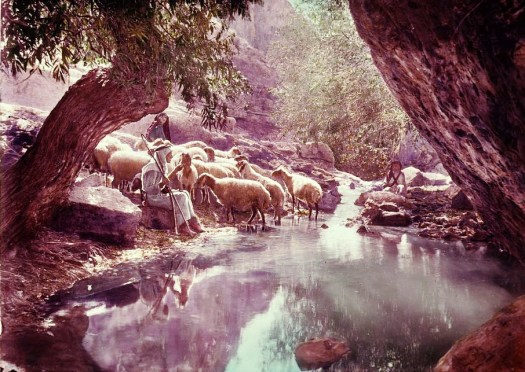
An old photographic slide of shepherd life taken in or around the Holy Land between about 1900-1920. It was one of a series illustrating Psalm 23.
The Greek word for ‘pastor’ (one of the gifts in Ephesians 4.11) is the closely related noun ‘shepherd’ (in Greek, poimēn). H.B. London writes, “I propose that one of the most important aspects of being a pastor is fulfilling the role of servant-shepherd. Next to being faithful to God and attentive to spouse and family is the pastor’s responsibility as shepherd—one who knows the flock, listens to the flock, watches out for the flock, cares for the flock, corrects the flock, and spends a great portion of time with the flock.” London’s brief article, available HERE, is very helpful and well worth reading.
But, as a postscript to London’s article, the pastoral ministry in a local church must extend beyond the one who holds the position of ‘pastor’. All elders of local churches should have a pastoral heart. Elders are to shepherd (the Greek verb poimainō) God’s flock (Acts 20.28, 1 Peter 5.1-2). And there may well be others in a local church besides the elders who have the Ephesians 4 gift of being a pastor.
And there is surely also a sense in which every member of a local church is to participate in this pastoral ministry at least to some degree. For example, we’re to teach and admonish one another (Colossians 3.16), encourage and build one another up (1 Thessalonians 5.11), bear one another’s burdens (Galatians 6.2); and love one another (for example, Romans 13.8, 1 Peter 1.22, 1 John 4.7).
The Passing of the Jews through the Red Sea painted by Wilhelm Kotarbinski (1848-1921).
The Exodus from Egypt was the key saving event in Israel’s history (see, for example, Deuteronomy 4.32-40, 6.20–25, 1 Samuel 12.6–8, Psalm 105.26-45, Jeremiah 32:20–21).
An Ask Pastor John podcast on the Desiring God website featured guest Don Carson speaking about the Exodus. The podcast’s introducer writes, “The Exodus of God’s people out of Egypt is “the greatest redemptive event in the Old Testament”, says Don Carson. To let that sink in for a moment, imagine this: If our publishing age is marked by the cross, it is because the cross the shorthand for the death and resurrection of Christ. His cross marks the centerpiece of redemptive history. But before the cross there was the Exodus. And so if the world of publishing today talks about the cross-centered life, and the cross-centered church, it would seem that a fitting analogy would be to perhaps imagine Old Testament era saints to have been inspired to write and publish books on the Exodus-centered life and the Exodus-centered synagogue. It is a major key to understand the Old Testament, and it is a major key to unlocking the meaning of the entire Biblical plotline. To explain I called Dr. Don Carson.” Hear (or read) what Dr. Carson said HERE.
I have posted a study comparing the Egyptian Exodus with the greater Exodus accomplished by Jesus Christ HERE.
During the 1970s I spent a year in Zambia and occasionally visited Lusaka Baptist Church. There was a Bible class that I attended there, which still stands out in my memory. The class leader was Dr. Michael Eaton. The passage we were going to study that morning was Matthew 1.1-17 – Jesus’ genealogy. I can remember being a bit puzzled – what were we going to learn from this passage? It turned out – a very great deal. Dr Eaton’s masterly exposition opened up truths embedded Jesus’s genealogy in a way I had never seen before.
David Thommen clearly agrees about the importance of Jesus’ family tree. He writes, “I will never forget the zeal, the excitement, and the anticipation of my first Christmas sermon. . . . . . . . I wanted to preach something that I had never heard from the pulpit for Christmas, or any other time for that matter. . . . . When one of my elders asked me what I would be preaching on, I confidently proclaimed: “The genealogy from Matthew 1”. His response was different than I expected. “Why would you do that? You never preach the genealogies.” Convinced that all Scripture is profitable (2 Timothy 3.16-17), I soldiered forward undeterred. I pondered, in light of the rather unexpected response, why does the genealogy at the beginning of Matthew matter to the Christian at Christmas?” He shows us four reasons why it matters HERE.
In this book, T. Desmond Alexander traces some of the central themes of the Bible story. Dr Alexander explores each theme in an unusual way – by beginning at the end of the Bible, in the final chapters of the Book of Revelation. In this way, he keeps the goal of God’s plan of redemption in view as we track each theme from Genesis onwards through the Bible.
There seven main chapters, bracketed by an introduction and conclusion. Here are the titles of these seven chapters; each is followed by an outline of the chapter’s content.
Chapter 2: “From sacred garden to holy city: experiencing the presence of God. ” This is by some way the longest chapter. It develops the central theme of God’s presence on Earth. We’re introduced to the end-goal of God’s plan: Revelation 21.1-3 describes the holy city that possibly fills the whole earth, and where God lives with His people. After an overview of the Bible’s theme of God’s dwelling on Earth, Alexander shows us that New Jerusalem is a temple-city. Then we’re taken back to the beginning: he shows us that God’s first dwelling place on Earth was the temple-garden of Eden. But after their sin, Alexander explains that God deprived Adam and Eve of their priestly status in God’s temple-garden; God’s plan that, in Alexander’s words, “the whole earth should become a holy garden-city” is jeopardised. Alexander briefly looks at the escalation of sin and God’s response by sending the Flood, and at the Babel project. Alexander then traces the path that God took to restore Earth to be His dwelling place with humanity – through the Tabernacle, the Temple in Jerusalem, and the Church as God’s temple. Finally, he looks briefly at the New Testament’s references to God’s promise of His city.
Chapter 3: “Thrown from the throne: re-establishing the sovereignty of God.” Alexander first looks at God’s sovereignty over Earth and mankind’s original vocation as God’s viceroys – as royal priests. But, as Alexander tells us, “By betraying God and obeying the serpent, the royal couple dethrone God” . He then traces the way God restored His sovereignty over the whole Earth – firstly, through Abraham and through the theocracy of Israel, and then through the Man Christ Jesus. The author shows that Christ is now God’s viceroy over Earth, a role that His Church – a royal priesthood – shares. As he writes, “By living in obedience to Christ, his disciples participate in the establishment of God’s kingdom on the earth.” Finally, he briefly looks forward to the time, pictured in Revelation chapters 21-22, when God is king over the whole Earth.
Chapter 4: “Dealing with the devil: destroying the source of evil.” In this chapter Alexander explains that Satan exercises authority over this world, and outlines how he came to do so. He traces the ensuing conflict between God and Satan as it is played out in the world. He looks at Jesus’ conflict with Satan, culminating in Jesus’s death, which seems to be a triumph for Satan. But, as he tells us, “Apparent defeat is dramatically turned into victory with the resurrection of Jesus. For this reason, Jesus can subsequently proclaim to his disciples, ‘All authority in heaven and on earth has been given to me’ (Matthew 28.18).” Finally, he briefly looks at the end of Satan’s domination as described in Revelation 20, and believers’ spiritual warfare in this present world.
Chapter 5: “The slaughter of the Lamb: accomplishing the redemption of creation. ” Five times, the last two chapters of Revelation refer to Jesus Christ as “the Lamb”; He is referred to as a “Lamb” 28 times in all. He briefly looks at the image of Christ as the Lamb in the Book of Revelation, then back to the Passover in Exodus. He writes that “the Lamb of Revelation 5 is undoubtedly associated with the Old Testament exodus story”. He takes us through the first Passover in Egypt. He explains that the Passover ritual in Egypt provided atonement and purification, and that Jesus’s sacrificial death provides atonement and purification for all believers. Dr Alexander also writes that eating the Passover lamb in Egypt made people holy; and that eating the New Testament equivalent – the Lord’s Supper – sanctifies believers. In his words, “Like the original Passover sacrifice, his death atones for the sin of the people, his blood purifies and cleanses, and those who eat his body at the Lord’s Supper share in his holy nature.” (However, it isn’t clear why eating the Lord’s Supper sanctifies us. I can personally see a connection, however. Both the Old Testament Passover and the Lord’s Supper are covenant meals. Participating in them reaffirms the covenant bond between the Lord and His people – that is, the God’s people are committed to and belong to the Lord – and so therefore are holy to the Lord.)
Chapter 6: “Feasting from the tree of life: reinvigorating the lives of people from every nation.” Alexander writes, “we have traced how God has acted to reclaim the earth as his own and build a temple-city by gradually establishing his presence and sovereignty through the theocracy of Israel and the church. Central to the redemptive activity of God is the cross of Christ, for through it Satan is defeated and human beings are enabled to regain the holy, royal status Adam and Eve lost. Building on these observations, this chapter explores how John’s vision of the New Jerusalem anticipates human existence as we have never known it. The life to come will be truly abundant and fully satisfying. This hope is reflected in themes found in Revelation 21–22 that reappear throughout the entire biblical meta-story, in particular, the concepts of ‘holy people’, ‘tree of life’ and ‘nations’.” Alexander look briefly at God’s people as holy people in His presence. He then explores what the Book of Leviticus teaches about holiness, cleanness/purity and uncleanness/impurity. Dr Alexander writes, “To be holy is to be unblemished or unmarred; it is to be complete, perfect, whole”. So he then looks at the bodily wholeness that will be part of our holiness – bodily perfection and immortality, with access to the tree of life. Finally, he looks at the ecological transformation of our planet, and the social harmony we’ll enjoy, where peoples from all races and nations will live in unity.
Chapter 7: “Strong foundations and solid walls: living securely among the people of God.” Dr Alexander makes it clear that the New Testament builds upon what is revealed in the Old Testament. He writes, “The continuity between the Old and New Testaments is also important because it provides a greater basis for believing in the reality of the future New Jerusalem. . . . . As our study has revealed, the New Jerusalem is a natural extension of all that has been revealed in the rest of the Bible.”. He then explores the contrasts between the New Jerusalem and the other city described in Revelation – Babylon. He explains, “Babylon and the New Jerusalem represent contrasting worlds.” Babylon is a prostitute; in Alexander’s “the city of Babylon represents humanity’s obsession with wealth and power, which become a substitute for knowing God” . New Jerusalem is a bride; Alexander writes, this city “promises holiness, wholeness and love in the presence of God.”. He points out, “the book of Revelation warns us to come out of Babylon and encourages us to take our stand with Christ”.
Dr Alexander specialises in the study of Pentateuch and Biblical Theology. This book is based on his expertise in these areas, and there’s substantial theological depth underpinning this book. It bridges the gap between books written at a popular level and those aimed at such people as seminary students and scholars. The book is relatively brief (less than 200 pages of text) and accessible. The text is accompanied by many footnotes, and there’s a 9-page select bibliography at the end.
David Schrock has written a helpful summary and brief analysis HERE.
T. Desmond Alexander is Senior Lecturer in Biblical Studies in Union Theological College, a constituent college of the Institute of Theology at Queen’s University Belfast. His research interests lie primarily in two areas: the Pentateuch and Biblical Theology. He has authored and edited a variety of articles and books.
In her book, Even Better than Eden, (which I review HERE), Nancy Guthrie traces nine themes through the Bible – the wilderness, the tree, God’s image, clothing, the Bridegroom, the Sabbath, the offspring, the dwelling place, and the city. Essentially, what she gives us is a series of nine mini-overviews of the Bible story, each one tracing the story from the point of view of one of these key themes. Guthrie has now produced this same material in a series of nine videos. Session 8 – The Story of a Dwelling Place – can be watched free of charge on Vimeo, above. The complete set can be purchased as digital downloads HERE or on a flash drive HERE.
Nancy’s website page for this book is available HERE. Reproducible personal Bible study questions for personal or small group use (not the same as the discussion guide in the book itself) and a leader’s guide are available for purchase as downloads from this page.
This workshop on Even Better Than Eden: How the Bible’s Story Changes Everything About Your Story with Nancy Guthrie was recorded at The Gospel Coalition’s 2018 Women’s Conference in Indianapolis, Indiana:
Nancy Guthrie teaches the Bible at her church, Cornerstone Presbyterian Church in Franklin, Tennessee, and at conferences worldwide. She is the author or editor of a number of books, together with some video resources. She is also the host of Help Me Teach the Bible, a podcast of the Gospel Coalition.
This daily reading book is subtitled Daily Readings for Advent from Genesis to Jesus. In his introduction, Tim Chester writes, “Everyone loves the Christmas story . . . . But the Christmas story is not just a great story. It’s the great story. It’s the story that ties together a thousand other stories. . . . . The Christmas story is the one true story because it completes and fulfils all the stories of the Bible. But it also goes on being the one true story. This is the story that makes sense of my story and your story. We were made to know God. All our longings only truly find their fulfilment in him and through him. The plotlines of our lives are meant to find their resolution in the enjoyment of God. But we’ve set our lives on other trajectories which always lead to disappointing endings. But through the Christmas story God is rewriting the story of human history, bringing it to a glorious climax. In all the busyness of Christmas, don’t miss the opportunity to discover or rediscover how you can be part of the one true story.”
Each of the 24 chapters traces a theme from the Old Testament that finds its culmination in Jesus – for example, The new Adam, The dragon-slayer, The new ark, The rock, The anointed one, The good shepherd, and The end of exile. The chapters also explore how the Christmas story connects with our stories. Each chapter ends in a meditation, and a prayer. This book is packed with Biblical insights, and will provide a rich feast for meditation through the Advent season (or, for that matter, other times of the year, too). I can thoroughly recommend it.
Tim Chester has also written two other Advent daily reading books: The One True Light: Daily Readings for Advent from the Gospel of John (read the publisher’s description HERE), and The One True Gift; Daily Readings for Advent to Encourage and Inspire (read the publisher’s description HERE).
The Garden of Eden: a Biblical-theological framework Dr David Schrock writes, “. . . in any study of Genesis and in any study of the Bible, we must understand the way in which Eden is more than an ancient garden. It is the place where God put his royal priests to cultivate and keep the earth he gave them to subdue and rule. Though framed in ancient language and imagery, it is vital modern Christians understand these original designs—for they have impact on the way we conceive of God, the world, and mankind’s place in the world.”
Exodus in 1 Kings Dr Alastair Roberts explores how the narrative of Solomon and the division of the kingdom is linked to Adam in the Garden of Eden and to the Exodus.
Old Testament word studies: ‘Abba’, “Father” Dr Allen Ross comments, “This Aramaic word ’Abba’,”Father,” has always been a significant word in the spiritual life of believers. It was used in the Old Testament to describe the spiritual relationship between believers and God; but it became more pronounced in the New Testament in the light of Jesus’ instructions on prayer and the apostolic teachings. But today there is little clear understanding of what the description means; moreover, it is being defined and used in a way that was not intended. The word, then, calls for closer scrutiny.”
”Speak, O Lord” – a hymn by Keith Getty and Stuart Townend The words and music of this superb hymn are by Keith Getty and Stuart Townend. Here’s a recording of it being sung congregationally at the 2012 Together for the Gospel Conference.
David Schrock writes, “God’s people dwelling in God’s place under God’s rule: This tripartite division, outlined by Graeme Goldsworthy in his book According to Plan, well articulates the relationship of Adam and Eve to God in the Garden. Yet, often when Christians read the creation account in Genesis 1–2 they miss the royal and priestly themes in those two chapters. . . . . So, in what follows, I hope to provide a brief summary of the biblical evidence for seeing the first image-bearers (imago Dei) as royal priests commissioned by God to have priestly dominion over the earth—a commission later restored in type to Israel (see Exodus 19:5–6), fulfilled in Christ (see, e.g., Hebrews 5), and shared with all those who are in Christ (see 1 Peter 2:5, 9–10). In these sections, we will focus on the temple and by extension to the purpose and work of mankind in that original garden-sanctuary.”
He then explores the theme of the garden in the Bible, focusing on the garden’s role as a priestly and a royal sanctuary. He notes how the Garden is clearly seen as a sacred temple when comparing it to Moses’ tabernacle and Solomon’s temple.
He concludes,“Therefore, in any study of Genesis and in any study of the Bible, we must understand the way in which Eden is more than an ancient garden. It is the place where God put his royal priests to cultivate and keep the earth he gave them to subdue and rule. Though framed in ancient language and imagery, it is vital modern Christians understand these original designs—for they have impact on the way we conceive of God, the world, and mankind’s place in the world.”
To help show the biblical basis for this approach to Eden, Dr Schrock very helpfully lists a number of Bible passages relating to the theme of the garden.
Read the whole article HERE. Much of the research behind this article stems from Dr. Schrock’s dissertation, A Biblical-Theological Investigation of Christ’s Priesthood and Covenant Mediation with respect to the Extent of the Atonement, which can be downloaded free of charge HERE.
Dr Alastair Roberts writes, “In the four hundred and eightieth year after the Exodus, Solomon began to build the temple of the Lord in Jerusalem. That the author of Kings should date the start of the building of the temple from the Exodus is noteworthy. . . . . The building of the temple on the mountain in Jerusalem is, in many respects, the climax and the completion of the process begun in the Exodus. . . . . Since its construction, the tabernacle had functioned as a sort of portable Mount Sinai, an architectural extension of the theophany that occurred there. It was also a new Eden and microcosmic representation of the wider creation . . . . Solomon’s Temple introduces a new stage of history and, once again, there are echoes of the original creation and of Eden.”
And, as Dr Roberts tells us, “Within this world, Solomon is like a glorious new Adam. He is the wise ruler of the world, who is able to name the trees and the animals (4:29-34). Indeed, when the Queen of Sheba comes to him, it is akin to Eve being brought to Adam, the moment when the story of the first creation arrived at its zenith of glory. Unfortunately, just as in the account of the original creation, it is at this point that things all start to crumble. The rest of the story of Solomon is a tragic story of the fall of the new Adam and of being removed from the peace and rest of the new Eden.”
Dr Roberts traces the sorry story of Solomon’s fall through the division of the kingdom to the day when Ahijah the prophet prophesied the doom of the northern kingdom of Israel in 1 Kings 14.7-16. In Dr Roberts’ words, “There would be a great reversal of the Exodus as Israel once again found itself in captivity. The Red Sea Crossing would be undone, as Israel would find itself cast on the far side of the great River.”
Read the whole of this fascinating exposition HERE.
Dr Allen Ross comments, “This Aramaic word ’Abba’, “Father,” has always been a significant word in the spiritual life of believers. It was used in the Old Testament to describe the spiritual relationship between believers and God; but it became more pronounced in the New Testament in the light of Jesus’ instructions on prayer and the apostolic teachings. But today there is little clear understanding of what the description means; moreover, it is being defined and used in a way that was not intended.”
Dr Ross then explores the origin and meaning of the word, and the significance of calling God “Father”. He concludes, ”What, then, does the term “Father” for God mean for use? First, to call God Father is to speak of him as the absolutely sovereign God of creation. . . . . Second, to call God “Father” is to use covenant language. In all of God’s covenants, the people are “sons” or “children” by their adoption into the covenant. . . . . Third, for us to call God “Father” is indeed to acknowledge a close personal relationship with him; it is after all a family term. It is fair to say that in Jesus’ time the word was colloquial but respectful, even in human families; but it was not a childish expression like “daddy”. To call God “Father” is to affirm that we have been born into the family of God, . . . . But he is still the sovereign and holy Lord God; and the significance of the word “Father” is one of a reverent, respectful and solemn adult address of God.”
As a postscript to Dr Ross’s article, my own personal attempt to translate ‘Abba’ – in order to bring out the intimacy and the respect that is inherent in the term – is “dearest Father”.
A friend of mine, Nicky Andrews, tells of a remarkable turning to Christ among Iranian refugees in Serbia. She writes, “The OM field leader of the Balkan region, Volker Sachse, doesn’t cry easily. But in the past three or four years, he has often been moved to tears by the plight of refugees he has met in Serbia; OM has played a significant humanitarian role in one of the government-run camps there since the ‘refugee crisis’ in Europe escalated in 2015. Today, however, it is tears of joy that brighten Volker’s eyes, as he describes how many refugees from Iran are turning to Jesus during a worldwide move of God amongst Iranians. “It’s a privilege for me to witness the Lord touching so many Iranians in Serbia, including in the camp where OM works,” he shares.”
There is now a need to disciple these new believers. Nicky writes, “[Volker] shares, though, that there is ongoing need to nurture the young believers towards greater maturity. “So, I’m very excited by the possibility of running an intensive discipleship training course for up to eight Iranian believers over five days, which would then be repeated for a second group of eight.” says Volker. . . . . The training would be aimed at equipping Christians to launch a church plant in the camp.”
More information about how to be involved, including how to contribute financially to the discipleship programme, is available HERE.
”Speak, O Lord” – a hymn by Keith Getty and Stuart Townend
The words and music of this superb hymn are by Keith Getty and Stuart Townend. This particular recording is part of an album recorded live from the 2012 Together for the Gospel Conference in Louisville, Kentucky.
An artist’s impression of the camp of Israel in the wilderness. The Tabernacle is in the centre of the camp. Above the Tabernacle is the pillar of cloud, which was the visible manifestation of God’s presence.
L. Michael Morales writes, “When the fiery cloud of God moved from the summit of Mount Sinai to the newly constructed tabernacle, covering God’s house with smoke and filling it with His glory (Exodus 40.34), a pinnacle in God’s dealings with humanity was realized. In this majestic scene, the book of Exodus ends with a resolution, albeit temporary and intermediate, to the story of humanity’s exile from Eden narrated in Genesis 3. Moreover, the glory-filled tabernacle also foreshadowed God’s ultimate solution to that primal expulsion through the person and work of Jesus Christ.”
Dr Morales continues, “As we consider the significance of the tabernacle (and later temple) in Scripture, it will be helpful to keep two points in mind. First, the tabernacle was the house of God, the place of His dwelling. . . . . Second, the tabernacle was also the way to God, its sacrificial rituals providing the atonement and cleansing needed to dwell with God. . . . . In sum, Israel’s relationship with God was preserved and cultivated by the sacrificial system of the tabernacle, enabling the Maker of heaven and earth to dwell with His people in fellowship. To understand the depth and wonder of such a purpose, we will reflect upon the meaning of the tabernacle first within God’s goal for creation and then as the heart of God’s covenant with His people—a purpose taken up and fulfilled by Jesus Christ.”
Dr. L. Michael Morales is professor of biblical studies at Greenville Presbyterian Theological Seminary in Taylors, South Carolina, and adjunct professor at Reformed Theological Seminary (Orlando/Dallas). He is author of Who Shall Ascend the Mountain of the Lord?: a Biblical Theology of the Book of Leviticus. You can read the publishers details for this book, which I can thoroughly recommend, HERE.
Dr Sinclair B. Ferguson asks, “. . . how do we legitimately preach the text of the Old Testament as those who stand on this side of Pentecost? What difference does it make to expound Genesis or Psalms as believers in Jesus Christ? Or, to put it in a more graphic way, how can we reconstruct the principles of Jesus’ conversation in Luke 24.25-27,45, and learn to follow his example of showing how all the Scriptures point to him so that hearts are ‘strangely warmed’ and begin to burn? . . . . Yet we must also preach the Scriptures without denuding them of the genuine historical events they record and the reality of the personal experiences they describe or to which they were originally addressed. How, then, do we preach Christ, and him crucified without leapfrogging over these historical realities as though the Old Testament Scriptures had no real significance for their own historical context?”
He explains, “. . . there are . . . very important principles that help us to develop Christ-centred expository skills. As we work with them, and as they percolate through our thinking and our approach to the Bible, they will help us develop the instinct to point people to Christ from the Old Testament Scriptures. The most general principle is one for which we might coin the expression fillfulment. Christ fulfils or ‘fills full’ the Old Testament. He came ‘not to abolish the Law or the Prophets but to fulfil them’ (Matthew 5.17). As Christians standing within the light of New Testament revelation and looking back on the Old Testament, Christ himself acts as a hermeneutical prism. Looking back through him, we see the white light of the unity of the truth of Jesus Christ broken down into its constituent colours in the pages of the Old Testament. Then, looking forwards we see how the multi-coloured strands of Old Testament revelation converge in him. . . . . We want to develop an instinct to preach Christ. This is the general principle. But it can be broken down into at least four subordinate principles . . . .”
Dr Ferguson then explains these four principles. In his conclusion, he comments, “These are general principles; they do not constitute a simple formula, an elixir to be sprinkled on our sermons to transform them into the preaching of Christ. There is no formula that will do that. . . . . But as we come to know the Scriptures more intimately, as we see these patterns deeply embedded in the Bible, and—just as crucially—as we come to know Christ himself more intimately and to love him better, we shall surely develop the instinct to reason, explain and prove from all the Scriptures the riches of grace which are proclaimed in Jesus, the Christ, the Saviour of the world.”
Dr Ferguson’s article is instructive and stimulating, and worth taking time to read and to digest – and to apply.
It’s available in 10 parts from website of The Proclamation Trust. For part 1, click HERE; for part 2, click HERE; for part 3, click HERE; for part 4, click HERE; for part 5, click HERE; for part 6, click HERE; for part 7, click HERE; for part 8, click HERE; for part 9, click HERE; and for part 10, click HERE.
An earlier version of this article is available as a single webpage HERE (the online version in 10 parts available above is a later edited version).
In her new book, Even Better than Eden: Nine Ways the Bible’s Story Changes Everything About Your Story, Nancy Guthrie traces nine themes through the Bible – the wilderness, the tree, God’s image, clothing, the Bridegroom, the Sabbath, the offspring, the dwelling place, and the city. Essentially, what she gives us is a series of nine mini-overviews of the Bible story, each one tracing the story from the point of view of one of these key themes. Each of these nine mini-overviews is just a chapter in length (in fact, the main text of the book is only 150 pages in length). Guthrie succeeds in her task brilliantly. Her writing is clear and engaging. Yet the book – despite the fact that it’s so accessible and easy to read – is also theologically rich.
Guthrie’s overall thrust is that God’s plan for His world is not simply to restore what was lost in Eden before the Fall. The new creation we read about on the final two chapters of Revelation will be far more glorious than the creation we see in the opening chapters of Genesis.
There’s a discussion guide at the end of the book, which gives questions for discussing the themes presented in each chapter. There are also endnotes to explain further and to support some of what she writes.
In the introduction, after talking a little about her own personal story, Guthrie writes, “There’s another story, a story that is found in the pages of the Bible—from the book of Genesis through the book of Revelation—that shapes and defines where I came from, why I am the way I am, what my life is like day to day, and what is ahead for me in the future. It is this story that explains my deepest joys as well as the empty places where contentment can be elusive. It is this story that explains my drive to be somebody and my sensitivity to feeling like a nobody. It explains what makes me cry and why I can laugh. This story explains my desire to look good, my craving for the good life, my longing for home and security, and much more.”Guthrie continues: “And whether you know it or not, this same grand story—the story found in the sixty-six books of the Bible—shapes the world you live in, who you are, and what you want too. That’s why you and I need to know this story. It is where we find the answers to our questions about what really matters now and into eternity. This story has the power to change everything about our stories.”
Scott R. Swain, President and James Woodrow Hassell Professor of Systematic Theology, Reformed Theological Seminary, Orlando, writes, “One of the weaknesses of much popular Christian teaching on the Bible is the tendency to read the story of the Bible in a circular manner, as if Jesus Christ came into the world to bring us back to Eden. Nancy Guthrie charts a better course in her book. In a manner that is profoundly biblical and deeply practical, she traces nine biblical themes along a common trajectory, from their beginning in God’s good creation, through their destruction and devastation by Adam’s sin, to the ways Christ perfects, consummates, and crowns each theme by means of his suffering and glory. Let Guthrie take you by the hand and lead you through the Bible to Jesus Christ, in whom we find a better provision, a better life, a better identity, a better rest, a better wardrobe, a better spouse, a better savior, a better sanctuary, and a better city than this world in its present state could or would afford.”
Read the publisher’s description HERE. Download an excerpt HERE.
Nancy’s website page for this book is available HERE. Reproducible personal Bible study questions for personal or small group use (not the same as the discussion guide in the book itself) and a leader’s guide are available for purchase as downloads from this page.
A nine-session video version of Even Better Than Eden is also available – click HERE for more information and to view one of the sessions free of charge.
This workshop on Even Better Than Eden: How the Bible’s Story Changes Everything About Your Story with Nancy Guthrie was recorded at The Gospel Coalition’s 2018 Women’s Conference in Indianapolis, Indiana:
Nancy Guthrie teaches the Bible at her church, Cornerstone Presbyterian Church in Franklin, Tennessee, and at conferences worldwide. She is the author or editor of a number of books, together with some video resources. She is also the host of Help Me Teach the Bible, a podcast of the Gospel Coalition.