The Friday Briefing 8 (27 April 2018)

Reading the Bible as one story Michael Goheen writes, “If the church is to be faithful to its missionary calling, it must recover the Bible as one true story. If the story of the Bible is fragmented into bits it can easily be absorbed into the reigning story of culture rather than challenging it. A fragmented Bible can lead to a church that is unfaithful, syncretistically accommodated to the idolatry of its cultural story, or in the words of Paul, a church “conformed to the world” (Romans 12.2).”

10 Bible translations you’ve never heard of Jost Zetzsche introduces ten lesser-known English translations, all but one of which were translated by individuals. He writes: “My hope is to pique your sense of adventure to seek out these or other translations and immerse yourself in them.”

The rise of comic superheroes and our longing for one Eric Geiger writes, “An unprecedented 20 superhero movies are expected to come to movie theaters between 2018 and 2020. Superhero movies are on the rise and people rave about the heroes in Black Panther, Avengers, and Spider-Man. Where does our longing for superheroes come from?”

Paul Young’s “Lies We Believe About God” Dismantles Precious Truths from Scripture Randy Alcorn writes, “Last year, Paul Young, author of The Shack, had a book come out called Lies We Believe About God. Ironically, many of the doctrinal concerns that I and many others expressed about his novel The Shack (and in response, were told “it’s just fiction” and “this isn’t theology” and “that’s not what he’s saying”) have proven to be true. This book clearly reveals the author’s actual theology.

Mission through meals Following on from last week’s review of Tim Chester’s book A Meal with Jesus, here is a video in which Tim explores the power of meals as a context for building community and sharing the gospel.

Reading the Bible as one story.

Michael Goheen writes, “All of human life is shaped by some story. . . . . For those of us living in the West, basically two stories are on offer: the biblical and the humanist. As [Lesslie] Newbigin points out: “In our contemporary culture . . . two quite different stories are told. One is the story of evolution, of the development of species through the survival of the strong, and the story of the rise of civilization, our type of civilization, and its success in giving humankind mastery of nature. The other story is the one embodied in the Bible, the story of creation and fall, of God’s election of a people to be the bearers of his purpose for humankind, and of the coming of the one in whom that purpose is to be fulfilled. These are two different and incompatible stories . . . .”

“The story of the Bible tells us the way the world really is. It is in the language of postmodernity it is a “metanarrative”; in the language of Hegel, “universal history.” Thus, the biblical story is not to be understood simply as a local tale about a certain ethnic group or religion. It begins with the creation of all things and ends with the renewal of all things. In between it offers an interpretation of the meaning of cosmic history. It, therefore, makes a comprehensive claim: our stories, our reality must find a place in this story.”

Michael concludes, “If the church is to be faithful to its missionary calling, it must recover the Bible as one true story. If the story of the Bible is fragmented into bits it can easily be absorbed into the reigning story of culture rather than challenging it. A fragmented Bible can lead to a church that is unfaithful, syncretistically accommodated to the idolatry of its cultural story, or in the words of Paul, a church “conformed to the world” (Romans 12.2). Much is at stake in reading the Bible as one story. Students who want to be faithful pastors or scholars would do well to master this story so that they might help others indwell it with them.

Read the whole article HERE.

Click here to go back to table of contents


10 Bible translations you’ve never heard of
.

Jost Zetzsche writes, “English readers have access to more translations of the Bible than readers of any other language. The American Bible Society estimates that there have been around 900 full and partial biblical translations into English.” Jost introduces us to ten lesser-known English translations, all but one of which were translated by individuals. He writes: “My hope is to pique your sense of adventure to seek out these or other translations and immerse yourself in them. . . . . When it comes to having access to a richness of Bible translations, no other readers of the 7,000 or so world languages are as privileged as English readers. So why not use that resource? . . . . In the original preface to the King James Version of 1611, its translators wrote ‘that varietie of Translations is profitable for the finding out of the sense of the Scriptures.’” Read the whole article HERE.

Click here to go back to table of contents

The rise of comic superheroes and our longing for one.

Eric Geiger writes, “An unprecedented 20 superhero movies are expected to come to movie theaters between 2018 and 2020. Superhero movies are on the rise and people rave about the heroes in Black Panther, Avengers, and Spider-Man. Where does our longing for superheroes come from?” Eric comments, “Stories of rescue that grip our culture remind us that people were created for the greater Story, for the greater Rescuer.” Read the whole article HERE.

Click here to go back to table of contents

Paul Young’s “Lies We Believe About God” Dismantles Precious Truths from Scripture.

Randy Alcorn writes, “Last year, Paul Young, author of The Shack, had a book come out called Lies We Believe About God. Ironically, many of the doctrinal concerns that I and many others expressed about his novel The Shack (and in response, were told “it’s just fiction” and “this isn’t theology” and “that’s not what he’s saying”) have proven to be true. This book clearly reveals the author’s actual theology. I wanted to believe the best, and not be quick to misunderstand or accuse. I have friends who read Paul’s writings, and my desire isn’t to take away from the positives they’ve received from The Shack. However, Lies We Believe About God shows in the author’s own words how far he has departed from some basic and central evangelical doctrines. I’ve read the whole book, and I saw truth intermixed with unbiblical error. But as is often the case with false doctrine, the truth serves to make the error appear more credible. . . . . I recommend this summary of some of the unbiblical content in Lies We Believe About God, well expressed by Tim Challies. While Paul Young remains a likable person, this doesn’t change the danger of revising God’s truth and telling people nice-sounding things on God’s behalf, when some of those explicitly contradict what He tells us in His Word: “Every word of God proves true; he is a shield to those who take refuge in him. Do not add to his words, lest he rebuke you and you be found a liar” Proverbs 30:5-6 (ESV)).

Read Randy Alcorn’s whole article HERE.

Read Randy Alcorn’s earlier article Reflections on The Shack HERE.

Read Tim Challies’ article What Does The Shack Really Teach? “Lies We Believe About God” Tells Us HERE.

Click here to go back to table of contents

”The Son of Man came eating and drinking”. (Matthew 11.19). Meals played a big part in the ministry of Jesus. In this video, Tim Chester explores the power of meals as a context for building community and sharing the gospel.

I review Tim Chester’s book A Meal with Jesus HERE.

Click here to go back to table of contents

Unless otherwise indicated, all Scripture quotations (apart from those in direct quotations) are from The Holy Bible, English Standard Version, published by HarperCollins Publishers. © 2001 by Crossway Bibles, a division of Good News Publishers. Used by permission. All rights reserved.

The Friday Briefing 5 (6 April 2018)

Helping our children ask, ‘What’s the worldview? ”. . . we parents need to be hugely intentional about equipping our children to know what they believe and why they believe what they believe.”

How ‘belonging before believing’ redefines the church “If we want to commend the gospel to non-Christians, what could be more effective than inviting them inside, letting them try it on before they commit to buying it? . . . . The idea is that, before they know it, not only will they feel like they belong, they will also believe what they belong to, because belonging has made belief plausible. This is an attractive idea. This is a seemingly effective idea. But it is also a bad idea. Here are three reasons why.”

Holy Trinity Brompton and the new form of British evangelicalism ”Among the most significant signs of a church more adapted to the marketplace will be a careful chamfering of the hard edges of the faith, a studied inoffensiveness, and a desire to avoid positions that might polarize its core market. For a consumer-driven church doctrinal vagueness is a feature, not a bug. . . . .”

How the early Church instructed new believers – and how we do it now. “There was such a rigorous plan and commitment by church leaders in the first four centuries to ground new believers in their Christian lives. The impact of this reading on my thinking led to some significant changes in our new Christians’ ministry, . . . .”

The Writings of C.S. Lewis Like You’ve Never Seen Them Before Watching these videos is rather like attending a talk given by C.S. Lewis in person.

Helping our children ask, ‘What’s the worldview?’

Andrew Carter, lecturer in theology, Bible and worldviews at The African Bible University, Kampala, Uganda, writes, “In August 2016 I was speaking at a Christian conference in Devon, UK. I’d been given the task of saying something about the role of apologetics in the believer’s life. In my talk I touched on the need for Christian parents to train their children in cultural analysis and worldview thinking. To help my audience with this, I listed about ten worldview questions that I teach my students here in Uganda, suggesting that they could use them to teach their children to think better and ask important questions about the world. . . . .”

“The morning after I’d spoken, I met a lady on the campsite who told me that she’d gone back to her tent and put each of my ten questions to her sixteen year old son. To her great dismay – she explained – he’d answered each one of them differently to her. As we chatted it became apparent that her answers were Christian and her son’s secular, or at least he worked with the assumption that God was virtually irrelevant to his life. She said something like this to me, “How can it be that raising my son in a Christian home has had virtually no impact on his worldview, whilst his schooling, peer group and cultural exposure has been so effective in shaping his world and life view?”

Andrew comments, “Perhaps the greatest failure of the church in the West has been the tendency to neglect to train the minds of God’s people; too many have acquired a kind of divided-life spirituality which assumes that the gospel only addresses a ‘spiritual’ realm of life: prayer, church activities, evangelism etc. Thinking is somehow seen as unspiritual and too intellectual. . . . . With our children, it just won’t do to tell them to accept Jesus into their hearts. Of course our children need to receive Christ as their Saviour, but we also need to show them why it makes sense to do so. In other words we need to give our children solid reasons why the Christian faith is true (nothing else explains reality as we find it) and contrast it with the inability of other worldviews to make sense of the world. . . . . . . . we parents need to be hugely intentional about equipping our children to know what they believe and why they believe what they believe.” Andrew gives some practical advice on how to begin.

Read the whole article HERE

Click here to go back to table of contents

How ‘belonging before believing’ redefines the church

Michael Lawrence writes, ”One of the great insights of the modern world is that John Donne was right and Simon & Garfunkel was wrong: I am not a rock; I am not an island. From who I think I am to what I believe about life and the universe, my beliefs are socially constructed. That doesn’t mean I don’t make independent decisions. It simply means that the social context in which I live largely determines the range of options I can choose from. . . . .”

”What happens when you apply these basic insights to the local church and its task of evangelism? All of a sudden, you realize that the local church is more than a preaching station or venue for evangelistic programs. . . . . . . . the entire community becomes a crucial element in the task of commending the gospel. That community becomes the plausible alternative to unbelief. It becomes a sub-culture that demonstrates what it looks like to love and follow Jesus and so love and serve one another. And it does all this as the church body lives out its life together. . . . .”

“In the last few decades, however, many churches have taken this insight a step further. . . . . If we want to commend the gospel to non-Christians, what could be more effective than inviting them inside, letting them try it on before they commit to buying it? . . . . The result? ‘Unbelievers’ become ‘seekers’, rather than non-Christians. They become fellow travelers on the journey with us, just at a different point. Practically, this means letting unbelievers join everything from the worship band to the after-school tutoring ministry, from ushering to coordinating rides for seniors. Everyone is included; everyone belongs, regardless of belief. The idea is that, before they know it, not only will they feel like they belong, they will also believe what they belong to, because belonging has made belief plausible. This is an attractive idea. This is a seemingly effective idea. But it is also a bad idea. Here are three reasons why.” Read the whole article HERE

Click here to go back to table of contents

Holy Trinity Brompton and the new form of British evangelicalism

Alastair Roberts comments (writing in 2014) “Andrew Wilson has a fascinating post on his blog on the subject of the ‘new centre of British evangelicalism.’ Within it he argues that, while there are parts of British evangelicalism that are not within the ambit of its direct influence, Holy Trinity Brompton has become by far the most significant player within the UK evangelical world. Andrew defines the ‘centre’ that HTB represents as ‘the reasonably large, obvious bit in the middle, as far away from all extremes as you can get, from which it is possible to influence most of the game, . . . .’”

”. . . . Andrew’s discussion of the character, reach, and effect of HTB’s influence is perceptive and stimulating. He makes a number of interesting observations along the way. One of the most important of these is that ‘contemporary evangelicalism is increasingly becoming aligned by shared conferences, courses and choruses, rather than confessions, creeds or catechisms.’ . . . . In perhaps the most important paragraph in the post, Andrew observes the manner in which HTB’s centrality ‘reflects decreasing levels of doctrinal clarity in British evangelicalism as a whole.’ . . . . ‘How many people who run Alpha or the Marriage Course, I wonder, know what view (if any) HTB have of penal substitution, or hell, or predestination, or gay marriage, or any number of other contentious issues in the contemporary church? (Egalitarianism . . . is probably the exception that proves the rule). Most evangelicals will wonder why it matters: if someone has a good course, or runs a good conference, what difference does it make what they think about penal substitution, hell, gender roles or gay marriage? This, of course, is exactly the point I’m making—that the centrality of HTB reflects the lack of doctrinal clarity in evangelicalism . . . .’”

Alastair comments, “Andrew’s assessment of HTB, while containing a note of caution, is largely favourable. I would be much less sanguine about the scale of HTB’s influence than Andrew seems to be, on account of many of the characteristics that he describes. My concerns are far too broad to be laid wholly at HTB’s door, although HTB does exemplify a number of the developments and trends that evoke some of my deepest reservations about much contemporary evangelicalism. HTB often strikes me as an example of a highly successful ecclesial adaptation to contemporary capitalism. Implicit within its approach are new models of the Church, the world, and the Christian. The Christian is now the religious consumer, to whom the Church must cater. The Alpha Course (whose approach has been imitated by many others) is a polished and franchised showcasing of Christian faith in a manner that minimizes the creative involvement of the local church. It provides a technique of evangelism and discipleship along with a vision of Christianity in which the distinct voice and authority of the local church are downplayed in favour of a predictable, uniform, and airbrushed product. . . . . Among the most significant signs of a church more adapted to the marketplace will be a careful chamfering of the hard edges of the faith, a studied inoffensiveness, and a desire to avoid positions that might polarize its core market. For a consumer-driven church doctrinal vagueness is a feature, not a bug. . . . .”

Read the whole article HERE

Read Andrew Wilson’s article HERE

Click here to go back to table of contents

How the early Church instructed new believers – and how we do it now.

I published a page with a link to this article, titled Early Church catechesis and new Christians’ classes in contemporary evangelicalism back in late 2013. It remains as relevant now. In this article, Clinton Arnold looks at how the early church trained new believers – and then poses some searching questions about how our present-day evangelical church approaches this task. He writes: “For twelve years my wife and I were deeply involved in a ministry to new believers at our local church. When we began developing this ‘assimilation’ ministry, we started with an eight-week course that covered many of the basics of the Christian life. . . . . The initial idea was for new believers to take the eight-week course as a primer in some of the basics of Christian doctrine and practice and then help them blend into the regular age-graded Sunday School program of the church.”

Dr. Arnold had also been doing some reading in the Church fathers about how new Christians were trained in the early church. He came away “deeply convicted about the superficiality of what we were doing. There was such a rigorous plan and commitment by church leaders in the first four centuries to ground new believers in their Christian lives. The impact of this reading on my thinking led to some significant changes in our new Christians’ ministry, especially the development of a ministry plan and curriculum that would keep them for two to three years.”

In this paper, Dr. Arnold gathers some insights from the Apostolic Tradition, the earliest source providing us with detailed information about how the church trained new believers, together with some other ancient sources that speak about this practice. He offers some thoughts on how the present-day church can learn from their forebears in the early church.

Read the whole article HERE

Read my original summary of the article HERE

Click here to go back to table of contents

The Writings of C.S. Lewis Like You’ve Never Seen Them Before

There’s a YouTube account CSLewisDoodle that brings the writings of C.S. Lewis to us in a novel form – using animated graphics, or ‘doodles’, to accompany an audio version of his writings.

In his article The writings of C.S. Lewis like you’ve never seen them before, Justin Taylor writes, “The Doodler (we’ll call him) essentially takes Lewis’s writings, adds audio, and then creates a sort of running visual commentary on them. Some people would dismiss such doodling (or even graphic novels) as too low of an art form, but to do something at this pace requires a very deep understanding of the subject matter. And the research behind the doodling is significant. Note his comment on his doodles for [the first chapter of] The Abolition of Man:“ “In order to aid understanding, I have also visited many libraries to collate the more than fifty literary references, in their original context. I provide them for you in a PDF document as endnotes (pg. 26) to the text of the first chapter.” The audiovisual for the first chapter of The Abolition of Man is available HERE, and the PDF document accompanying it is available HERE.

Listening to these videos is the next best thing to listening to C.S. Lewis himself. They are superb, and the ‘doodling’ that takes place on the video as you listen holds your attention and reinforces the message in a remarkable way. The video above, entitled The Invasion, is one of them. It’s an audiovisual presentation of C.S Lewis’ third talk of the third radio series called What Christians Believe. This talk became one of the chapters (chapter 2 of Book 2) in Lewis’s book Mere Christianity. (The Morse code at the very end of this video can be translated by pushing the captions/subtitles button on the video.)

Read Justin Taylor’s article HERE

Click here to go back to table of contents

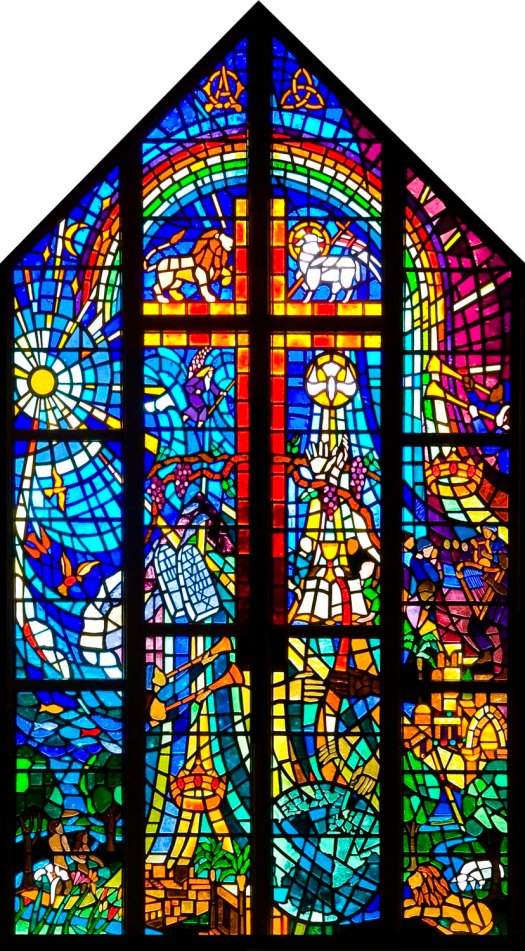
The Bible story captured in stained glass

Peninsula Bible Church, Cupertino, in California, USA, installed the stained glass window, shown below, in 2007. It is 23 feet high, and dominates the auditorium of the church. This window is not only a breathtaking piece of art. It’s also a wonderful teaching tool, telling the Bible story in a series of images through the window. At the centre, and dominating the window, is a cross. Another striking element is the rainbow that flows around the top of the cross, from the first vertical panel on the left, right through and into the final vertical panel on the right. The window was designed by Bernard Bell, a pastor of that church, who called it The Big Picture. He hopes that the window will form and shape an understanding of the great story told in the Bible in both adults and children.

Shortly after its installation, Bernard Bell preached a sermon explaining the window. He said, “Our service today is shaped around our new window. You’ve had a couple of weeks to look at this window, to figure out what is in it. It has been fun to watch you reading the window, especially to see you reading it with your kids. This window is indeed designed to be read, just like the stained glass windows of the old cathedrals in Europe. The Bible is a story, the great story of God’s involvement with the world and of human response to him. This window tells that story pictorially; it is to be read as a story. The window is structurally designed in four vertical bays, but thematically designed as five acts with a prelude. The prelude is God himself. The five acts are the five major stages in his dealings with the world: creation, Israel, Christ, church, and consummation.” Click HERE to read the rest of this sermon; it’s also available as a PDF HERE.

Bernard preached two other sermons relating to this window. A sermon entitled A Window on Advent is available in audio and written formats (including a PDF version) HERE. A sermon entitled Stories and the Story is available in audio and written formats (including a PDF version) HERE.

The window was featured in the local newspaper, the Cupertino Courier. Read the journal’s article HERE.

The Friday Briefing 4 (30 March 2018)

Crucifixion by the Romans from Wikimedia

The painting above is Crucifixion by the Romans by the Russian artist Vasily Vereshchagin (1842-1904). This magnificent painting is epic in scale – around 3 metres high and 4 metres wide! In their press release ahead of this painting’s sale (available HERE), the auction house Christie’s tells us, “The composition is undoubtedly striking: in direct contrast to traditional depictions of the Crucifixion, Vereshchagin positions Christ, illuminated, on the extreme right of the painting, placing the primary emphasis of the composition on the crowd. The viewer becomes part of the crowd, peering over people and horses to view the spectacle. A large expanse of dark sky stretches across the horizontal, the city wall looms heavy over a crowd of traders, Pharisees and a mournful group of Christ’s supporters. In the foreground, Roman soldiers with their spears and lances stand guard.”

What did the Cross achieve?

The dying of Jesus Christ

Thief or terrorist: what kind of criminal was crucified with Jesus?

The Day of Atonement

The Crossing Point of History – a video

What did the Cross achieve?

Here is J.I. Packer’s brilliant, carefully argued, penetrating defence of penal substitution – the doctrine that teaches that, on the Cross, Jesus suffered the penalty for our sin instead of us, as our Substitute. This is one of the foundational doctrines of our Christian faith. Delivered as a lecture at Tyndale House, Cambridge, in 1973, this article is now a classic. It is not, admittedly, the easiest of reads, but it is a foundational study that deserves close study. In it, Dr. Packer writes, “The notion which the phrase ‘penal substitution’ expresses is that Jesus Christ our Lord, moved by a love that was determined to do everything necessary to save us, endured and exhausted the destructive divine judgment for which we were otherwise inescapably destined, and so won us forgiveness, adoption and glory.”

Paul wrote “Christ redeemed us from the curse of the law by becoming a curse for us—for it is written, ‘Cursed is everyone who is hanged on a tree’”. In one of the footnotes in this article, Packer quotes from Luther’s comment on this verse, “Luther puts this dramatically and exuberantly, as was always his way. ‘All the prophets did foresee in spirit, that Christ should become the greatest transgressor, murderer, adulterer, thief, rebel, blasphemer, etc., that ever was . . . for he being made a sacrifice, for the sins of the whole world, is not now an innocent person and without sins . . . our most merciful Father . . . sent his only Son into the world and laid upon him the sins of all men, saying: Be thou Peter that denier; Paul that persecutor, blasphemer and cruel oppressor; David that adulterer; that sinner which did eat the apple in Paradise; that thief which hanged upon the cross; and, briefly, be thou the person which hath committed the sins of all men; see therefore that thou pay and satisfy for them. Here now cometh the law and saith: I find him a sinner . . . therefore let him die upon the cross . . .’”

Thirty years later, Dr. Packer wrote a briefer article, Penal substitution revisited, available HERE. In it, he commented: “Throughout my 63 years as an evangelical believer, the penal substitutionary understanding of the cross of Christ has been a flashpoint of controversy and division among Protestants. It was so before my time, . . . . It remains so, as liberalism keeps reinventing itself and luring evangelicals away from their heritage. Since one’s belief about the atonement is bound up with one’s belief about the character of God, the terms of the gospel and the Christian’s inner life, the intensity of the debate is understandable. If one view is right, others are more or less wrong, and the definition of Christianity itself comes to be at stake.” He concluded, “A lawyer, having completed his argument may declare that here he rests his case. I, having surveyed the penal substitutionary sacrifice of Christ afresh, now reaffirm that here I rest my hope. So, I believe, will all truly faithful believers.”

Read What did the Cross Achieve? HERE

James Innell Packer (born 22 July 1926), usually cited as J. I. Packer, is a British-born Canadian Anglican theologian. He is Board of Governors’ Professor of Theology at Regent College in Vancouver, Canada. He is regarded as one of the most important evangelical theologians of the 20th Century.

Click here to go back to table of contents

The dying of Jesus Christ

Arthur C. Custance brings a fresh look at the death of Jesus Christ in this fascinating study. He writes, “Man dies two deaths. The Saviour of man must therefore also suffer two deaths, first by dying spiritually as man dies spiritually, and then by dying physiologically as man dies physiologically. For such a Saviour both deaths are substitutionary, unique as to their nature and cause, and unique as to their effect.”

As to the first – spiritual – death, Dr. Custance explains: “When man sins, he does so by choice and he thus commits spiritual suicide. . . . . Thereafter he is, spiritually considered, a dead man: dead in trespasses and sins (Ephesians 2:1) . . . . . . . . From the God and Father of our Lord Jesus Christ he has effectively cut himself off, separated himself — as Isaiah 59:2 puts it . . . . Paul describes this spiritual death as “eternal destruction from the presence of the Lord” (2 Thessalonians 1:9, Revised Standard Version). But it may be asked, When did this kind of dying ever happen in the life of the Lord Jesus Christ? The answer is, On the cross in those three hours of darkness — as indicated when He cried out in his extreme isolation and agony of soul, “My God, My God! Why have You forsaken Me?” For in becoming an offering for our sins, He had suddenly experienced for the first time in the eternity of his being “destruction from the presence of the Lord,” a destruction which for all He knew was final. It happened not by his choice (as it is with us) but by imposition when He was made sin, when He became guilty by imputation of all the horror and frightfulness of man’s wickedness since history began with the murder of Abel. When this judgment fell upon Him, it was as though the murder, the torture, the rape, the mutilation, the degradation, and the utter cruelty of man towards man, became in effect his responsibility. . . . . We cannot really have the slightest conception of what this experience meant to One who was completely without sin.”

As to the second – physiological – death, Dr. Custance explains: “It was not, therefore, the crucifixion that really ended his life. He died ON the cross, but not FROM crucifixion. The cross was the occasion but not the cause of his dying. He was dead within less than six hours, a circumstance almost unheard of. . . . . It is therefore no wonder that the centurion in charge of the crucifixion detail was so amazed (Mark 15:39), and that Pilate also was incredulous (Mark 15:44) that He was so soon dead. Both were Romans: both probably had had considerable experience in such matters. To them it was a most exceptional circumstance. . . . . Thus in his exercise of absolute authority over his own life He did not give up his spirit in the sense that other men give up theirs. He deliberately dismissed it, and the transformation of his body from a living organism into a dead body was so immediate that the centurion was amazed.”

Read the whole article HERE

Arthur Custance’s writings can be accessed at no cost HERE. They are a wonderful storehouse of thoughtful and reverent explorations of Biblical truth, with a special focus on the interface of science and the Bible. Here is an outline of his life (as given on the Arthur C. Custance website, and available HERE): “Arthur C. Custance was born and educated in England and moved to Canada in 1928. In his second year at the University of Toronto he was converted to faith in Christ. The experience so changed his thinking that he switched courses, obtaining an honours M.A. in Hebrew and Greek. In his 13 years of formal education, he explored many facets of knowledge and was particularly interested in anthropology and origins. He completed his Ph.D. at the University of Ottawa in 1959 while serving as head of the Human Engineering Laboratories of the Defence Research Board in Ottawa (Canada) and was engaged in research work for 15 years. During that time he also wrote and published The Doorway Papers, and in retirement in 1970, he wrote 6 major books. His writings are characterized by a rare combination of scholarly thoroughness and biblical orthodoxy.”

Click here to go back to table of contents

Thief or terrorist: what kind of criminal was crucified with Jesus?

Tom Hobson writes, “’Thief’ is too mild a word in the verse where we are told that Jesus was “crucified between two thieves” (Matthew 27:38). The same is true in John 18:40, where we are told, “Now Barabbas was a robber”. The language is too mild. Not even “bandit” has enough kick to translate the word lēstēs. Barabbas and his buddies who were crucified with Jesus would be better described as revolutionaries, guerillas, pirates (the landlubber variety), or (to use a modern term) ‘terrorists’.

Dr Hobson concludes: ”How degrading, for Jesus to suffer Rome’s most hideous punishment with such dangerous, violent men! Here we have a vivid picture of the depths to which Jesus humbled himself (Philippians 2:8), from whence God highly exalted him, and gave him the name at which every knee shall bow. Let us ponder the humiliation Jesus suffered by being crucified between two terrorists, as we commemorate Good Friday and celebrate Resurrection Sunday.”

Read the whole article HERE

Click here to go back to table of contents

The Day of Atonement

The day of Atonement (described in Leviticus 16.1-34 and Numbers 29.7-11) lay at the heart of the whole Old Testament sacrificial system. On this day a final great purification offering was offered for all of Israel’s sins over the preceding year. This sacrifice consisted of a pair of goats, which, together, constituted a single purification offering. That sacrifice – and the whole Old Testament sacrificial system was fulfilled Jesus’s sacrificial death on the Cross – an event we remember this Good Friday.

In this article, Michael Morales brings a fresh and illuminating perspective on the Day of Atonement and its fulfilment by our great High Priest, Jesus Christ. He writes, “As part of the profound theology of atonement in the Old Testament, sin was understood as both deeply-seated within the heart and exceedingly defiling. Because the earth had been polluted by humanity’s sin and consequent death, the LORD God who is the fountain of life could not dwell with his people—yet this was the very purpose for which he had created the heavens and earth. The Tabernacle (and later Temple) was, therefore, a provisional ‘creation in miniature’, an architectural cosmos that would allow the holy Creator to dwell in a sacred, clean ‘house’ among his people. Again, the Tabernacle was a temporary solution during the interim before the establishment of a new (that is, newly cleansed and renovated) heavens and earth. But even during the interim, God taught and warned his people that his earthly abode, the Tabernacle, could not remain in the midst of his people when defiled by the uncleanness of their sins. Although faithful Israelites would offer sin offerings throughout the year, their own consciences surely testified to the inadequacy of their repentance, let alone remembrance, of sin. If one were to offer sin offerings (typically a young goat) for every sin committed in a single day, one would never leave the Tabernacle precincts and would become exceedingly poor in the process since livestock were a precious commodity. Many sins, then, had not been dealt with through the cleansing blood of atonement. Worse still, Israel’s sins spread their uncleanness so that the Tabernacle would steadily become defiled; without a remedy, God would need to remove his holy presence from among his people. Such a need for comprehensive forgiveness and cleansing from sin was addressed by the Day of Atonement ceremony, allowing for a fresh start annually—a new year, as it were.”

“The analogy between creation and the Tabernacle proves prophetic. If the high priest, through the blood of atonement, could cleanse God’s architectural cosmos (i.e., the Tabernacle) from sin’s defilement, then could such cleansing also be possible for creation itself? The book of Hebrews teaches precisely this point. Jesus was not a Levitical high priest, linked to the Tabernacle as a miniature copy of the cosmos. Rather, the Son of God is a high priest after the order of Melchizedek, and has accomplished creation’s Day of Atonement, cleansing God’s people and the cosmos definitively from sin’s defilement. With his own blood, Jesus entered heaven itself, the reality which the Tent’s holy of holies only copied. All of God’s people, from every era and nation, will dwell with him in glory in a new heavens and earth because of the Messiah’s work of atonement. A foretaste of that glorious life may be experienced every Lord’s Day as the church below enters through the new and living way—the person and work of the Lord Jesus Christ—into the joys of the heavenly Mount Zion (Hebrews 12.22-24).”

Read the whole article HERE

Michael Morales is Professor of Old Testament at Greenville Presbyterian Theological Seminary in Greenville, South Carolina. He is the author of Who Shall Ascend the Mountain of the Lord?: A Biblical Theology of the Book of Leviticus (see the publisher’s description for this book HERE). This is a suberb study of the book of Leviticus, and its place in the whole Bible story. I will post about it in due course.

Click here to go back to table of contents

The Crossing Point of History – a video

In this video, the eleventh in the series The Journey (available HERE) we look at Jesus’s trials and crucifixion, and His resurrection and ascension into Heaven. These events are the great turning point in the history of this world, and the key to God’s plan for us and for our world. A Leader’s Guide, to aid in group discussion after viewing the video, is available HERE. A more detailed 20-page study is available for download HERE.

Click here to go back to table of contents

Unless otherwise indicated, all Scripture quotations (apart from those in direct quotations) are from The Holy Bible, English Standard Version, published by HarperCollins Publishers. © 2001 by Crossway Bibles, a division of Good News Publishers. Used by permission. All rights reserved.

The Friday Briefing 3 (23 March 2018)

Welcome to the third issue of The Friday Briefing. (If you missed the first and second, they’re available HERE and HERE.) The aim of this weekly briefing is to introduce a wide range of books, articles, and audio and video resources helpful for studying the Bible, for Biblical thinking and understanding, and for Christian discipleship. It will also include quotations that I’ve found thought-provoking and significant. There’ll also be alerts to material uploaded on this site.

The greatest drama ever staged

The gift of pain (Genesis 3.16-19)

We have lost the sense of God

I’m a modern woman who loves my church’s all-male pastor’s rule

Book review: Easter Enigma by John Wenham

The real reason you love music

The greatest drama ever staged

Here is a bracing argument for the importance and dramatic impact of Christian theology from the pen of Dorothy Sayers (1893-1957), an English crime writer, poet, playwright, essayist, and translator. Written over 50 years ago, it’s relevance remains. She writes: “Official Christianity, of late years, has been having what is known as ‘a bad press’. We are constantly assured that the churches are empty because preachers insist too much upon doctrine – ‘dull dogma’, as people call it. The fact is the precise opposite. It is the neglect of dogma that makes for dullness. The Christian faith is the most exciting drama that ever staggered the imagination of man – and the dogma is the drama.”

”That drama is summarized quite dearly in the creeds of the Church, and if we think it dull it is because we either have never really read those amazing documents, or have recited them so often and so mechanically as to have lost all sense of their meaning. The plot pivots upon a single character, and the whole action is the answer to a single central problem: What think ye of Christ?

Read the whole article HERE

Click here to go back to table of contents

The gift of pain (Genesis 3.16-19)

Bernard Bell, a pastor at Peninsula Bible Church, Cupertino, San Fransisco, writes: ”America should be the happiest country on earth. It is officially founded on the ‘self-evident’, God-given, ‘unalienable’ right to pursue happiness. Yet there is a lot of pain in this country: physical, emotional, psychological. Despite the highest per-capita spending on health-care we rank near the bottom in the West on any measure of health. Despite massive consumption of painkillers the pain persists. Despite numerous counselors the anguish endures.”

”Many who have visited Third World countries on mission trips have been struck by how happy people seem, even though they live in relative poverty, with poor access to health care and no painkillers. Many of us know people who have remained remarkably joyful in the midst of great pain: they don’t deny the pain, but the pain doesn’t paralyze their lives. In short, there does not seem to be a direct correlation between pain, suffering and happiness.”

”We wish the pain would go away, but pain is valuable. . . . . Today I want to rehabilitate pain, not by removing it, but by showing its positive effects.” Bernard concludes, “The antidote to pain is not Tylenol. It’s not relationships, or marriage, or family, or work. It’s certainly not death. The antidote to pain is God. Our chief end is to glorify God and enjoy him forever. God uses pain as a tool to keep us from ourselves, to keep us from enjoying lesser things too much, to keep us from being too easily pleased.”

Read the whole message HERE

This message is part of series preached by Bernard Bell entitled Genesis 1-11: Our Story of Origins. The whole series is available HERE. This series can be downloaded in a single PDF file HERE and as a single EPub document HERE.

Click here to go back to table of contents

We have lost the sense of God

Conrad Mbewe, pastor of Kabwata Baptist Church in Lusaka, the capital city of Zambia, writes: “After my last blog post in which I addressed the issue of believers abandoning going to church on a Sunday in preference for watching a football match, I tossed and turned most of the night. I kept asking myself how believers could do this. I could not understand how even pastors are now joining in this revelry with a clear conscience. I mean, how?

”I was sure that the football craze that had engulfed this generation is only a symptom of a greater disease. But what was that disease? That is the question I was wrestling with. By the time the sun rose, I think that I had an answer. The best way to phrase it is by the title of this blog post: We have lost the sense of God. I know that this sounds like an outlandish accusation but that is because we are comparing ourselves with ourselves. Hear me out.” Read the whole article HERE

You can learn a little more about Conrad Mbewe here HERE

Click here to go back to table of contents

I’m a modern woman who loves my church’s all-male pastor’s rule

Katy Faust writes, “I know plenty of women who are incredible leaders and gifted speakers who can expound, exegete, and exhort as well as Keller or Piper, Pratt or Chan. But I don’t believe those gifted women should be lead pastors of the local church. . . . . While I believe the most biblical position prohibits women as elders and pastors, here I’ll try to outline a more pragmatic argument.” Read the whole article HERE

Click here to go back to table of contents

Book review: Easter Enigma by John Wenham

This book brings vividly to life the events of the Resurrection that we will be celebrating this Easter. Easter Enigma weaves together the five accounts of Jesus’s Resurrection and His subsequent appearances, and gives us a compelling overview of what happened during those momentous 40 days. This book had an unforgettable impact on me when I first read it. It took me into the events of Jesus’s Resurrection and subsequent appearances in such a way that I felt that I could almost have been there in person when these momentous events took place.

Read the whole review HERE.

Click here to go back to table of contents

The real reason you love music

Gavin Ortlund muses on why we love music. He writes, “As someone who studies theology, I’m interested in the philosophy of music. What does music mean? Is it merely pleasant—’auditory cheesecake’, as Steven Pinker puts it—or does it actually have a significance that corresponds to its effect on us?”

Gavin comments: “If a triune God created the world as a work of art—not out of necessity, but out of love and freedom—then music can be understood, along with everything beautiful in the world, as a faint reflection of the pre-temporal glory of God. It is a tiny echo of what was happening before time and space. What rhythm and harmony are trying to do, however imperfectly, is trace out something of that love and joy that has been forever pulsating between Father, Son, and Holy Spirit.”

Read the whole article HERE. And – as a pointer to the joy that music can bring us – here’s a video of the U.S. Air Force Band treating visitors to the Smithsonian National Air and Space Museum to a flash mob performance of Jesu, Joy of Man’s Desiring/Joy to the World.

Click here to go back to table of contents

Book review – ‘Bound Together’ by Chris Brauns

Cover for Brauns C. 'Bound Together'

Bound Together: How We Are Tied to Others in Good and Bad Choices by Chris Brauns.

Bound Together is a highly readable and engaging book on a vital yet often neglected truth. Here’s the publisher’s commendation: “We are not just isolated individuals. Instead, our lives are woven together with others. We have solidarity with other people—the choices one person makes affects the lives of others, for good and for bad. Because much of the pain we endure in life is in the context of relationships, this truth often strikes us as unfair. Why should a child suffer because of the choices of his parents? And on a grander scale, why do we all suffer the curse of Adam’s sin? Why should anyone be judged for someone else’s sin? In Bound Together, Chris Brauns unpacks the truth that we are bound to one another and to the whole of creation. He calls this, “the principle of the rope.” Grasping this foundational principle sheds new light on marriage, the dynamics of family relationships, and the reason why everyone lives with the consequences of the sins that others commit. Brauns shows how the principle of the rope is both bad news and good news, revealing a depth to the message of the gospel that many of us have never seen before.”

In chapters 2, 3 and 4, Chris explains two vital truths – truths that lie at the heart of the Gospel message.

 People’s union with the first man, Adam. In chapter 2, Chris explains how everyone has been bound to Adam. So, when Adam committed his first sin in the Garden of Eden, every human was involved in that sin. This is what is called the doctrine of ‘original sin’.

 Believers’ union with Christ. Everyone who repents and trusts in Jesus Christ for their salvation is, so to speak, unbound from Adam and bound to Jesus Christ. They are united with Christ. In other words, they are, as Paul often says, “in Christ”. And that changes everything. Robert Letham writes, “Union with Christ is right at the center of the Christian doctrine of salvation”. In chapters 3 and 4, Chris explains what it means for believers to be united with Christ and takes us through images that the Bible uses to illustrate this union.

Michael Horton, J. Gresham Machen Professor of Systematic Theology and Apologetics at Westminster Seminary California writes: “In Bound Together, Chris Brauns cleverly unpacks two key theological concepts—union with Christ, and original sin—and manages to explain them in a way that any reader can understand. Highly recommended.”

View the publisher’s description page HERE.

Read some reviews HERE and HERE.

Chris Brauns’ website A Brick in the Valley is HERE. I recommend it.

Chris Brauns is senior pastor of the The Red Brick Church, Stillman Valley, Illinois, United States. He is the author of three books and numerous articles. Chris and his wife Jamie have four children. You can read more about Chris background HERE.

The LUMO Project Gospel videos

Image © LUMO Project

Jesus calls his first disciples – a scene from one of the LUMO Project videos.

The LUMO Project has produced a series of videos of the four Gospels, one for each Gospel. These videos have three key features that, together, contribute to these films’ stunning level of authenticity.

 Firstly, the voice-over is a narration of the Bible text – nothing is added, and nothing is removed. The actors in the film speak Aramaic, as it was spoken in Jesus’ time. But their dialogue is muted, and overlaid with voice-over narration using the unabridged Biblical text as script. John’s Gospel is available in the New International Version and the King James Versions of the Bible; the other Gospels are available in the NIV only. There are also versions available in other languages. The film is currently available in 20 languages – Afrikaans, Arabic, Bengali, Cantonese, Dutch, English, German, Hindi, Italian, Korean, Mandarin, Polish, Portuguese, Russian, Spanish, Swahili, Tagalog, Thai, Turkish and Vietnamese.

 Secondly, the scenery was shot on location in Morocco, and is faithful to the first-century Palestinian world of the Gospels. The LUMO Project used CGI to reconstruct the city of Jerusalem from a difference.

 Thirdly, and uniquely, the actors look the part of first-century Palestinian people. This adds a further level of authenticity to the videos. In the December 2002 issue of Popular Mechanics, an article by Mike Fillon, entitled The Real Face of Jesus, described how scientists and archaeologists used forensic anthropology to reconstruct what a first-century Galilean man might have looked like. The image is quite different from the Western face we typically see depicted today. In the LUMO films, Jesus is played by the British actor Selva Rasalingam. Rasalingam’s ethnicity is partly Tamil, and he looks more like the reconstructed image developed by this team of scientists and archaeologists than the typical Westernised depiction that we’re familiar with.

LUMO tells us “LUMO revolutionizes the way we experience and understand the historical Jesus. Anyone, anywhere in the world can fully experience their translation of Scripture overlaying the stunningly visual representations of the life of Christ set against the backdrop of an authentic rendition of first century Palestine during Jesus’ time.”

Justin Taylor, on the Gospel Coalition website, writes: “I am a big fan of the Lumo Project, which is seeking—for the first time—to film all four Gospels as feature films, using only the unabridged biblical text as their script.” Read his review HERE.

The Journey video series, available for free viewing or download from this site, uses – because of their authentic portrayals – many stills from the LUMO films for Jesus and the Gospel narratives.

What is the LUMO project? This very brief video explains:

Click HERE for the LUMO website and to watch a trailer.

Here’s a video explaining the project:

This is a trailer for the Gospel of John:

LUMO’s YouTube channel, with a variety of trailers and explanatory videos available is HERE.

You can buy the LUMO videos on Amazon USA and Amazon UK. Outside of the United States and Canada, the films can be downloaded from the LUMO Project website for use in churches or community group.

Read Scripture videos by The Bible Project – a great resource for teaching the Bible

The Bible Project has produced (among many other resources) a series of 71 short videos, named Read Scripture, that take you right through the Bible. They’re are a wonderful tool for teaching the Bible story – snappy, engaging, visually impacting, and theologically astute. And they’re all free – as is everything produced by The Bible Project.

These Read Scripture videos are suitable for teenagers as well as adults. They’re a great introduction to the Bible story that you could use with your family, your small group, or your whole church. I first encountered one of these videos at a church service where the preacher used the video to introduce a sermon series on the Book of Numbers. It was a brilliant way to begin that series.

Here’s the Read Scripture video on Genesis chapters 1 to11:

Other resources related to this video on Genesis 1-11 from The Bible Project are available HERE

The full set of Read Scripture videos for the Old Testament are available HERE.

Here’s the Read Scripture video on Matthew chapters 1 to 13:

Other resources related to this video on Matthew 1-13 from The Bible Project are available HERE

The full set of videos for the New Testament are available HERE.

The Bible Project is a non-profit animation studio that produces short, animated videos, podcasts, and study guides that explore the Bible’s unified story. They focus on the Bible’s overarching themes and each book’s literary design, and they are committed to understanding the Bible in its historical context. To find out more about The Bible Project, click HERE.

‘The Journey’ Video 16 – “All Things New”

In this final session of The Journey, we’ll begin by looking at the emergence of the Antichrist and the final rebellion against God that will occur at the end of this age.

And at the end of this age, Jesus will return to Earth. We’ll look at everything that happens when He comes – the destruction of Antichrist and the evil world system under his control, and the resurrection and final judgment, and how the present heaven and earth will be transformed – a process that we can compare to the emergence of a beautiful butterfly from a caterpillar. We’ll also look at the apostle Paul’s picture of the seed to explain how our present mortal bodies will be transformed into the new glorious bodies we’ll possess in the new creation.

We’ll also take a moment to look at what the Bible tells us about Hell – where Satan and his evil angels, and every human who has rejected God will exist for eternity.

And we’ll look at the wonderful description of the New Heaven and Earth that we read in the final two chapters of the Book of Revelation. We’ll explore what life will be like there, and what believers will do there. There will be Heaven on Earth for all eternity. God’s people will live in God’s paradise in God’s presence for ever.

Invisible text

https://youtu.be/BxqsafDOlP0

Click on the MP4 icon below to download
the MP4 version of this video.

Invisible text

Leader’s Guide for group study

This Group Study Guide contains three questions, with Bible passages to read, together with some notes to help the group leader to guide the discussion.

Click on the PDF icon below to download
the PDF version of this Leader’s Guide.

Invisible text

You may want to begin by asking if anything particularly struck people as they watched the video.

Question 1
In Session 1, we saw several things in both the first two chapters of Genesis and the final two chapters of Revelation. What do we find in the new creation that we do not find in Genesis? What does this tell us about our future lives in the new creation that we look forward to?

Bible passages to read
Revelation 21.1-4, 22-27, 22.1-5.

In our first session, we highlighted four things found both in the original creation described in Genesis and in the new creation described in Revelation:

 Heaven and Earth. In Genesis, God creates Heaven and Earth (Genesis 1.1). In Revelation He creates a New Heaven and a New Earth (Revelation 21.1).

 Light. In the beginning, God created light (Genesis 1.3-5). In the new creation, God is its light (Revelation 22.5, see also 21.23-24).

 A river. A river waters the Garden of Eden (Genesis 2.10). In Revelation, we see a river flowing from the throne of God and of the Lamb (Revelation 22.1).

 The tree of life. There’s a tree of life in the Garden of Eden (Genesis 2.9). In Revelation 22.2 we read that “on either side of the river” is “the tree of life” .

The most obvious difference between the original creation and the new creation is this: in the original creation there was a garden – the Garden of Eden; in the new creation there’s a citya garden city. This city is the New Jerusalem. It’s where God lives (Revelation 21.1-3,22). New Jerusalem is a real place, of course – though it won’t be like any city we’ve seen here on Earth. But it also symbolises something. What is a city? A city – any city – is an interdependent community. God’s people – God’s community – live in New Jerusalem. God lives there with His people. In the city is “the river of the water of life” and “the tree of life” . New Jerusalem is a garden. This city is a picture of God’s people living in God’s presence in God’s paradise – in other words, the Kingdom of God. New Jerusalem symbolises God’s perfect world.

There’s something else that distinguishes the new creation from the Garden of Eden. God is present in both the garden and the new creation. In the garden He is “walking” (Genesis 3.8). But in New Jerusalem He is enthroned. God reigns there in all His glory. There’s no temple in the city (Revelation 21.22) – “its temple is the Lord God the Almighty and the Lamb” . The whole city is the temple, the dwelling-place of God. God’s presence fills the entire city. The city’s shape tells us that. It’s a cube (Revelation 21.16). That’s like the Most Holy Place, both in the Temple (1 Kings 6.20) and in the Tabernacle (this can be calculated from the description in Exodus 26.1-37). The Most Holy Place was the innermost sanctuary, the place of God’s immediate presence (see Exodus 25.22, Numbers 7.89). The whole city is the eternal Most Holy Place, where God lives on Earth. So everyone in the city is in the Most Holy Place, too. Once, only one man could enter the Most Holy Place in the Tabernacle and the Temple, and only under the strictest conditions. Now all God’s people live there in His immediate presence!

Question 2
Jesus has justified us believers; our names are written in “the book of life” . Nonetheless, “each of us will give an account of ourselves to God” (Romans 14.12 NIV). How should this impact our priorities in life, and what we think, say and do?

Bible passage to read
Romans 14.10-12, 2 Corinthians 5.10, 2 Peter 3.11-14, Revelation 20.11-15.

After we die, we will all stand before God’s judgment seat. In Revelation 20.11, John does not say whether the Father or the Son is seated on the “great white throne” of judgment. But we know that the Father has handed over all judgment to the Son (John 5.22,27, Acts 10.42, 17.31, Romans 2.16). It’s reasonable to conclude that Jesus will be our Judge.

Why has God given Jesus this role? One reason is surely this: because Jesus is not only God, but a human being like us. People can’t say to Him: “You have no right to judge us; you don’t know what it’s like to be human – you’ve never suffered like we have, you’ve never been tempted” . He has. In life as well as in death, Jesus suffered more than we could ever know. He was tempted just as we are (Hebrews 4.15).

When Jesus returns we will all stand before Him. Each one of us “will give an account of ourselves to God” (Romans 14.12 NIV). Sam Storms comments: “Is it not sobering to think that every random thought, every righteous impulse, every secret prayer, hidden deed, long-forgotten sin, or act of compassion will be brought into the open for us to acknowledge and for the Lord to judge? And all this, we are reminded, without any ‘condemnation for those who are in Christ Jesus’ (Romans 8.1).”

We are accountable for our lives. In the end, none of us can blame heredity or environment, or what others have done to us, for the kind of person we are. It’s our reactions – what we have thought and said and done in response to the circumstances of life – that makes us what we are at the moment of death.

Our childhood years were our ‘formative’ years. Our present life on Earth, too, is like a childhood. These are our ‘formative years’, a period of training and maturation that’s preparing us for our life in the world to come. We will reap what we sow (Galatians 6.7-9).

God is laying a foundation in our lives, and we must co-operate with Him. How much do we allow God’s Spirit to mould us into the image of His Son (see 2 Corinthians 3.18)? Are we presenting our bodies “as a living sacrifice, holy and acceptable to God” (Romans 12.1)? Are we allowing the Spirit of God to transform us by the renewing of our minds (Romans 12.2)? Are we allowing Him to refashion the way we think, to come to see things as God sees them – so that we discern what His will is, agree with it and do it?

Have we yielded our lives fully to God? Have we walked in the Spirit, rather than in our own strength? Have we resolutely trusted God, come what may?

Our faith is proved by acts of obedience (James 2.14-26). Have we obeyed God – in the small things that other people don’t see, as well as the big things? Have we overcome temptation, compromise and persecution for Jesus’s sake? Have we loved? Have we forgiven?

Question 3
We have a glorious hope of heaven – that is, living in the New Heaven and Earth with all God’s people in God’s paradise in God’s presence. How has this session helped you in your understanding of heaven? How should the hope of heaven affect how we live?

Bible passage to read
Romans 8.18-25, Colossians 1.3-5, 1 Peter 1.3-9.

We need to remind ourselves – and each other – often that our eternal home will be the New Heaven and Earth, where we will see God and be part of His royal priesthood, sharing in Christ’s rule over creation and serving God and other people in unimaginably wonderful ways – as we saw in the video. In fact, that is the world that God made us for.

We should keep “the hope laid up” for us “in heaven” (Colossians 1.5) at the centre of our thinking and allow it to mould our lives – our relationship with God, our ambitions, our friendships, how we spend our time and money, and how we treat other people.

Keeping our minds on the world to come gives true perspective to our present lives. C.S. Lewis wrote, “A man who has been in another world does not come back unchanged.” When we see what the Bible teaches about the world to come and allow these truths to sink in to our minds and penetrate our hearts, we will not be unchanged.

The hope of heaven has a special impact on how we view the struggles and disappointments and sufferings that we experience in our present lives. Peter writes, “In this you rejoice, though now for a little while, if necessary, you have been grieved by various trials“ (1 Peter 1.6; the phrase “in this” refers back to the whole of the previous verses 3-5, in other words, “a living hope through the resurrection of Jesus Christ . . . an inheritance that is imperishable, undefiled, and unfading, kept in heaven for you, . . . .” ). Randy Alcorn, in his excellent book Heaven, writes, “Anticipating Heaven doesn’t eliminate pain, but it lessens it and puts it in perspective. . . . . . . . suffering and death are temporary conditions. . . . . The biblical doctrine of Heaven is about the future, but it has tremendous benefits here and now. If we grasp it, it will . . . radically change our perspective on life. This is what the Bible calls ‘hope’, a word used six times in Romans 8.20-25, the passage in which Paul says that all creation longs for our resurrection and the world’s coming redemption.”

CREDITS Text copyright © 2017 Robert Gordon Betts Unless otherwise indicated, all Scripture quotations are from the ESV® Bible (The Holy Bible, English Standard Version®), copyright © 2001 by Crossway, a publishing ministry of Good News Publishers. Used by permission. All rights reserved. Scripture quotations marked ‘NIV’ are taken from THE HOLY BIBLE, NEW INTERNATIONAL VERSION®, NIV® Copyright © 1973, 1978, 1984, 2011 by Biblica, Inc.® Used by permission. All rights reserved worldwide.

Video and study guide on local church life (part 14 of The Journey)

In this video we explore:

 what the local church is, and what it means to be part of a local church;

 the four key pictures that the New Testament uses to describe the church – the body of Christ, God’s household, God’s temple, and the Bride of Christ;

 the spiritual gifts that God gives believers;

 how God’s people can fulfil the royal and priestly roles that God intended mankind to fulfil from the very beginning;

 why we gather together regularly as a local church, and what we do when we gather – including the Lord’s Supper.

This video is accompanied by a a group study guide. The video and guide are suitable for use in a small group study or Bible class on local church life.

Invisible text

Click on the MP4 icon below to download
the MP4 version of this video.

Invisible text

Leader’s Guide for group study

This Group Study Guide contains three questions, with Bible passages to read, together with some notes to help the group leader to guide the discussion.

Click on the PDF icon below to download
the PDF version of this Leader’s Guide.

Invisible text

You may want to begin by asking if anything particularly struck people as they watched the video.

Question 1
What is the purpose of our church gatherings?

Bible passages to read
Acts 2.42, Acts 13.1-3, 1 Corinthians 14.1-5,26, 1 Timothy 4.13, Hebrews 10.24-25.

Acts 2.42 seems to suggest a broad outline for what happens in our gatherings – “teaching”, “fellowship”, “breaking of bread”, and “prayers”. The word “fellowship” translates the Greek word koinonia. This word suggests partnership in something done together.

What should a gathering of the local church include? There might be teaching and public reading of the Scriptures. There may be praise, thanksgiving and adoration of God – both spoken and sung. There may be prayer for the needs of people or situations. There may be prophecy, messages of wisdom, messages of knowledge, words of encouragement, tongues and interpretations. There might be testimonies – that is, people sharing what God has done for them. Not all these things will necessarily occur in every gathering. Each time we meet will be a unique occasion. And there may be times when the main focus of the meeting is, for example, prayer or teaching.

Everything that takes place when we meet together should build up the body. Paul writes: “Everything must be done so that the church may be built up.” (1 Corinthians 14.26 NIV). For example, too, those that prophesy, do so for believers’ “upbuilding and encouragement and consolation.” (1 Corinthians 14.3).

It seems clear from the New Testament that there should generally be opportunity for a variety of people to contribute. We can all take part in encouraging and building up our fellow-believers.

The Lord’s Supper is central to the life of a local church. It’s a shared meal that celebrates the new covenant between God and His people (prophesied in Jeremiah 31.31). This new covenant was sealed with Jesus’s blood. Through His blood – in other words, His sacrificial death – Jesus paid the penalty and made full amends for our sin. Now we can come into relationship with God. We can be bound to Him by the New Covenant.

In the Lord’s Supper, the bread symbolises Jesus’s body given for us. The wine symbolises His blood shed for us. When we eat the bread and drink the wine, we remember that it was His death that enabled us to be in covenant relationship with God – and to enjoy all the blessings that this brings.

All believers are bound to God by His New Covenant. And that means we’re bound to each other, too. We are one body. The Lord’s Supper is a time of fellowship with God. And it’s also a time of fellowship with each other. The Lord’s Supper provides an opportunity for believers to reflect on their relationship with God and with other believers. Are they really living according to the terms of the New Covenant, loving and obeying God, and loving and serving their fellow-believers?

Question 2
The Church is God’s temple. What implications does that have for our lives?

Bible passages to read
Exodus 40.34-35, 1 Kings 8.10-11, John 14.23, 1 Corinthians 3.16-17, 1 Peter 2.4-5.

The church is God’s temple – the place where God lives. Each believer is a temple – as Paul tells us: “your body is a temple of the Holy Spirit within you” (1 Corinthians 6.19). God lives within them (John 14.16-17,23). The whole Church, too, is a temple (1 Corinthians 3.16-17, 2 Corinthians 6.16, Ephesians 2.21-22).

God is holy (for example, Leviticus 11.44-45, Isaiah 6.3). His holiness is more than His moral purity; it is the sum of His divine attributes that sets Him apart from everything that He has made. He is the Uncreated, eternal, transcendent, divine Being, overwhelmingly and awesomely glorious in majesty. He is absolutely separate from evil, infinitely perfect, immaculately pure, faultlessly righteous. Central to God’s holy being is love – perfect, pure love.

When the Tabernacle was complete, “Moses was not able to enter the tent of meeting because the cloud settled on it, and the glory of the Lord filled the tabernacle.” (Exodus 40.35). God’s glory filled the Temple, too, at its dedication ceremony (1 Kings 8.10-11). Remember, too, Mount Sinai quaked and smoked as God descended on it (Exodus 19.18). Now God lives in each believer, and among us as a local church! The lesson is clear: we, and our church, must be in a state fit for God to live amongst us. In other words, we have to be holy. Peter writes: “. . . as he who called you is holy, you also be holy in all your conduct, since it is written, ‘You shall be holy, for I am holy.’” (1 Peter 1.15-16).

God is uniquely holy in a way that is totally unattainable by any created being. But we believers are holy, too, in the sense that we now belong to God. We are His own special, distinctive people, set apart for His purposes. God made us believers holy (or, to use another Bible word, “sanctified” us) at the moment we became a child of God. We’re “sanctified in Christ Jesus” (1 Corinthians 1.2).

Yet becoming holy (in other words, our sanctification) is also a process that continues throughout our lives. We’re to turn away from sin and pursue godliness. We have to put off our old way of life – our wrong attitudes, wrong ways of thinking and speaking, and sinful habits. New attitudes, right ways of thinking and speaking, and godly habits, need to be formed (see Ephesians 4.21-24, Colossians 3.5-17). God’s Holy Spirit guides us and gives us the power to do all this. But we must co-operate with Him and obey Him. As we obey Him, His Spirit purifies us, so that all that we think and say and do reflects more and more exactly the character of the holy God Who lives in us.

A vital part of our obedience to God is this: we’re to read the Bible and pray regularly, and meet often with other believers (see Hebrews 10.24-25). These things will strengthen us and help us to live holy lives.

Holiness means to belong to God for His purposes. Our purpose as God’s people is to be a community of people who extend His Kingdom across Earth through the power of His Spirit. Each believer has a special role in this magnificent calling. But to fulfil our role, we must be holy. So you can see how crucial our own personal holiness is to God’s plan for this world.

Question 3
What do these three images of the Church – a human body, a temple, a household – have in common?

Bible passages to read
Romans 12.3-8, 1 Corinthians 12.12-27, Ephesians 2.19-22.

Three ways in which the Church is pictured in the Bible are as a temple, a body, and a household. A temple is a single structure made up of many different components. A body is a single organism comprising a complex assembly of cells, tissues and organs, each of which has a part to play in the health and function of the whole body. A household is an economic and socially interdependent group of people who share a common life.

Each of these three images implies an integrated, interdependent community. Why is there such emphasis on community and interdependence? Because that’s how God made us. As we saw in Session 3, mankind isn’t just a group of unrelated individuals. The human race is a family, all descended from Adam and Eve. We’re all connected. John Donne wrote: “No man is an island, entire of itself. . . .” At the heart of our beings is the capacity for love. We are relational beings. Donald Macleod wrote: “A life lived apart from community is a life that violates human nature”.

So when God speaks about the Church as a temple, a body, and a household, it isn’t a completely new idea. He built the idea of community into human nature right from the beginning. The Church is God’s new humanity. The Church is a community of people who love each other, support each other and share their lives with each other. When people see a local church functioning as a community as God intended, they are seeing what it really means to be truly human.

And all this means that we affect one another – for good or bad. We have the power to be a blessing to each other. In the church, God has given each of us gifts to build up our brothers and sisters in Christ (see 1 Corinthians 14.12,26, and see also Ephesians 4.11-16). Conversely, we have power to harm each other. Failing to use my gifts damages the body. One person’s sin can defile many (compare Hebrews 12.15). We hurt people by breaking off relationships, or refusing to forgive.

CREDITS Text copyright © 2017 Robert Gordon Betts Unless otherwise indicated, all Scripture quotations are from the ESV® Bible (The Holy Bible, English Standard Version®), copyright © 2001 by Crossway, a publishing ministry of Good News Publishers. Used by permission. All rights reserved. Scripture quotations marked ‘NIV’ are taken from THE HOLY BIBLE, NEW INTERNATIONAL VERSION®, NIV® Copyright © 1973, 1978, 1984, 2011 by Biblica, Inc.® Used by permission. All rights reserved worldwide.