‘Once more: Jesus was not born in a stable’ by Ian Paul

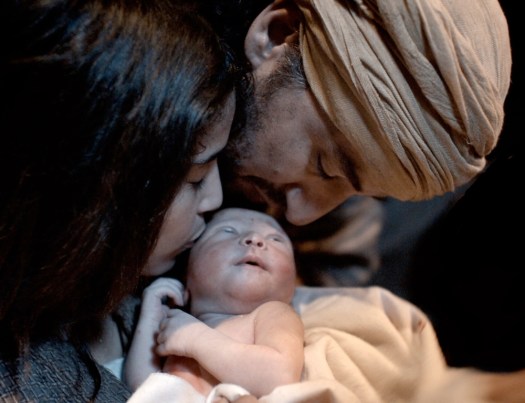
Image © Lumo Project through Free Bible Images All rights reserved

A re-enactment of the nativity scene: Jesus with His mother Mary, and her husband Joseph.

Dr. Ian Paul writes, “I am sorry to spoil your preparations for Christmas . . . . But Jesus wasn’t born in a stable, and, curiously, the New Testament hardly even hints that this might have been the case. So where has the idea come from? I would track the source to three things: traditional elaboration; issues of grammar and meaning; and ignorance of first-century Palestinian culture.”

Dr Paul opens up some fascinating insights into Jesus’ nativity. He tells us why oxen and asses are traditionally placed in the nativity scene. He explains the meanings of the Greek word in Luke 2.7 that’s translated “inn” in the ESV and the King James Version (but translated “guest room” in the NIV). And he takes us back to the first-century setting of the narrative, including the culture of the time and the actual design of Palestinian homes. Dr Paul draws on resources by other writers and provides links to two sermons, one by himself, another by Stephen Kuhrt, that retell the Christmas story in way that is faithful to its first-century Palestinian background.

Read the whole article HERE

‘Defending against defeater beliefs.’ Two talks by Don Carson

Don Carson gave two talks at the FIEC (Fellowship of Independent Evangelical Churches) Leaders’ Conference in Torquay this year. They’re entitled Defending against Defeater Beliefs. The FIEC’s website page for the first talk is HERE; the page for the second talk is HERE.

In the first session, Dr Carson briefly overviewed seven defeater beliefs that challenge, and can defeat, our own Christian beliefs. He said, “. . . it’s become a little more difficult to do evangelism, a little more challenging, not because the gospel has changed, but because the nature of the defeater beliefs that are challenging the gospel are progressively more diverse, progressively more antithetical to . . . Christianity. So let me . . . give a survey of . . . seven [defeater beliefs] with a few comments along the line and then I’ll close by returning to this point regarding the importance of the Bible storyline.”

The ‘defeater beliefs’ that Dr Carson deals with are these:

1 “There cannot be only one way to God.”

2 “Freedom is tied to our capacity for individual self-definition, . . . for individual self-identity; we choose our own self identities.”

3 “This freedom . . . includes our right to define sin for ourselves.”

4 “What I’ve learned to call the new tolerance.”

5 “Moralistic therapeutic deism.”

6 “God couldn’t possibly send people to hell – or if there is some kind of punishment, it’s for really bad blokes like Stalin, but it’s not for nice people like me.”

7 “The God of the Bible is Himself spectacularly morally flawed.”

In his conclusion, Dr Carson said, “What is required for this and all the other defeater beliefs at the end of the day is not only some individual answers . . . [but] an alternative biblical theological framework – the Bible’s storyline. . . . Ideally you want to take people from a frame of reference in which they’re holding a whole lot of defeater beliefs, which if you tackle them one by one . . . you’re likely to get smashed down one by one . . . and present instead an alternative picture, a big story, which changes all of those defeater beliefs into something else. Now, this can be done in a lot of different ways. It can be done by one-on-one Bible study to invite people into beginning to read the Bible and find out how it clashes with their own assumptions . . . .” There are quite a few resources that cover the Bible storyline. Two that Dr Carson mentioned are God’s Big Picture by Vaughan Roberts (described HERE), and his own resource The God Who Is There. This is available as a book with a leaders’ guide, and also a video series. The videos and transcripts are available free of charge HERE; you will also find audio versions of the talks here, together with details of the accompanying book and leader’s guide for group study.

In his second talk on defeater beliefs, Dr. Carson deals with this question: how can we be sure that what we believe is true? He begins, “Yesterday I gave a brief overview of defeater beliefs and how they work and how Christians should think of them. Today I want to deal with just one such defeater belief. Someone responds to our witness by saying, “You can’t be sure of your interpretation; you can’t be sure that what you’re saying is the truth – it’s just not possible.” Now what lies behind that is a whole lot of postmodern assumptions. But sometimes when we are hit with something like that we don’t know immediately how to respond. We’ve just been sidelined. Our very dogmatism, which might be attractive to some, becomes the ground for dismissal by others. And so we need to think through how this defeater belief works, and how to begin to respond to it.”

Dr D.A. Carson is Emeritus Professor of New Testament at Trinity Evangelical Divinity School in Deerfield, Illinois.

The Friday Briefing 17 (7 December 2018)

What is the greatest of all Protestant ‘heresies’ Cardinal Robert Bellarmine (1542–1621), a key figure in the sixteenth-century Counter-Reformation, once wrote, “The greatest of all Protestant heresies is _______ .”What do you think that heresy is? Dr Sinclair Ferguson explains.

Australian church leaders, prepare your people for persecution
Campbell Markham exhorts leaders in the Australian churches – an exhortation equally relevant to church leaders in many other countries: “Prepare your churches for persecution, and particularly your young people. You have no time to lose. And give them the priceless gift of gospel clarity. No Christian will survive persecution if they do not have a very clear, comprehensive, and precise understanding and conviction about the gospel.”

Hidden gems Nathan Young asks why it is that some people in a local church, though having definite potential for serving in in that church, get passed over. He asks, ”Who are the hidden gems in your church?”

3 classic poems every Christian should read Leland Ryken introduces us to three classic poems which he says “should be read and cherished by Christians today”.

Behold the Lamb who bears our sins away (Communion Hymn) Stuart Townend and Keith and Kristyn Getty wrote this wonderful hymn specifically for the celebration of the Lord’s Supper.

What is the greatest of all Protestant ‘heresies’?

Sinclair Ferguson writes, “Cardinal Robert Bellarmine (1542–1621) was a figure not to be taken lightly. He was Pope Clement VIII’s personal theologian and one of the most able figures in the Counter-Reformation movement within sixteenth-century Roman Catholicism. On one occasion, he wrote: “The greatest of all Protestant heresies is _______ .” Complete, explain, and discuss Bellarmine’s statement. How would you answer? What is the greatest of all Protestant heresies?” And why does Dr Ferguson exclaim “The greatest of all heresies? If heresy, let me enjoy this most blessed of ‘heresies’!” Read Dr. Ferguson’s article HERE.

Click here to go back to table of contents

Australian church leaders, prepare your people for persecution.

Last year an 18-year-old Australian Christian called Madeline, who worked as a contractor for the children’s entertainment company Capital Kids Parties, had her contract ended after posting a picture on Facebook with the filter ‘It’s OK to Vote No’ (in other words, ‘No’ to same-sex marriage] in the run-up to the Australian Parliament’s vote on whether to legalise same-sex marriage.

Campbell Markham writes, “We live and worship within a growing hostile environment. How are we going to go? How must we respond to this change?” His comments are, of course, relevant to Christians in many other countries.

Markham comments, “I expect, within the remainder of my lifetime, that Christians will be legally restricted in their ability to speak out and live out their faith in the public sphere.  . . . . I expect, within the remainder of my lifetime, that Christians will be forbidden to educate their children the way they want to. . . . . I expect, within the remainder of my lifetime, that professing Christians will begin to be barred from such professions as law, education, healthcare, the academy, and the civil service.”

Markham exhorts leaders in the church: “Prepare your churches for persecution, and particularly your young people. You have no time to lose. And give them the priceless gift of gospel clarity. No Christian will survive persecution if they do not have a very clear, comprehensive, and precise understanding and conviction about the gospel. Only the gospel will hold us up upright under the hail of persecution’s arrows.”

Read the whole article HERE.

Click here to go back to table of contents

Hidden gems.

Nathan Young writes, “Picture a small church with under 15 members, the pastor is working class, as are a couple of the core team members. . . . . This church not only has a desire to reach working class people, but also wants to train and disciple working-class people for future ministry and service. Imagine that a young woman from the local estate starts attending – she’s professing faith but is still uncertain on some theological issues and rough around the edges. She knows the community and has no problems sharing her faith. She might not be a ready-made female gospel worker, but there’s definitely future potential. The question is: why did one of the elders not see that future potential until it was pointed out to him? Of course, this small church is real – it’s New Life Church Middlesbrough, and the short-sighted elder was me.”

In answering this question, Stone makes the following observation, “In his lecture ‘The Inner Ring’, C.S. Lewis starts by talking about the character Boris Dubretskoy from War and Peace. Young Boris learns that in the army there is both the formal structure made up of officers, lieutenants and corporals, but there is a second, unspoken organisation which transcends all of that, where some people somehow belong and some people simply don’t. . . . . Could this be the problem in our churches?” I think Stone has highlighted an important point – and one that perhaps every church leader needs to consider.

Read the whole article HERE.

Click here to go back to table of contents

3 classic poems every Christian should read.

Leland Ryken introduces us to three classic poems which he says “should be read and cherished by Christians today” – one each by John Milton (1608-1674), Christina Rossetti (1830-1894) and Gerard Manley Hopkins (1844-1889). Along with the text, Dr. Ryken includes some commentary. Read the whole article HERE.

Click here to go back to table of contents

Behold the Lamb who bears our sins away (Communion Hymn).

This is a wonderful hymn from Stuart Townend and Keith and Kristyn Getty. It was written specifically for the celebration of the Lord’s Supper. Townend writes, “When I’m preparing to write a lyric, I usually gather together everything I can find in the Scriptures on a particular theme, so I can get as comprehensive a picture as possible of what the bible teaches. And as I did that, three aspects of communion became clear: the act of remembering and celebrating Christ’s death through eating bread and drinking wine; the expression of being one in Christ through sharing in one bread and one cup; and the proclamation of Christ’s return.”

The lyrics and other information are available on Stuart Townend’s website page for this song HERE.

Click here to go back to table of contents

On the pastoral ministry, with H.B. London

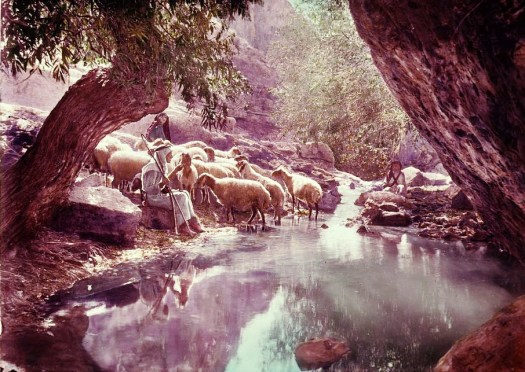
Image from the Library of Congress Prints and Photographs collection.

An old photographic slide of shepherd life taken in or around the Holy Land between about 1900-1920. It was one of a series illustrating Psalm 23.

The Greek word for ‘pastor’ (one of the gifts in Ephesians 4.11) is the closely related noun ‘shepherd’ (in Greek, poimēn). H.B. London writes, “I propose that one of the most important aspects of being a pastor is fulfilling the role of servant-shepherd. Next to being faithful to God and attentive to spouse and family is the pastor’s responsibility as shepherd—one who knows the flock, listens to the flock, watches out for the flock, cares for the flock, corrects the flock, and spends a great portion of time with the flock.” London’s brief article, available HERE, is very helpful and well worth reading.

But, as a postscript to London’s article, the pastoral ministry in a local church must extend beyond the one who holds the position of ‘pastor’. All elders of local churches should have a pastoral heart. Elders are to shepherd (the Greek verb poimainō) God’s flock (Acts 20.28, 1 Peter 5.1-2). And there may well be others in a local church besides the elders who have the Ephesians 4 gift of being a pastor.

And there is surely also a sense in which every member of a local church is to participate in this pastoral ministry at least to some degree. For example, we’re to teach and admonish one another (Colossians 3.16), encourage and build one another up (1 Thessalonians 5.11), bear one another’s burdens (Galatians 6.2); and love one another (for example, Romans 13.8, 1 Peter 1.22, 1 John 4.7).

CREDITS Unless otherwise indicated, all Scripture citations (other than those used in text that other authors have written) are from The Holy Bible, English Standard Version, published by HarperCollins Publishers. © 2001 by Crossway Bibles, a division of Good News Publishers. Used by permission. All rights reserved.

‘Exodus: understanding one of the Bible’s major themes’ by D.A. Carson

The Passing of the Jews through the Red Sea from Wikimedia

The Passing of the Jews through the Red Sea painted by Wilhelm Kotarbinski (1848-1921).

The Exodus from Egypt was the key saving event in Israel’s history (see, for example, Deuteronomy 4.32-40, 6.20–25, 1 Samuel 12.6–8, Psalm 105.26-45, Jeremiah 32:20–21).

An Ask Pastor John podcast on the Desiring God website featured guest Don Carson speaking about the Exodus. The podcast’s introducer writes, “The Exodus of God’s people out of Egypt is “the greatest redemptive event in the Old Testament”, says Don Carson. To let that sink in for a moment, imagine this: If our publishing age is marked by the cross, it is because the cross the shorthand for the death and resurrection of Christ. His cross marks the centerpiece of redemptive history. But before the cross there was the Exodus. And so if the world of publishing today talks about the cross-centered life, and the cross-centered church, it would seem that a fitting analogy would be to perhaps imagine Old Testament era saints to have been inspired to write and publish books on the Exodus-centered life and the Exodus-centered synagogue. It is a major key to understand the Old Testament, and it is a major key to unlocking the meaning of the entire Biblical plotline. To explain I called Dr. Don Carson.” Hear (or read) what Dr. Carson said HERE.

I have posted a study comparing the Egyptian Exodus with the greater Exodus accomplished by Jesus Christ HERE.

CREDITS Text in quotations © Desiring God Foundation.

‘4 reasons to preach the genealogies at Christmas (really!)’ by David Thommen

During the 1970s I spent a year in Zambia and occasionally visited Lusaka Baptist Church. There was a Bible class that I attended there, which still stands out in my memory. The class leader was Dr. Michael Eaton. The passage we were going to study that morning was Matthew 1.1-17 – Jesus’ genealogy. I can remember being a bit puzzled – what were we going to learn from this passage? It turned out – a very great deal. Dr Eaton’s masterly exposition opened up truths embedded Jesus’s genealogy in a way I had never seen before.

David Thommen clearly agrees about the importance of Jesus’ family tree. He writes, “I will never forget the zeal, the excitement, and the anticipation of my first Christmas sermon. . . . . . . . I wanted to preach something that I had never heard from the pulpit for Christmas, or any other time for that matter. . . . . When one of my elders asked me what I would be preaching on, I confidently proclaimed: “The genealogy from Matthew 1”. His response was different than I expected. “Why would you do that? You never preach the genealogies.” Convinced that all Scripture is profitable (2 Timothy 3.16-17), I soldiered forward undeterred. I pondered, in light of the rather unexpected response, why does the genealogy at the beginning of Matthew matter to the Christian at Christmas?” He shows us four reasons why it matters HERE.

‘Even Better than Eden’ video series by Nancy Guthrie

In her book, Even Better than Eden, (which I review HERE), Nancy Guthrie traces nine themes through the Bible – the wilderness, the tree, God’s image, clothing, the Bridegroom, the Sabbath, the offspring, the dwelling place, and the city. Essentially, what she gives us is a series of nine mini-overviews of the Bible story, each one tracing the story from the point of view of one of these key themes. Guthrie has now produced this same material in a series of nine videos. Session 8 – The Story of a Dwelling Place – can be watched free of charge on Vimeo, above. The complete set can be purchased as digital downloads HERE or on a flash drive HERE.

Nancy’s website page for this book is available HERE. Reproducible personal Bible study questions for personal or small group use (not the same as the discussion guide in the book itself) and a leader’s guide are available for purchase as downloads from this page.

This workshop on Even Better Than Eden: How the Bible’s Story Changes Everything About Your Story with Nancy Guthrie was recorded at The Gospel Coalition’s 2018 Women’s Conference in Indianapolis, Indiana:

Nancy Guthrie teaches the Bible at her church, Cornerstone Presbyterian Church in Franklin, Tennessee, and at conferences worldwide. She is the author or editor of a number of books, together with some video resources. She is also the host of Help Me Teach the Bible, a podcast of the Gospel Coalition.

‘The One True Story’ by Tim Chester

This daily reading book is subtitled Daily Readings for Advent from Genesis to Jesus. In his introduction, Tim Chester writes, “Everyone loves the Christmas story  . . . . But the Christmas story is not just a great story. It’s the great story. It’s the story that ties together a thousand other stories. . . . . The Christmas story is the one true story because it completes and fulfils all the stories of the Bible. But it also goes on being the one true story. This is the story that makes sense of my story and your story. We were made to know God. All our longings only truly find their fulfilment in him and through him. The plotlines of our lives are meant to find their resolution in the enjoyment of God. But we’ve set our lives on other trajectories which always lead to disappointing endings. But through the Christmas story God is rewriting the story of human history, bringing it to a glorious climax. In all the busyness of Christmas, don’t miss the opportunity to discover or rediscover how you can be part of the one true story.”

Each of the 24 chapters traces a theme from the Old Testament that finds its culmination in Jesus – for example, The new Adam, The dragon-slayer, The new ark, The rock, The anointed one, The good shepherd, and The end of exile. The chapters also explore how the Christmas story connects with our stories. Each chapter ends in a meditation, and a prayer. This book is packed with Biblical insights, and will provide a rich feast for meditation through the Advent season (or, for that matter, other times of the year, too). I can thoroughly recommend it.

Read the publisher’s description HERE

Tim Chester has also written two other Advent daily reading books: The One True Light: Daily Readings for Advent from the Gospel of John (read the publisher’s description HERE), and The One True Gift; Daily Readings for Advent to Encourage and Inspire (read the publisher’s description HERE).

‘Preaching Christ from the Old Testament’ by Sinclair B. Ferguson

Image from Lightstock

Dr Sinclair B. Ferguson asks, “. . . how do we legitimately preach the text of the Old Testament as those who stand on this side of Pentecost? What difference does it make to expound Genesis or Psalms as believers in Jesus Christ? Or, to put it in a more graphic way, how can we reconstruct the principles of Jesus’ conversation in Luke 24.25-27,45, and learn to follow his example of showing how all the Scriptures point to him so that hearts are ‘strangely warmed’ and begin to burn? . . . . Yet we must also preach the Scriptures without denuding them of the genuine historical events they record and the reality of the personal experiences they describe or to which they were originally addressed. How, then, do we preach Christ, and him crucified without leapfrogging over these historical realities as though the Old Testament Scriptures had no real significance for their own historical context?”

He explains, “. . . there are . . . very important principles that help us to develop Christ-centred expository skills. As we work with them, and as they percolate through our thinking and our approach to the Bible, they will help us develop the instinct to point people to Christ from the Old Testament Scriptures. The most general principle is one for which we might coin the expression fillfulment. Christ fulfils or ‘fills full’ the Old Testament. He came ‘not to abolish the Law or the Prophets but to fulfil them’ (Matthew 5.17). As Christians standing within the light of New Testament revelation and looking back on the Old Testament, Christ himself acts as a hermeneutical prism. Looking back through him, we see the white light of the unity of the truth of Jesus Christ broken down into its constituent colours in the pages of the Old Testament. Then, looking forwards we see how the multi-coloured strands of Old Testament revelation converge in him.  . . . . We want to develop an instinct to preach Christ. This is the general principle. But it can be broken down into at least four subordinate principles . . . .”

Dr Ferguson then explains these four principles. In his conclusion, he comments, “These are general principles; they do not constitute a simple formula, an elixir to be sprinkled on our sermons to transform them into the preaching of Christ. There is no formula that will do that. . . . . But as we come to know the Scriptures more intimately, as we see these patterns deeply embedded in the Bible, and—just as crucially—as we come to know Christ himself more intimately and to love him better, we shall surely develop the instinct to reason, explain and prove from all the Scriptures the riches of grace which are proclaimed in Jesus, the Christ, the Saviour of the world.”

Dr Ferguson’s article is instructive and stimulating, and worth taking time to read and to digest – and to apply.

It’s available in 10 parts from website of The Proclamation Trust. For part 1, click HERE; for part 2, click HERE; for part 3, click HERE; for part 4, click HERE; for part 5, click HERE; for part 6, click HERE; for part 7, click HERE; for part 8, click HERE; for part 9, click HERE; and for part 10, click HERE.

An earlier version of this article is available as a single webpage HERE (the online version in 10 parts available above is a later edited version).

‘Even Better than Eden: Nine Ways the Bible’s Story Changes Everything About Your Story’ by Nancy Guthrie

In her new book, Even Better than Eden: Nine Ways the Bible’s Story Changes Everything About Your Story, Nancy Guthrie traces nine themes through the Bible – the wilderness, the tree, God’s image, clothing, the Bridegroom, the Sabbath, the offspring, the dwelling place, and the city. Essentially, what she gives us is a series of nine mini-overviews of the Bible story, each one tracing the story from the point of view of one of these key themes. Each of these nine mini-overviews is just a chapter in length (in fact, the main text of the book is only 150 pages in length). Guthrie succeeds in her task brilliantly. Her writing is clear and engaging. Yet the book – despite the fact that it’s so accessible and easy to read – is also theologically rich.

Guthrie’s overall thrust is that God’s plan for His world is not simply to restore what was lost in Eden before the Fall. The new creation we read about on the final two chapters of Revelation will be far more glorious than the creation we see in the opening chapters of Genesis.

There’s a discussion guide at the end of the book, which gives questions for discussing the themes presented in each chapter. There are also endnotes to explain further and to support some of what she writes.

In the introduction, after talking a little about her own personal story, Guthrie writes, “There’s another story, a story that is found in the pages of the Bible—from the book of Genesis through the book of Revelation—that shapes and defines where I came from, why I am the way I am, what my life is like day to day, and what is ahead for me in the future. It is this story that explains my deepest joys as well as the empty places where contentment can be elusive. It is this story that explains my drive to be somebody and my sensitivity to feeling like a nobody. It explains what makes me cry and why I can laugh. This story explains my desire to look good, my craving for the good life, my longing for home and security, and much more.”Guthrie continues: “And whether you know it or not, this same grand story—the story found in the sixty-six books of the Bible—shapes the world you live in, who you are, and what you want too. That’s why you and I need to know this story. It is where we find the answers to our questions about what really matters now and into eternity. This story has the power to change everything about our stories.”

Scott R. Swain, President and James Woodrow Hassell Professor of Systematic Theology, Reformed Theological Seminary, Orlando, writes, “One of the weaknesses of much popular Christian teaching on the Bible is the tendency to read the story of the Bible in a circular manner, as if Jesus Christ came into the world to bring us back to Eden. Nancy Guthrie charts a better course in her book. In a manner that is profoundly biblical and deeply practical, she traces nine biblical themes along a common trajectory, from their beginning in God’s good creation, through their destruction and devastation by Adam’s sin, to the ways Christ perfects, consummates, and crowns each theme by means of his suffering and glory. Let Guthrie take you by the hand and lead you through the Bible to Jesus Christ, in whom we find a better provision, a better life, a better identity, a better rest, a better wardrobe, a better spouse, a better savior, a better sanctuary, and a better city than this world in its present state could or would afford.”

Read the publisher’s description HERE. Download an excerpt HERE.

Nancy’s website page for this book is available HERE. Reproducible personal Bible study questions for personal or small group use (not the same as the discussion guide in the book itself) and a leader’s guide are available for purchase as downloads from this page.

A nine-session video version of Even Better Than Eden is also available – click HERE for more information and to view one of the sessions free of charge.

This workshop on Even Better Than Eden: How the Bible’s Story Changes Everything About Your Story with Nancy Guthrie was recorded at The Gospel Coalition’s 2018 Women’s Conference in Indianapolis, Indiana:

Nancy Guthrie teaches the Bible at her church, Cornerstone Presbyterian Church in Franklin, Tennessee, and at conferences worldwide. She is the author or editor of a number of books, together with some video resources. She is also the host of Help Me Teach the Bible, a podcast of the Gospel Coalition.