In this part― the penultimate part of this reader’s guide―we cover chapters 17 to 20. We see how God destroys, step by step, all the structures and forces of evil: firstly Babylon (symbolising mankind’s godless civilisation under Satan’s domination), then the beast and the false prophet, and finally Satan himself. But alongside these scenes of judgment and destruction, we see God’s people, ready to marry Jesus Christ, and coming to life and reigning with Him for a thousand years. Click HERE to read more, and to download the 4-page introduction and the 16-page reader’s guide to this section of Revelation.
The Lamb is the Lord, part 4: Crashing Waves of Judgment Introduction and Questions
This is part 4 of a 7-part reader’s guide to the Book of Revelation. For parts 1 to 3, click HERE and follow the links given there. Parts 5 to 7 will be published in the next few weeks.
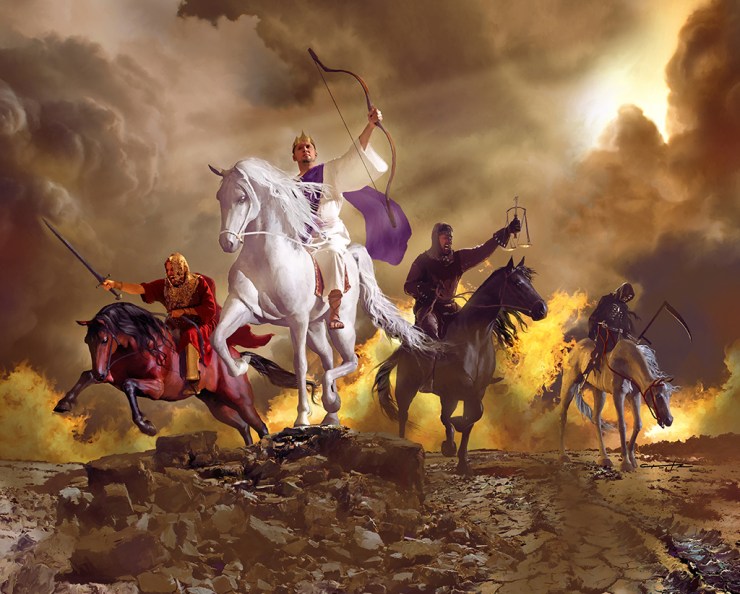
An artist’s depiction of the four horsemen who bring the judgments unleashed by the opening of the first four seals of the scroll (Revelation 5:1-8)―the ‘four horsemen of the apocalypse’.
Click the icon below to download a 4-page PDF of this page.
Click the icon below to download a 16-page Reader’s Guide This explores Revelation 6:1-11:19, 15:1 and 15:5-16:21 in more detail.
Three sets of seven judgments
We now arrive at perhaps the most challenging―and at times, disturbing―section of Revelation. Perhaps this is the section of the course you’ve been anticipating most!
The Lamb begins to open the scroll―the scroll He took “from the right hand of him who was seated on the throne” (Revelation 5:7). Three series of seven judgments sweep across the Earth. The first set is heralded by the opening of the seals (6:1-17, 8:1,3-5); the second by the blowing of seven trumpets (8:2, 8:6-9:21), and the third by the emptying of seven bowls (15:1, 15:5-16:21).
This is a new series covering the key events and themes of the Bible, together with many of the key doctrines of the Christian faith.
The series aims to be a simple but reasonably comprehensive teaching tool for new Christians; it could also serve as a refresher for those who’ve been Christians for many years. It’s a scaled-down and revised adaptation of The Big Journey series featured in this website.
The text is supplemented by numerous illustrations, and each step ends with one or more Bible passages and questions to think about.
The 52 Steps series is suitable for personal reading and small group study; it could also serve as a discipleship resource for a whole church. It could be used weekly to span a complete year; it might also be used as a daily reading over a period of between 7 and 8 weeks. It was, in fact, used by the church my wife and I attend here in Leicestershire, England―Harborough Community Church; it was distributed in the weekly emailed church newsletter.
Click HERE to see the introduction to the series; click HERE to view the contents and outline of each of the 52 steps.
This is an offer not to be missed! Starting today, January 1 and running through January 8, Crossway+ members can purchase ebooks and audiobooks for up to 90% off (with some exclusions): ebooks and audiobooks priced $29.99 or less are $2.99; ebooks and audiobooks priced $30–$59.99 are $4.99, and ebooks and audiobooks priced $60–$99.99 are $6.99. Click HERE for details.
There are also two free resources available, a free ebook and a free audiobook. There’s no limit to how many ebooks and audiobooks you can purchase through this offer.
This offer is open to members of the Crossway+ scheme. Anyone can join the Crossway+ scheme for free. And the offer is not only for existing members of this scheme―you can join now to take advantage of the offer. Read about the Crossway+ scheme, and sign up for free membership of the scheme HERE. When you join the Crossway+ scheme, you can, for example, purchase ebooks and audiobooks at half price. You will also occasionally receive access to special offers on select Crossway resources via email―and this special offer is one such example.
There is significant benefit to buying ebooks from Crossway that only a few publishers offer. If you buy the ebook, you usually (but not always) get the book in all three formats―PDF, epub and mobi. And the PDFs can be printed―this format doesn’t have printing disabled. This gives all the advantages that the ebook offers (such as searchability), with the opportunity, if you wish, to print a copy to read offline.
Click the icon below to download a 4-page PDF of this page.
Click the icon below to download a 16-page Reader’s Guide This introduces the Book of Revelation and explores Revelation 1:1-20 in more detail.
Introduction
This is the first of a seven-part series on the Book of Revelation. We’ll trace Revelation’s storyline and themes. We’ll explore its symbolism and imagery. And we’ll see what God is saying to us believers as we follow Jesus day by day.
The word ‘Revelation’ is apocalupsis in Greek―from which we get our word ‘apocalyptic’. This Greek word means ‘an uncovering’, ‘an unveiling’. In the Book of Revelation, Jesus unveils what’s really going on in Heaven and on Earth, and where human history is heading.
God’s perspective on history
There’s a famous photograph that’s entitled ‘Earthrise’ (see above). It was taken by an Apollo 8 crewmember in 1968, while in orbit around the Moon. These men were the very first humans who saw Earth as viewed from the Moon. It gave them―and all humanity―a completely new perspective on our planet.
‘Earthrise’―Earth above the lunar horizon. This image was taken by Apollo 8 crewmember Bill Anders on December 24, 1968, while in orbit around the Moon.
Likewise, in Revelation, God gives us a new perspective―a heavenly perspective, God’s perspective. Christ is seated “in the heavenly places” (Ephesians 1:20). We’re seated there with Him (Ephesians 2:6). We need to view everything from that viewpoint―a heavenly viewpoint. And that’s the perspective Revelation gives us.
Here is a new song written by Bob Kauflin and Tim Chester, with a small team of others. It’s based on Psalm 91, which begins, “He who dwells in the shelter of the Most High will abide in the shadow of the Almighty. I will say to the LORD, “My refuge and my fortress, my God, in whom I trust.”” (Psalm 91:1-2). The song’s strong theology, combined with its tuneful and singable melody, make it ideal for congregational singing. Bob Kauflin writes: “Christ Will Be My Hideaway is a congregational song for a pandemic or any time really. It’s based on Psalm 91, which is filled with encouraging, soul-strengthening promises from God that lift our eyes above our circumstances to see his providential, wise, powerful care.” The video below is a version that may be useful for online church gatherings:
Click HERE for Bob Kauflin’s blog post about this song, where you can find the lyrics, chord chart and lead sheet. Click HERE for Tim Chester’s blog post.
This is the season when some of us may be beginning Bible reading plans for the coming year. But why do so many of us struggle to enjoy our Bibles consistently? In this short video, Dr Peter Mead gives us seven simple and helpful guidelines for feasting on God’s word, the Bible.
In four series of short videos, Peter Mead takes us through seven basic principles that will help us to understand and learn from the Bible. He applies these seven principles as he guides us through the books of Ruth, Titus and Jonah, and the book of Psalms (taking Psalms 3-8 and 11 as examples). The series on the Psalms also includes four additional videos, entitled Why Did God Give Us Psalms?, Real Truth in a World of Lies, Real Hurt, and The Psalms and Jesus. Peter’s aim is to enable these seven principles to become part of the way we approach the Scriptures and feast on its riches. He says, “My aim, my goal, my prayer is that as you look at God’s word, spending time studying it, thinking about it, applying these principles, . . . you’ll get to know Him better, . . . you’ll be stirred to love him more, and . . . you’ll find yourself feasting on God’s word.” The video below is the introduction to the whole series:
Here are the first videos in each of the four series, on the books of Ruth, Titus, Jonah, and Psalms respectively. At the top of each video, to the right-hand side, there’s a menu icon (the one with three horizontal lines and an arrow). Click this menu icon to access the complete playlist for that series.
Dr Peter Mead is the director of Cor Deo, a ministry training programme in Chippenham, England. He is also part of the leadership team of Trinity Chippenham, a church Peter helped to plant back in 2014. Peter is a lecturer for Union School of Theology. He studied at Multnomah Biblical Seminary before getting his Doctor of Ministry degree under Haddon Robinson at Gordon-Conwell Theological Seminary in the area of expository preaching. Peter is the author of a number of books, including The Little Him Book, Pleased to Dwell, Lost in Wonder, and Foundations. He is also the author of the preaching blog BiblicalPreaching.net.
Have you ever wondered why Jesus’ birth was announced to shepherds? In his commentary on Luke’s Gospel, I. Howard Marshall writes, “the motif that God reveals the birth of the Saviour to ordinary, lowly people, is undoubtedly present.” God’s angelic army announced the Saviour’s birth to humble shepherds, not to those of wealth and status. But there are two other possible reasons why shepherds were privileged with the news of the Saviour’s birth. Read the whole article HERE.
In his book, ‘A Not-So-Silent Night: the Unheard story of Christmas and Why It Matters’ Verlyn D. Verbrugge writes, “One of the most familiar elements of the Christmas story in Luke 2 is the appearance of the angel to the shepherds. That angel was soon joined by a “great company of the heavenly host . . . praising God and saying, ‘Glory to God in the highest, and on earth peace to men on whom his favor rests’” (Luke 2.13– 14 NIV). . . . . The word that Luke uses for “host” is the Greek word ‘stratia’, a word that in classical Greek almost invariably denotes an army or a company of soldiers. On occasion the word could be used as an alternate for the Greek word ‘strateia’, which denotes a military expedition. In either case, the word has strong military connotations.” But why is this military connation significant? Read the whole article HERE.
Dr. Ian Paul writes, “. . . Jesus wasn’t born in a stable, and, curiously, the New Testament hardly even hints that this might have been the case. So where has the idea come from?” Dr Paul tells us why oxen and asses are traditionally placed in the nativity scene. He explains the meanings of the Greek word in Luke 2.7 that’s translated “inn” in the ESV and the King James Version (but translated “guest room” in the NIV). And he takes us back to the first-century setting of the narrative, including the culture of the time and the actual design of Palestinian homes. Dr Paul draws on resources by other writers and provides links to two sermons, one by himself, another by Stephen Kuhrt, that retell the Christmas story in way that is faithful to its first-century Palestinian background. Read the whole article HERE.
Have you ever studied – or preached on – one of Jesus’ genealogies? David Thommen has. He writes, “I will never forget the zeal, the excitement, and the anticipation of my first Christmas sermon. . . . . . . . I wanted to preach something that I had never heard from the pulpit for Christmas, or any other time for that matter. . . . . When one of my elders asked me what I would be preaching on, I confidently proclaimed: “The genealogy from Matthew 1”. His response was different than I expected. “Why would you do that? You never preach the genealogies.” Convinced that all Scripture is profitable (2 Timothy 3.16-17), I soldiered forward undeterred. I pondered, in light of the rather unexpected response, why does the genealogy at the beginning of Matthew matter to the Christian at Christmas?” He shows us four reasons why it matters. Read the whole article HERE.
How contemporary worship music is shaping us—for better or worse Matt Merker writes, “Now that contemporary worship music has become not only a major feature of evangelical identity in North America but also a multimillion-dollar industry, it’s worth asking an often neglected question: How does contemporary worship music shape us? Monique Ingalls, assistant professor of music at Baylor University, tackles this question in her book, Singing the Congregation: How Contemporary Worship Music Forms Evangelical Community. . . . . Rather than proceed with a traditional book review, it may be more useful to my readers to share some ways in which Ingalls’s work has prompted my own thinking. So here are four areas of reflection, which I invite you to consider with me.”
Christian life: learning from the Battle of the Atlantic – we can only win the spiritual battle if we fight for our devotional life John Stevens writes, “I have just finished reading Jonathan Dimbleby’s excellent book The Battle of the Atlantic . . . . . . . . The Battle of the Atlantic was the unsung campaign of the war. . . . . There were few dashing heroes and much hard slog. But it was the crucial battle, because every other battle depended upon it. We need to make sure that we fight the crucial battle to maintain our spiritual health and vitality if we are to prevail in the spiritual war in which we find ourselves.”
Typology: what it is and why we need it David Schrock writes, “. . . Christians going back to the early church have rightly seen (and looked for) ‘types’ of Christ in the Old Testament. But at the same time, questions have arisen to ask: What is a type? That is the question I want to answer today in broad and simple strokes. . . . . for those just getting acquainted with the idea, I want to introduce typology as simply as I can.”
5 lessons Jordan Peterson has taught the Church Esther O’Reilly writes, “A year ago, I had no idea who Jordan Peterson was. . . . . As I watched Peterson’s status rocket rise, it became a social experiment in itself to watch how Christians reacted to it all. It seemed that they either really, really liked Peterson or really, really did not like him.” She asks, “Is Peterson getting something right that the Church has been getting wrong? It’s easy to run down a list of things Jordan Peterson could learn from the Church. But could the Church learn something from Jordan Peterson? Bearing in mind that The Church is not a monolith, and thus any attempt to answer these questions will over-simplify, I think the answer is yes. I didn’t come up with twelve rules, but here are five.”
God’s metrics Nick Batzig comments, “God’s metrics are not our metrics. The way in which we seek to measure fruitfulness and faithfulness is often quite skewed.” He asks, “What ought a faithful ministry look like?”
Matt Merker writes, “Now that contemporary worship music has become not only a major feature of evangelical identity in North America but also a multimillion-dollar industry, it’s worth asking an often neglected question: How does contemporary worship music shape us? Monique Ingalls, assistant professor of music at Baylor University, tackles this question in her book, Singing the Congregation: How Contemporary Worship Music Forms Evangelical Community. Focusing on the decade from 2007 to 2017, she examines modern praise through sociological lenses.”
He comments, “. . . the main value of Singing the Congregation is its thorough description of the world that contemporary worship music has created. For that reason, even if musicology is a new field for you, I recommend this book to pastors, worship leaders, and anyone else with an interest in the modern worship movement—fans and critics alike. . . . . Ingalls’s focus is on worship music as sociological phenomenon, so there is little here in the way of theological interaction with worship lyrics. Still, Ingalls’s in-depth account of how contemporary worship shapes evangelical life proves the axiom that ‘the medium is the message’. In other words, contemporary worship music not only reflects evangelical values and convictions about how to engage with God, it also profoundly influences those values and convictions. . . . . Rather than proceed with a traditional book review, it may be more useful to my readers to share some ways in which Ingalls’s work has prompted my own thinking. So here are four areas of reflection, which I invite you to consider with me.”
Read the whole article HERE. Matt Merker serves as an elder and pastoral assistant at Capitol Hill Baptist Church in Washington, D.C. He writes congregational hymns, including He Will Hold Me Fast. His music website is HERE.
John Stevens writes, “I have just finished reading Jonathan Dimbleby’s excellent book The Battle of the Atlantic which I received as a Christmas present. He makes a compelling case that the battle to defeat the U-boat menace in the North Atlantic was the most important campaign in the Second World War, since it ensured the supply of food, fuel, raw materials and arms to the UK and Russia. . . . . However, despite the crucial importance of this “battle” – which was really a sustained four-year campaign – it does not receive the attention given to other allied victories such as the Battle of Britain, or El Alamein.”
Stevens applies this to our Christian walk. He comments, “The Battle of the Atlantic is a reminder to us that some battles are ultimately more important than others. Offensive warfare cannot be maintained unless the supply lines on which it depends are maintained. . . . . The Battle of the Atlantic was the unsung campaign of the war. . . . . There were few dashing heroes and much hard slog. But it was the crucial battle, because every other battle depended upon it. We need to make sure that we fight the crucial battle to maintain our spiritual health and vitality if we are to prevail in the spiritual war in which we find ourselves. If you have neglected your personal devotional life and church commitment take drastic action now.”
David Schrock writes, “In yesterday’s sermon on Numbers 20, we ran into something known as typology. As it has been variously defined in church history, typology occurs in the Bible when an historical person, event, or institution—in this case a water-giving rock—foreshadows the coming Son of God. As with Exodus 17, this life-giving, water-streaming rock is a type of Christ, at least according to the apostle Paul. Writing in 1 Corinthians 10, Paul recounts a number of events in Israel’s history (see vv. 1–13), including this rock. . . . . . . . Paul makes the stunning claim that the Rock was to be identified with the Lord, and since Christ is the Lord (cf. 1 Corinthians 8:6), the Rock is to be identified with Christ. Two verses later, he adds, “Now these things took place as examples (typoi) for us, that we might not desire evil as they did” (v. 6). Most versions rightly translate typoi as “examples” but you can see from the Greek word that the examples Paul has in mind were types, a word he uses elsewhere to relate Adam and Christ (Rom 5:14), a word Peter uses to speak of Noah’s baptism (1 Peter 3:21), and a word used in Hebrews to relate the tabernacle on earth with the one in heaven (Hebrews 8:5).”
Dr. Schrock continues, “On the basis of passages like these, Christians going back to the early church have rightly seen (and looked for) ‘types’ of Christ in the Old Testament. But at the same time, questions have arisen to ask: What is a type? That is the question I want to answer today in broad and simple strokes. . . . for those just getting acquainted with the idea, I want to introduce typology as simply as I can.”
Esther O’Reilly writes, “A year ago, I had no idea who Jordan Peterson was. Like many people, I got my first inkling after That Debate went viral. I was entertained, but I didn’t understand what I was watching. If you had told me then that this Canadian psychology professor was embarked on nothing less than a decades-long quest to rescue Western Civilization from the pit of nihilistic despair, I would have assumed you were joking. But Jordan Peterson, it seems, was not. As I watched Peterson’s status rocket rise, it became a social experiment in itself to watch how Christians reacted to it all. It seemed that they either really, really liked Peterson or really, really did not like him. . . . . Fortunately, some Christian engagements were balanced and thoughtful.” O’Reilly provides links to a number of commentaries by Christians on Jordan Peterson that she especially enjoyed. She makes special mention of Paul VanderKlay, a pastor who, she says, has “attained a level of understanding that the bite-sized book reviews and quick takes I’ve seen can’t touch.”
O’Reilly comments, “It is a myth that all of Peterson’s fans are young men, angry or otherwise. . . . . However, young men—particularly quirky, introverted, intellectually curious young men—do form a large percentage of his base. It hasn’t escaped people’s notice that this is precisely the demographic the Church has not been reaching, or worse, has been losing. Yet VanderKlay has said in interviews that he “could not have asked for a better men’s ministry” than the influx of men he has been regularly meeting to discuss Peterson’s work and its religious connotations. Men who would never attend a Bible study are suddenly beating down Paul’s virtual and real-life door to have conversations about God, Jesus and the Bible.”
O’Reilly asks, “Is Peterson getting something right that the Church has been getting wrong? It’s easy to run down a list of things Jordan Peterson could learn from the Church. But could the Church learn something from Jordan Peterson? Bearing in mind that The Church is not a monolith, and thus any attempt to answer these questions will over-simplify, I think the answer is yes. I didn’t come up with twelve rules, but here are five.”
O’Reilly’s points out five imperatives demanding the Church’s attention today. By way of example, one point she makes concerns teaching in the local church. She points out that the Church ”must satisfy the intellectually curious”. In her discussion of this, she says, “The Bible says we are to love God not only with our hearts but with our minds. Church should equip us to do both. The intellectually hungry should not go away unfed. Bible studies should not offer milk when people are silently begging for meat. Pastors should be well-read, not only in theology but in great literature, in poetry, in history. Highly educated church members with the gift of teaching should be connected with young people craving what their anemic public educations are not giving them.”
Nick Batzig writes, “God’s metrics are not our metrics. The way in which we seek to measure fruitfulness and faithfulness is often quite skewed. . . . . The fruitfulness of a Gospel ministry is never observed in total in the here and now. . . . . While the fruit may not always be evident in the here and now, Paul insisted that there is a day coming when “each one will receive his own reward according to his own labor”. What ought a faithful ministry look like?”
Batzig comments, “. . . those who are faithful will build with the persistent preaching of Christ crucified, sound doctrine, prayer, the sacraments, church discipline, a loving and holy Christian community and biblical worship and evangelism. . . . . It’s easy for those laboring faithfully to become discouraged when they look over at other churches and see how much more quickly they seem to have grown. It is much more difficult for them to remember that everything is merely scaffolding; and, one day God will reveal what sort of materials were used in the building.”
This is a superb hymn written by Stuart Townend and Keith Getty. Townend writes, “The song paints the picture of that Good Friday when Christ was tried, beaten, nailed to a cross, suffered and died, and the chorus tries to explain the significance of it all. Then the last verse effectively paints us into that picture, for it is our name written in His wounds.” The lyrics and other information are available on Stuart Townend’s website page for this hymn HERE.







 Creation to New Creation - a Bible Overview
