Read Scripture videos by The Bible Project – a great resource for teaching the Bible

The Bible Project has produced (among many other resources) a series of 71 short videos, named Read Scripture, that take you right through the Bible. They’re are a wonderful tool for teaching the Bible story – snappy, engaging, visually impacting, and theologically astute. And they’re all free – as is everything produced by The Bible Project.

These Read Scripture videos are suitable for teenagers as well as adults. They’re a great introduction to the Bible story that you could use with your family, your small group, or your whole church. I first encountered one of these videos at a church service where the preacher used the video to introduce a sermon series on the Book of Numbers. It was a brilliant way to begin that series.

Here’s the Read Scripture video on Genesis chapters 1 to11:

Other resources related to this video on Genesis 1-11 from The Bible Project are available HERE

The full set of Read Scripture videos for the Old Testament are available HERE.

Here’s the Read Scripture video on Matthew chapters 1 to 13:

Other resources related to this video on Matthew 1-13 from The Bible Project are available HERE

The full set of videos for the New Testament are available HERE.

The Bible Project is a non-profit animation studio that produces short, animated videos, podcasts, and study guides that explore the Bible’s unified story. They focus on the Bible’s overarching themes and each book’s literary design, and they are committed to understanding the Bible in its historical context. To find out more about The Bible Project, click HERE.

God’s Big Picture by Vaughan Roberts – a series of 10 brief videos taking you through the Bible


God’s Big Picture: A Short Intro


https://youtu.be/pD2kq9cSw2Y

Vaughan Roberts explains the course in 45 seconds!

The God’s Big Picture Bible overview course traces the story of the whole Bible from Genesis to Revelation to see how it all fits together, telling of God’s wonderful plan to save the world through Jesus Christ.

Each of the 9 units consists of a 10 minute video followed by an hour long Bible study which you could do in a group at church or by yourself at home. The entire course is free to download at Clayton TV.

Click HERE to download this intro video and click HERE to download a short printable guide How to Use God’s Big Picture.

Click HERE to download the whole course (all videos and printable material). At average download speed (10Mbps) this could take up to half an hour.

The course is taught by Vaughan Roberts, author of the best selling book of the same name, which I review HERE). This book is highly recommended for anyone wanting to dig deeper into the Bible and understand its storyline.


Unit 1: The Pattern of the Kingdom


https://youtu.be/fFtwtcXEF1w

God’s people, in God’s place, under his rule and blessing- that’s how it all starts . . .

The Bible isn’t just a random collection of books but one connected story and it is vital to understand it in that context. This first video explains that the Bible has one author: God, one subject: Jesus Christ and one overarching theme: God’s plan to save the world through his son Jesus Christ.

We begin to look at this unfolding story in Genesis, the first book of the Bible, which sets up the pattern of God’s kingdom that we will trace through the rest of the units. We see that in God’s perfect created order, God’s People, Adam and Eve, live in God’s Place, the Garden of Eden, and enjoy his Rule and Blessing. In this creation the relationships between God and mankind, man and woman and mankind and creation are perfect, just as they were supposed to be. But it doesn’t last long . . . .

Click HERE to download this unit’s video, and HERE to download this unit’s printables (talk outline and bible study materials).


Unit 2: The Perished Kingdom


https://youtu.be/9xkZwrgPbNA

An evil snake, two foolish rebels and then judgment, murder and death . . .

God’s perfect creation is all too quickly ruined. In this episode we consider the question of evil, the tactics of the Devil who wants people to distrust and disobey God and the sinfulness of human hearts.

As we read more of Genesis we see that God’s people, Adam and Eve, disobey God, reject his rule and suffer the dire consequences. Once they have turned their back on God he must turn his back on them. Relationships are broken and God’s people suffer the just curses of a fallen world. Sin and death infect the whole of creation. God’s people deserve judgment but in God’s grace this isn’t where the story ends . . .

Click HERE to download this unit’s video, and HERE to download this unit’s printables (talk outline and bible study materials).


Unit 3: The Promised Kingdom


https://youtu.be/xvBVDFbp8Ac

God’s eternal plan to fix his broken world; shafts of light in the darkness of sin; and then a promise to one man that would set the agenda for the rest of history . . .

It looks like it’s all gone wrong but in unit 3 we learn that God has an eternal plan to save his people and restore his perfect creation. Reading on in Genesis we see that God, in his amazing grace, is going to send a saviour to rescue his fallen people. He then makes a foundational covenant or promise with one man, Abraham, which has implications for the rest of history. God promises to make himself a people through Abraham, to bring his people to a place and to bless them. As we see more of human sin and weakness we also see more and more of God’s grace and we realise God’s people cannot save themselves. Only God can save.

But questions abound. . . . How will he make a people from an elderly, barren couple? Where is this land? And how can he restore the perfect relationships of creation?

Click HERE to download this unit’s video, and HERE to download this unit’s printables (talk outline and bible study materials).


Unit 4: The Partial Kingdom – People, Rule and Blessing


https://youtu.be/N7lQcs0TtBM

A million slaves rescued, a face off between God and Pharaoh, and a nation is born . . .

God’s covenant promises of unit 3 are beginning to be worked out. In Genesis 12 – Exodus 18 we see how God begins to make a people for himself by miraculously granting Abraham and Sarah children and then many descendants. We see again and again that evil, unworthy persons become God’s people and it becomes clear that it is God who saves and that no man can boast.

We see how God rescues his people from slavery in Egypt by substitution, by conquest and by defeating their enemies. Once freed from slavery God begins to bless his people by giving them his law and by living amongst them. Things are begining to look up, but there is much more to be fulfilled.

Click HERE to download this unit’s video, and HERE to download this unit’s printables (talk outline and bible study materials).


Unit 5: The Partial Kingdom – Place and King


https://youtu.be/v2Z_vnnE0Rw

A million lives lost in the desert, the farewell speech of a dying man, and then battles, chaos and coronations . . .

Having seen the ‘people’ and ‘blessing’ promises partially fulfilled we’re now looking out for the promsie of ‘land’ to be fulfilled.

But, because of further disobedience, we read in the book of Numbers that God’s people are delayed forty years in getting into the land he has promised them. Once in the land things don’t get much better: the nation descends into a cycle of sin, judgment and grace. God provides judges to rule his people.

Perhaps God’s people would do better if they had a king to rule over them? In 1 Samuel – 2 Chronicles God’s promise of a king is seemingly fulfilled by Saul, David and then Solomon. The last two kings bring great periods of peace and prosperity to Israel, but ultimately each one fails to bring the everlasting peace and kingdom that God has promised. We conclude that these partially fulfilled promises must be pointing to something greater.

Click HERE to download this unit’s video, and HERE to download this unit’s printables (talk outline and bible study materials).


Unit 6: The Prophesied Kingdom


https://youtu.be/1C574uH_qBQ

A disastrous line of idolatrous kings, the catastrophic destruction of God’s kingdom, and admist the rubble, new shoots of hope . . .

Israel’s history takes a downward turn as the people continue to disobey. They are exiled from the promised land, they become a scattered fragmented people and are left facing God’s judgment rather than blessing. But in his grace God sends prophets to speak his word to his people and enforce his covenant.

This unit maps the various prophets found in the Old Testament, all bringing a message of judgment and hope. Speaking God’s words and not their own, the prophets stress that God’s people will face judgment if they continue to disobey, but the prophets also bring a wonderful message of hope: God will keep his promise to bless his people. Most excitingly they prophesy of a new hope and a glorious, perfect King who will rule God’s people forever – that is of course, Jesus Christ. We’re left at the end of this unit eagerly looking for the arrival of true God’s King.

Click HERE to download this unit’s video, and HERE to download this unit’s printables (talk outline and bible study materials).


Unit 7: The Present Kingdom


https://youtu.be/XMIw8WWefCI

The promised king has finally come and nothing will ever be the same again . . .

Finally all of God’s promises are fulfilled! Here we truly see how the whole of the Bible fits together. God’s promised king arrives to save God’s people – Jesus is born. This unit shows how each of the four gospels (Matthew, Mark, Luke and John) give complementary accounts of Jesus’ life and teachings, each concluding that Jesus is the Messiah, the saviour of God’s people and the fulfilment of all the Old Testament promises. We see how Jesus is God’s people, place, rule and blessing and what each of these promises means for the believer.

Most importantly this unit describes the way in which Jesus saves God’s people through substitution, by taking the punishment they deserve, so that God’s people can be restored to perfect relationship with him. There is a tension that remains however because the presence of sin remains . . .

Click HERE to download this unit’s video, and HERE to download this unit’s printables (talk outline and bible study materials).


Unit 8: The Proclaimed Kingdom


https://youtu.be/7l_xuFLjKJE

How can a kingdom be both now and not yet? Why doesn’t the king just come back? And who is the Holy Spirit? . . .

Jesus’ kingdom is both ‘now’ and ‘not yet’. This unit explains that we live in the ‘last days’ between Jesus’ first and second comings. God is patiently waiting for more people to come into his kingdom before he sends Jesus back to wrap everything up. As we move on to the book of Acts we see that to accomplish the task of making a great people for himself God sends his Holy Spirit into Christians so they can tell others of Jesus.

We learn that the Holy Spirit brings about new birth, he equips believers to serve Christ and he produces holiness. Though believers have been wonderfully saved God does not promise an easy life now, rather suffering is to be expected. Believers are to persevere in holiness and in spreading the gospel, by looking forward to the glorious, eternal future when sin and death will be no more.

Click HERE to download this unit’s video, and HERE to download this unit’s printables (talk outline and bible study materials).


Unit 9: The Perfected Kingdom


https://youtu.be/7ExQ10mzafA

A curtain is drawn back to reveal the truth behind human history and our king, slain but now triumphant ushers in a whole new world . . .

The end of evil and the beginning of eternity: the final book of the Bible, Revelation, is a series of visions given to the apostle John which conveys a message through symbols to strengthen believers.

There is a vision of a lamb on a throne in Heaven which encourages believers to know that though this world is full of evil there is someone in charge, Jesus, who gave his life for his people. Next there is a series of visions of seals, trumpets and bowls which depict the warmongering, economic instability and death that will mark every age until Christ returns. Then there is the final judgment when all evil and opposition to God will be totally and finally destroyed. And finally, there is the glorious picture of the new creation; God’s perfect kingdom where there will be no sin, or sadness or death.

We see how God’s promise to Abraham is fully and finally fulfilled: God’s people from all nations will live in God’s place, the new creation, and enjoy his rule and the blessing of his presence eternally. So we pray ‘Come Lord Jesus’ and while we wait ask for ‘the grace of the Lord be with God’s people Amen’.

Click HERE to download this unit’s video,and HERE to download this unit’s printables (talk outline and bible study materials).

Egypt’s Exodus and ours

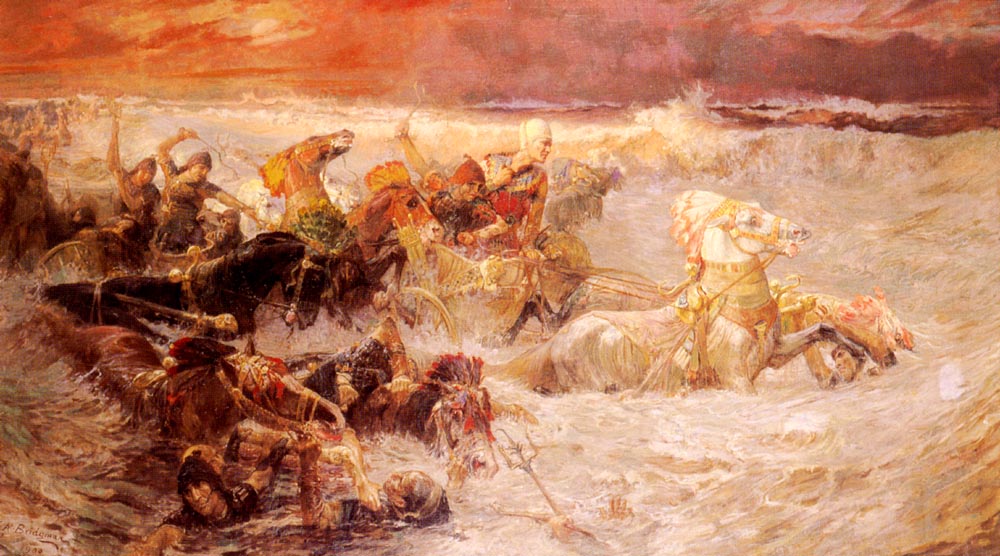
Pharaoh’s Army Engulfed by the Red Sea

Image from by Wikimedia Public domain

‘Pharaoh’s army engulfed by the Red Sea’, by Frederick Arthur Bridgman (1847-1928)

The Exodus is a foundational theme in the Bible. God delivered His people Israel from Egypt through an Exodus. Jesus, too, saves people through an Exodus.

The Exodus from Egypt was the key saving event in Israel’s history (see, for example, Deuteronomy 4.32-40, 6.20–25, 1 Samuel 12.6–8, Psalm 105.26-45, Jeremiah 32:20–21). But the prophets told God’s people there would be another Exodus. That second Exodus was – at one level – fulfilled in the return from Exile. But the prophets also saw another Exodus – an Exodus more far-reaching than the return to the Promised Land, an Exodus that would eclipse even the Exodus from Egypt.

This new Exodus is prophesied in a number of places (for example Isaiah 11.10-16 and Isaiah 43.14-21). God was going to rescue people from a slavemaster far worse than the Egyptians. He was going to rescue them from bondage to sin and Satan. That Exodus would be accomplished by the Messiah, Jesus Christ. The Messiah would deliver people from sin and Satan through His death, resurrection and ascension to His Father in heaven.

The first Exodus


It was preceded by a sacrifice

Before the Exodus, Passover sacrifices were to be offered (Exodus 12.1-14,21-27,43-49). The Passover animals (lambs or young goats) died; the Israelites’ firstborn sons were spared. The Passover animals died instead of the firstborn, who collectively represented all Israel.

That sacrifice formed the main part of a meal. This meal – the Passover meal – affirmed the covenant relationship between God and His people. It was a covenant meal. Israel was to celebrate the Passover every year.

It was a baptism

The first Exodus was a baptism. Paul writes: “all were baptized into Moses in the cloud and in the sea” (1 Corinthians 10.2).

It released Israel from bondage

Through the first Exodus God delivered Israel from bondage in Egypt. The pursuing Egyptians perished in the overflowing waters.

It was a new creation – it brought a nation into being

At the Passover and Exodus, God’s people Israel were born. It was their birthday. For the very first time, we read of “all the congregation of Israel” and “the whole assembly of the congregation of Israel” (Exodus 12.3,6). Accordingly, God appointed the month in which Passover occurred as the first month of their calendar year (Exodus 12.2). Just as every year we celebrate our birthdays, God’s people celebrated their national birthday annually at the feast of Passover and Unleavened Bread (see Exodus 12.14,17,24-27).

In Isaiah 43.1,7 Isaiah prophesies about how God brought His people into existence – and he does so using creation language that echoes Genesis 1 and 2. God “created” , “formed” and “made” His people. These are the three words used to describe God’s creation of mankind. In Genesis 1.26, God said “Let us make man . . . .” ; in the following verse, we read “So God created man . . . .” and in Genesis 2.7, “the Lord God formed the man . . . .” . Israel was a new creation, a new mankind made in His image, made to live in fellowship with Him, created for His glory.

There are links, too, between the Exodus and the original creation. God sent a “wind” (Hebrew rûach) over the sea (Exodus 14.21). This reminds us of how His Spirit (Hebrew rûach) moved over the Earth at the beginning (Genesis 1.2). Dry land appears where once there was sea – reminding us of the appearance of the dry land recorded in Genesis 1.9-10). The light and darkness (Exodus 14.20) reminds us of God dividing the light from the darkness on the first creation day (Genesis 1.3-5). God was creating again. God was creating a new people, and He was going to bring them into a new Eden – the Promised Land.

The second Exodus

Just as Moses led God’s people through the first Exodus, so Jesus the Messiah takes people through a second Exodus.

It was accomplished by a sacrifice

At His transfiguration, Jesus talked with Moses and Elijah about His “his departure, which he was about to accomplish at Jerusalem” (Luke 9.31). The word “departure” here translates the Greek word exodos. Jesus’ Exodus was His death and resurrection – with the emphasis on His death.

Before the first Exodus, Passover animals were sacrificed. Our Exodus happened because of a sacrifice – the sacrificial death of our Passover Lamb, Jesus (1 Corinthians 5.7).

The first Exodus was preceded by a meal. Jesus’ Exodus was preceded by a meal, too – the Last Supper. This meal celebrated the new covenant that Jesus was about to inaugurate through His sacrificial death. It was a covenant meal.

Israel was to celebrate their covenant meal – the Passover – annually. We are to celebrate our covenant meal – the Lord’s Supper – regularly, too. In fact, the early church seems to have celebrated it every time they met together as a church.

It was a baptism

The first Exodus was a baptism. Jesus’ Exodus was a baptism, too. He said “I have a baptism to be baptized with, . . . .” (Luke 12.50). His baptism was His suffering and death.

And everyone who believes in Jesus shares in His baptism of death. Paul writes: “Do you not know that all of us who have been baptized into Christ Jesus were baptized into his death? We were buried therefore with him by baptism into death, in order that, just as Christ was raised from the dead by the glory of the Father, we too might walk in newness of life.” (Romans 6.3-4). As believers, we died with Christ and were buried with Him. When Jesus died, so did our “old self” that was enslaved to sin. Our “old self” was “crucified with him” (Romans 6.6, and see Colossians 3.9). And we rose with Him into resurrection life (Ephesians 2.6, Colossians 2.12).

It releases people from bondage

Through baptism in the cloud and the sea, Israel was released from slavery. The nation crossed over into a new life. Through sharing in Jesus’ baptism, we are released from slavery to sin and cross over into a new life with God. We have “crossed over from death to life” (John 5.24 NIV and see 1 John 3.14). The Father “has delivered us from the domain of darkness and transferred us to the kingdom of his beloved Son” (Colossians 1.13). We have been raised with Christ into a new life of freedom from bondage to sin.

It is a new creation – it brings a new humanity into being

The Passover and Exodus brought a nation into being – God’s people Israel. Jesus’ sacrificial death brought a new humanity into being. He has fulfilled the terms of the New Covenant promised to His people Israel (Jeremiah 31.31-34) and gathered both Jews and Gentiles into His new humanity, the Church. We are “one new humanity” (Ephesians 2.15 NIV).

Paul writes, “. . . if anyone is in Christ, he is a new creation. The old has passed away; behold, the new has come.” (2 Corinthians 5.17). Believers are new people, and participate in the new creation inaugurated by Christ’s death, resurrection and ascension into heaven – a new creation that will be consummated in the New Heaven and Earth.

The beginning of our natural life was through natural birth. The beginning of a Christian’s new life is a spiritual birth. Our natural conception and birth made us part of the old sinful humanity ‘in Adam’. New birth makes a person part of the new humanity ‘in Christ’. Once they were Satan’s offspring (see 1 John 3.10 and compare John 8.44). At new birth, they become God’s children (John 1.12-13, Romans 8.14-17, Galatians 3.26, 4.4-7, 1 John 3.1-2). They now have the right to call the Father, “Abba! Father!” (Romans 8.15, Galatians 4.6). God Himself comes to live in them; He gives them His uncreated, eternal life (see Romans 6.23). They are “born . . . of God” (John 1.13).

The Bible describes this new birth in a variety of ways: they’re “born again” (John 3.3,7) – or to use William Barclay’s rendering of John 3.7, “reborn from above” . They’re “born anew” (1 Peter 1.23, J. Ramsey Michaels’ translation), they’re regenerated (Titus 3.5). New birth is, in John Stott’s words “a deep, radical, inward transformation” . God’s children have a new disposition, a new inward inclination to obey God. In Oswald Chambers’ words, they bear “a strong family likeness” to their Father. And it’s only when someone is born into God’s new family, that they really become fully human as God created us to be. Ole Hallesby put it this way: “. . . if I were to tell you why I became a Christian and were to give my answer quickly and in one short sentence, I think that I would have to state it thus, to be as simple and as clear as possible: I did it to become a man.”

CREDITS Text copyright © 2017 Robert Gordon Betts Unless otherwise indicated, all Scripture quotations are from the ESV® Bible (The Holy Bible, English Standard Version®), copyright © 2001 by Crossway, a publishing ministry of Good News Publishers. Used by permission. All rights reserved. Scripture quotations marked ‘NIV’ are taken from THE HOLY BIBLE, NEW INTERNATIONAL VERSION®, NIV® Copyright © 1973, 1978, 1984, 2011 by Biblica, Inc.® Used by permission. All rights reserved worldwide.

‘The Journey’ Video 16 – “All Things New”

In this final session of The Journey, we’ll begin by looking at the emergence of the Antichrist and the final rebellion against God that will occur at the end of this age.

And at the end of this age, Jesus will return to Earth. We’ll look at everything that happens when He comes – the destruction of Antichrist and the evil world system under his control, and the resurrection and final judgment, and how the present heaven and earth will be transformed – a process that we can compare to the emergence of a beautiful butterfly from a caterpillar. We’ll also look at the apostle Paul’s picture of the seed to explain how our present mortal bodies will be transformed into the new glorious bodies we’ll possess in the new creation.

We’ll also take a moment to look at what the Bible tells us about Hell – where Satan and his evil angels, and every human who has rejected God will exist for eternity.

And we’ll look at the wonderful description of the New Heaven and Earth that we read in the final two chapters of the Book of Revelation. We’ll explore what life will be like there, and what believers will do there. There will be Heaven on Earth for all eternity. God’s people will live in God’s paradise in God’s presence for ever.

Invisible text

Click on the MP4 icon below to download
the MP4 version of this video.

Invisible text

Leader’s Guide for group study

This Group Study Guide contains three questions, with Bible passages to read, together with some notes to help the group leader to guide the discussion.

Click on the PDF icon below to download
the PDF version of this Leader’s Guide.

Invisible text

You may want to begin by asking if anything particularly struck people as they watched the video.

Question 1
In Session 1, we saw several things in both the first two chapters of Genesis and the final two chapters of Revelation. What do we find in the new creation that we do not find in Genesis? What does this tell us about our future lives in the new creation that we look forward to?

Bible passages to read
Revelation 21.1-4, 22-27, 22.1-5.

In our first session, we highlighted four things found both in the original creation described in Genesis and in the new creation described in Revelation:

 Heaven and Earth. In Genesis, God creates Heaven and Earth (Genesis 1.1). In Revelation He creates a New Heaven and a New Earth (Revelation 21.1).

 Light. In the beginning, God created light (Genesis 1.3-5). In the new creation, God is its light (Revelation 22.5, see also 21.23-24).

 A river. A river waters the Garden of Eden (Genesis 2.10). In Revelation, we see a river flowing from the throne of God and of the Lamb (Revelation 22.1).

 The tree of life. There’s a tree of life in the Garden of Eden (Genesis 2.9). In Revelation 22.2 we read that “on either side of the river” is “the tree of life” .

The most obvious difference between the original creation and the new creation is this: in the original creation there was a garden – the Garden of Eden; in the new creation there’s a citya garden city. This city is the New Jerusalem. It’s where God lives (Revelation 21.1-3,22). New Jerusalem is a real place, of course – though it won’t be like any city we’ve seen here on Earth. But it also symbolises something. What is a city? A city – any city – is an interdependent community. God’s people – God’s community – live in New Jerusalem. God lives there with His people. In the city is “the river of the water of life” and “the tree of life” . New Jerusalem is a garden. This city is a picture of God’s people living in God’s presence in God’s paradise – in other words, the Kingdom of God. New Jerusalem symbolises God’s perfect world.

There’s something else that distinguishes the new creation from the Garden of Eden. God is present in both the garden and the new creation. In the garden He is “walking” (Genesis 3.8). But in New Jerusalem He is enthroned. God reigns there in all His glory. There’s no temple in the city (Revelation 21.22) – “its temple is the Lord God the Almighty and the Lamb” . The whole city is the temple, the dwelling-place of God. God’s presence fills the entire city. The city’s shape tells us that. It’s a cube (Revelation 21.16). That’s like the Most Holy Place, both in the Temple (1 Kings 6.20) and in the Tabernacle (this can be calculated from the description in Exodus 26.1-37). The Most Holy Place was the innermost sanctuary, the place of God’s immediate presence (see Exodus 25.22, Numbers 7.89). The whole city is the eternal Most Holy Place, where God lives on Earth. So everyone in the city is in the Most Holy Place, too. Once, only one man could enter the Most Holy Place in the Tabernacle and the Temple, and only under the strictest conditions. Now all God’s people live there in His immediate presence!

Question 2
Jesus has justified us believers; our names are written in “the book of life” . Nonetheless, “each of us will give an account of ourselves to God” (Romans 14.12 NIV). How should this impact our priorities in life, and what we think, say and do?

Bible passage to read
Romans 14.10-12, 2 Corinthians 5.10, 2 Peter 3.11-14, Revelation 20.11-15.

After we die, we will all stand before God’s judgment seat. In Revelation 20.11, John does not say whether the Father or the Son is seated on the “great white throne” of judgment. But we know that the Father has handed over all judgment to the Son (John 5.22,27, Acts 10.42, 17.31, Romans 2.16). It’s reasonable to conclude that Jesus will be our Judge.

Why has God given Jesus this role? One reason is surely this: because Jesus is not only God, but a human being like us. People can’t say to Him: “You have no right to judge us; you don’t know what it’s like to be human – you’ve never suffered like we have, you’ve never been tempted” . He has. In life as well as in death, Jesus suffered more than we could ever know. He was tempted just as we are (Hebrews 4.15).

When Jesus returns we will all stand before Him. Each one of us “will give an account of ourselves to God” (Romans 14.12 NIV). Sam Storms comments: “Is it not sobering to think that every random thought, every righteous impulse, every secret prayer, hidden deed, long-forgotten sin, or act of compassion will be brought into the open for us to acknowledge and for the Lord to judge? And all this, we are reminded, without any ‘condemnation for those who are in Christ Jesus’ (Romans 8.1).”

We are accountable for our lives. In the end, none of us can blame heredity or environment, or what others have done to us, for the kind of person we are. It’s our reactions – what we have thought and said and done in response to the circumstances of life – that makes us what we are at the moment of death.

Our childhood years were our ‘formative’ years. Our present life on Earth, too, is like a childhood. These are our ‘formative years’, a period of training and maturation that’s preparing us for our life in the world to come. We will reap what we sow (Galatians 6.7-9).

God is laying a foundation in our lives, and we must co-operate with Him. How much do we allow God’s Spirit to mould us into the image of His Son (see 2 Corinthians 3.18)? Are we presenting our bodies “as a living sacrifice, holy and acceptable to God” (Romans 12.1)? Are we allowing the Spirit of God to transform us by the renewing of our minds (Romans 12.2)? Are we allowing Him to refashion the way we think, to come to see things as God sees them – so that we discern what His will is, agree with it and do it?

Have we yielded our lives fully to God? Have we walked in the Spirit, rather than in our own strength? Have we resolutely trusted God, come what may?

Our faith is proved by acts of obedience (James 2.14-26). Have we obeyed God – in the small things that other people don’t see, as well as the big things? Have we overcome temptation, compromise and persecution for Jesus’s sake? Have we loved? Have we forgiven?

Question 3
We have a glorious hope of heaven – that is, living in the New Heaven and Earth with all God’s people in God’s paradise in God’s presence. How has this session helped you in your understanding of heaven? How should the hope of heaven affect how we live?

Bible passage to read
Romans 8.18-25, Colossians 1.3-5, 1 Peter 1.3-9.

We need to remind ourselves – and each other – often that our eternal home will be the New Heaven and Earth, where we will see God and be part of His royal priesthood, sharing in Christ’s rule over creation and serving God and other people in unimaginably wonderful ways – as we saw in the video. In fact, that is the world that God made us for.

We should keep “the hope laid up” for us “in heaven” (Colossians 1.5) at the centre of our thinking and allow it to mould our lives – our relationship with God, our ambitions, our friendships, how we spend our time and money, and how we treat other people.

Keeping our minds on the world to come gives true perspective to our present lives. C.S. Lewis wrote, “A man who has been in another world does not come back unchanged.” When we see what the Bible teaches about the world to come and allow these truths to sink in to our minds and penetrate our hearts, we will not be unchanged.

The hope of heaven has a special impact on how we view the struggles and disappointments and sufferings that we experience in our present lives. Peter writes, “In this you rejoice, though now for a little while, if necessary, you have been grieved by various trials“ (1 Peter 1.6; the phrase “in this” refers back to the whole of the previous verses 3-5, in other words, “a living hope through the resurrection of Jesus Christ . . . an inheritance that is imperishable, undefiled, and unfading, kept in heaven for you, . . . .” ). Randy Alcorn, in his excellent book Heaven, writes, “Anticipating Heaven doesn’t eliminate pain, but it lessens it and puts it in perspective. . . . . . . . suffering and death are temporary conditions. . . . . The biblical doctrine of Heaven is about the future, but it has tremendous benefits here and now. If we grasp it, it will . . . radically change our perspective on life. This is what the Bible calls ‘hope’, a word used six times in Romans 8.20-25, the passage in which Paul says that all creation longs for our resurrection and the world’s coming redemption.”

CREDITS Text copyright © 2017 Robert Gordon Betts Unless otherwise indicated, all Scripture quotations are from the ESV® Bible (The Holy Bible, English Standard Version®), copyright © 2001 by Crossway, a publishing ministry of Good News Publishers. Used by permission. All rights reserved. Scripture quotations marked ‘NIV’ are taken from THE HOLY BIBLE, NEW INTERNATIONAL VERSION®, NIV® Copyright © 1973, 1978, 1984, 2011 by Biblica, Inc.® Used by permission. All rights reserved worldwide.

‘The Book of Revelation: the Seen and the Unseen’ by Bernard Bell

In his New Testament Commentary Survey, D.A. Carson writes this: “Of the writing of books on Revelation there is no end: most generations produce far too many.” But among those published in the last 50 years or so, there are quite a number that can greatly help us when grappling with this crucial final book of the New Testament. One of them is Bernard Bell’s The Book of Revelation: the Seen and the Unseen, which you can download and read for free HERE.

This superb commentary comprises the transcripts of 37 sermons preached by Bernard Bell at Peninsula Bible Church Cupertino, the church of which he is a pastor. His commentary is one of the key texts that I’m using as a resource to teach through the Book of Revelation in a men’s Bible study group. It’s one of the most thoughtful and perceptive commentaries at a popular level I have yet encountered. It’s clarity and readability is aided by Bernard’s elegant writing style. It’s no doubt also helped by the fact that what Bernard wrote in this commentary was actually preached by him.

Here are a few quotations taken from the first three chapters to introduce this commentary:

“The revelation is an apocalypse, from the Greek word for revelation. An apocalypse is an uncovering or revealing of things that are otherwise hidden. This revelation concerns what must soon take place. Most people assume therefore that the revelation is of a detailed timetable concerning future events, the events at the end of time. I’m sorry to disappoint you, but there is no such detailed timetable in the book. The revelation does indeed concern the events that will soon take place, but we won’t understand those events unless we first understand the present. A characteristic of apocalyptic is that the revelation concerns not just what will happen in the unseen future, but what is happening right now in unseen realms.”

“In the vision of Revelation there are only two colonies. The colony of hell on earth is peopled by “the citizens of the earth.” They live in Babylon, they worship the beast, and they bear the mark of the beast. The colony of heaven on earth is peopled by the faithful witnesses, who worship God, who bear the seal of the Lamb, and whose city is the New Jerusalem.”

“Over the past four years I have thought a great deal about the topic of worship. My primary textbook has been the Book of Revelation. Nothing has done more to stimulate my thinking about, and understanding of, worship than this book. How can this be, you ask? Isn’t Revelation all about the Great Tribulation, the Rapture, the Millennium, and Armageddon? No, Revelation is all about worship. More accurately, this book is all about God and about his Christ; about the one seated upon the throne, and the Lamb enthroned beside him. Everyone in the book worships; everyone that is except the Trinity in heaven, Father, Son and Spirit; and the counterfeit trinity on earth, dragon, beast and false prophet. Not everyone worships correctly, but everyone worships. It’s not a question of who are the worshipers and who the non-worshipers, but of who are the true worshipers and who are the false worshipers. It’s the same today. Everyone worships someone or something.”

“The Book of Revelation has helped me grow in my longing for the coming of Jesus. Seven times Jesus says, “I am coming” (erchomai). Another three times he uses a different verb, “I will come” (hēxō) to say the same thing. . . . . In the prologue John concludes his doxology addressed to Jesus with the excited cry, “Look, he is coming” (1:7). At the end of the prologue Jesus says, “Yes, I am coming soon.” To which John answers, “Amen. Come, Lord Jesus” (22:20). It seems that the whole book is designed to so reorient our vision that at the end we cry out, “Maranatha, Come Lord.””

Video and study guide on local church life (part 14 of The Journey)

In this video we explore:

 what the local church is, and what it means to be part of a local church;

 the four key pictures that the New Testament uses to describe the church – the body of Christ, God’s household, God’s temple, and the Bride of Christ;

 the spiritual gifts that God gives believers;

 how God’s people can fulfil the royal and priestly roles that God intended mankind to fulfil from the very beginning;

 why we gather together regularly as a local church, and what we do when we gather – including the Lord’s Supper.

This video is accompanied by a a group study guide. The video and guide are suitable for use in a small group study or Bible class on local church life.

Invisible text

Click on the MP4 icon below to download
the MP4 version of this video.

Invisible text

Leader’s Guide for group study

This Group Study Guide contains three questions, with Bible passages to read, together with some notes to help the group leader to guide the discussion.

Click on the PDF icon below to download
the PDF version of this Leader’s Guide.

Invisible text

You may want to begin by asking if anything particularly struck people as they watched the video.

Question 1
What is the purpose of our church gatherings?

Bible passages to read
Acts 2.42, Acts 13.1-3, 1 Corinthians 14.1-5,26, 1 Timothy 4.13, Hebrews 10.24-25.

Acts 2.42 seems to suggest a broad outline for what happens in our gatherings – “teaching”, “fellowship”, “breaking of bread”, and “prayers”. The word “fellowship” translates the Greek word koinonia. This word suggests partnership in something done together.

What should a gathering of the local church include? There might be teaching and public reading of the Scriptures. There may be praise, thanksgiving and adoration of God – both spoken and sung. There may be prayer for the needs of people or situations. There may be prophecy, messages of wisdom, messages of knowledge, words of encouragement, tongues and interpretations. There might be testimonies – that is, people sharing what God has done for them. Not all these things will necessarily occur in every gathering. Each time we meet will be a unique occasion. And there may be times when the main focus of the meeting is, for example, prayer or teaching.

Everything that takes place when we meet together should build up the body. Paul writes: “Everything must be done so that the church may be built up.” (1 Corinthians 14.26 NIV). For example, too, those that prophesy, do so for believers’ “upbuilding and encouragement and consolation.” (1 Corinthians 14.3).

It seems clear from the New Testament that there should generally be opportunity for a variety of people to contribute. We can all take part in encouraging and building up our fellow-believers.

The Lord’s Supper is central to the life of a local church. It’s a shared meal that celebrates the new covenant between God and His people (prophesied in Jeremiah 31.31). This new covenant was sealed with Jesus’s blood. Through His blood – in other words, His sacrificial death – Jesus paid the penalty and made full amends for our sin. Now we can come into relationship with God. We can be bound to Him by the New Covenant.

In the Lord’s Supper, the bread symbolises Jesus’s body given for us. The wine symbolises His blood shed for us. When we eat the bread and drink the wine, we remember that it was His death that enabled us to be in covenant relationship with God – and to enjoy all the blessings that this brings.

All believers are bound to God by His New Covenant. And that means we’re bound to each other, too. We are one body. The Lord’s Supper is a time of fellowship with God. And it’s also a time of fellowship with each other. The Lord’s Supper provides an opportunity for believers to reflect on their relationship with God and with other believers. Are they really living according to the terms of the New Covenant, loving and obeying God, and loving and serving their fellow-believers?

Question 2
The Church is God’s temple. What implications does that have for our lives?

Bible passages to read
Exodus 40.34-35, 1 Kings 8.10-11, John 14.23, 1 Corinthians 3.16-17, 1 Peter 2.4-5.

The church is God’s temple – the place where God lives. Each believer is a temple – as Paul tells us: “your body is a temple of the Holy Spirit within you” (1 Corinthians 6.19). God lives within them (John 14.16-17,23). The whole Church, too, is a temple (1 Corinthians 3.16-17, 2 Corinthians 6.16, Ephesians 2.21-22).

God is holy (for example, Leviticus 11.44-45, Isaiah 6.3). His holiness is more than His moral purity; it is the sum of His divine attributes that sets Him apart from everything that He has made. He is the Uncreated, eternal, transcendent, divine Being, overwhelmingly and awesomely glorious in majesty. He is absolutely separate from evil, infinitely perfect, immaculately pure, faultlessly righteous. Central to God’s holy being is love – perfect, pure love.

When the Tabernacle was complete, “Moses was not able to enter the tent of meeting because the cloud settled on it, and the glory of the Lord filled the tabernacle.” (Exodus 40.35). God’s glory filled the Temple, too, at its dedication ceremony (1 Kings 8.10-11). Remember, too, Mount Sinai quaked and smoked as God descended on it (Exodus 19.18). Now God lives in each believer, and among us as a local church! The lesson is clear: we, and our church, must be in a state fit for God to live amongst us. In other words, we have to be holy. Peter writes: “. . . as he who called you is holy, you also be holy in all your conduct, since it is written, ‘You shall be holy, for I am holy.’” (1 Peter 1.15-16).

God is uniquely holy in a way that is totally unattainable by any created being. But we believers are holy, too, in the sense that we now belong to God. We are His own special, distinctive people, set apart for His purposes. God made us believers holy (or, to use another Bible word, “sanctified” us) at the moment we became a child of God. We’re “sanctified in Christ Jesus” (1 Corinthians 1.2).

Yet becoming holy (in other words, our sanctification) is also a process that continues throughout our lives. We’re to turn away from sin and pursue godliness. We have to put off our old way of life – our wrong attitudes, wrong ways of thinking and speaking, and sinful habits. New attitudes, right ways of thinking and speaking, and godly habits, need to be formed (see Ephesians 4.21-24, Colossians 3.5-17). God’s Holy Spirit guides us and gives us the power to do all this. But we must co-operate with Him and obey Him. As we obey Him, His Spirit purifies us, so that all that we think and say and do reflects more and more exactly the character of the holy God Who lives in us.

A vital part of our obedience to God is this: we’re to read the Bible and pray regularly, and meet often with other believers (see Hebrews 10.24-25). These things will strengthen us and help us to live holy lives.

Holiness means to belong to God for His purposes. Our purpose as God’s people is to be a community of people who extend His Kingdom across Earth through the power of His Spirit. Each believer has a special role in this magnificent calling. But to fulfil our role, we must be holy. So you can see how crucial our own personal holiness is to God’s plan for this world.

Question 3
What do these three images of the Church – a human body, a temple, a household – have in common?

Bible passages to read
Romans 12.3-8, 1 Corinthians 12.12-27, Ephesians 2.19-22.

Three ways in which the Church is pictured in the Bible are as a temple, a body, and a household. A temple is a single structure made up of many different components. A body is a single organism comprising a complex assembly of cells, tissues and organs, each of which has a part to play in the health and function of the whole body. A household is an economic and socially interdependent group of people who share a common life.

Each of these three images implies an integrated, interdependent community. Why is there such emphasis on community and interdependence? Because that’s how God made us. As we saw in Session 3, mankind isn’t just a group of unrelated individuals. The human race is a family, all descended from Adam and Eve. We’re all connected. John Donne wrote: “No man is an island, entire of itself. . . .” At the heart of our beings is the capacity for love. We are relational beings. Donald Macleod wrote: “A life lived apart from community is a life that violates human nature”.

So when God speaks about the Church as a temple, a body, and a household, it isn’t a completely new idea. He built the idea of community into human nature right from the beginning. The Church is God’s new humanity. The Church is a community of people who love each other, support each other and share their lives with each other. When people see a local church functioning as a community as God intended, they are seeing what it really means to be truly human.

And all this means that we affect one another – for good or bad. We have the power to be a blessing to each other. In the church, God has given each of us gifts to build up our brothers and sisters in Christ (see 1 Corinthians 14.12,26, and see also Ephesians 4.11-16). Conversely, we have power to harm each other. Failing to use my gifts damages the body. One person’s sin can defile many (compare Hebrews 12.15). We hurt people by breaking off relationships, or refusing to forgive.

CREDITS Text copyright © 2017 Robert Gordon Betts Unless otherwise indicated, all Scripture quotations are from the ESV® Bible (The Holy Bible, English Standard Version®), copyright © 2001 by Crossway, a publishing ministry of Good News Publishers. Used by permission. All rights reserved. Scripture quotations marked ‘NIV’ are taken from THE HOLY BIBLE, NEW INTERNATIONAL VERSION®, NIV® Copyright © 1973, 1978, 1984, 2011 by Biblica, Inc.® Used by permission. All rights reserved worldwide.

New series of videos: ‘The Journey’. Video 11: ‘The Crossing Point of History’

The Journey is a series of 16 videos (of around 25-30 minutes each) that will take us through the Bible story. The YouTube video above is number 11 in this series. Entitled The Crossing Point of History, it tells about Jesus’s trials and crucifixion, and His resurrection and ascension into Heaven. These events are the great turning point in the history of this world.

This video series can be used for group study (in fact, it’s currently being used in the author’s home church in the United Kingdom for group study). Each video is accompanied by a two-page Leader’s Guide, in PDF format. These give a few questions for group discussion, and provide guidance for the leader in helping the group to answer the questions. Click on the PDF icon below to download this.

As we approach Good Friday and Easter, this and the previous video (entitled Immanuel, God With Us), and their accompanying Leaders’ Guides, might provide a suitable study for your church or Bible study group at this season when we remember Jesus’s crucifixion and resurrection.

The writer Dorothy Sayers pronounced the Christian faith to be “the most exciting drama that ever staggered the imagination of man . . .” It’s helpful to step back and view this drama in one great panorama – a kind of large-scale map from Genesis to journey’s end in glory.

This series of videos (supplemented with the written studies entitled The Big Journey provided on this website) aims to be that map. It’s a panorama of the Bible narrative from creation through redemption to new creation. We explore the Old Testament story, Jesus’s life, death and resurrection, and the story of the Church from the Day of Pentecost to the present day. Finally, we’ll look at what happens at the end of this age, Jesus’s Second Coming, and the New Heaven and Earth. In particular, we’ll see how Jesus’s life, death, resurrection and ascension is the focus of all history, and the key to God’s plan for us and our world.

Along the way, the series introduces some of the foundational doctrines of the Christian faith at appropriate points in the narrative (for example, the Incarnation is explained in the video above, which tells about Jesus’ birth and life).

New series of videos: ‘The Journey’. Video 10: ‘Immanuel, God With Us’

The Journey is a series of 16 videos (of around 25-30 minutes each) that will take us through the Bible story. The YouTube video above is number 10 in this series. Entitled Immanuel, God With Us, it begins the New Testament story by looking at Jesus’s birth and life, and His ministry and teaching until He enters Jerusalem shortly before His crucifixion. And we’ll see how each of the four Gospels gives us a unique view of Jesus’s life and character and ministry.

This video series can be used for group study (in fact, it’s currently being used in the author’s home church in the United Kingdom for group study). Each video is accompanied by a two-page Leader’s Guide, in PDF format. These give a few questions for group discussion, and provide guidance for the leader in helping the group to answer the questions. Click on the PDF icon below to download this.

The next video in this series will cover Jesus’s trials and crucifixion, and His resurrection and ascension into Heaven. It will be uploaded on Thursday 23rd March. As we approach Good Friday and Easter, these two videos, and their accompanying Leaders’ Guides, might provide a suitable study for your church or Bible study group at this season when we remember Jesus’s crucifixion and resurrection.

The writer Dorothy Sayers pronounced the Christian faith to be “the most exciting drama that ever staggered the imagination of man . . .” It’s helpful to step back and view this drama in one great panorama – a kind of large-scale map from Genesis to journey’s end in glory.

This series of videos (supplemented with the written studies entitled The Big Journey provided on this website) aims to be that map. It’s a panorama of the Bible narrative from creation through redemption to new creation. We explore the Old Testament story, Jesus’s life, death and resurrection, and the story of the Church from the Day of Pentecost to the present day. Finally, we’ll look at what happens at the end of this age, Jesus’s Second Coming, and the New Heaven and Earth. In particular, we’ll see how Jesus’s life, death, resurrection and ascension is the focus of all history, and the key to God’s plan for us and our world.

Along the way, the series introduces some of the foundational doctrines of the Christian faith at appropriate points in the narrative (for example, the Incarnation is explained in the video above, which tells about Jesus’ birth and life).

‘The Big Journey’ audio series – part 1

3092670031_5de39d143b_b (640 px wide)

Image ¸ gigi 62 ~ Flickr.com (CC BY- 3.0)

We are beginning to upload The Big Journey as a series of audio talks. The first one, entitled Charting Our Course is available here as an MP3 – just click on the MP3 icon below:

mp3-icon

This audio recording will be the first of around 20 or so taking you right through the Bible.

These audio recordings will supplement the Small Group studies we are beginning to upload here. Though written with small groups in view, they would also, of course, be useable for individual study.

Each study could comfortably be completed in a week’s study. At this pace, in just 4 months your group would go right through the Bible, getting to grips with its big picture and learning about some key themes and doctrines.

Each study consists of:

BAn introduction followed by Bible passages to read and around half a dozen questions to think about. The questions in this series of studies are designed primarily to help you learn about the Bible’s big picture and some key Bible doctrines.

BA Leader’s Guide – this gives guidance in answering each of the questions.

BA study guide, which goes more deeply into the subject area covered by the introduction.

The first Small Group Study, which this audio talk accompanies, is available in PDF form HERE. The Leader’s Guide is available HERE as a PDF document. The accompanying full study guide (it’s 12 pages long and goes into more detail) is available HERE as a PDF document.

← Back

Thank you for your response. ✨

Small Group Studies – now revised

Bible Overview Bible Survey

Small Group Studies

The Big Journey’s Small Group studies have now been revised. There are 16 in the series. This series takes you right through the Bible from Genesis to Revelation. They will be uploaded here at regular intervals. Though written with small groups in view, they would also, of course, be useable for individual study.

Each study could comfortably be completed in a week’s study. At this pace, in just 4 months your group would go right through the Bible, getting to grips with its big picture and learning about some key themes and doctrines.

Each study consists of:

BAn introduction followed by Bible passages to read and around half a dozen questions to think about. The questions in this series of studies are designed primarily to help you learn about the Bible’s big picture and some key Bible doctrines.

BA Leader’s Guide – this gives guidance in answering each of the questions.

BA study guide, which goes more deeply into the subject area covered by the introduction.

The first Small Group Study follows. This introduces the whole Bible story. This study is also available in PDF form HERE. The Leader’s Guide is available HERE as a PDF document. The accompanying full study guide (it’s 12 pages long and goes into more detail) is available HERE as a PDF document.


3092670031_5de39d143b_b (640 px wide)

Image ¸ gigi 62 ~ Flickr.com (CC BY- 3.0)

Why this course?

BFirstly, we hope it will make the Bible story clearer. Many things in the Bible seem rather haphazard and obscure – especially in the Old Testament. But when we see them in the context of the whole story that the Bible tells, we see their true significance.

BWe hope it will help you to understand the Bible in a new way. We want to teach more than simply the Bible’s storyline. We hope that this course opens up a larger, richer understanding of the Bible – and of God, of ourselves as His people, and of the Universe He created.

BWe hope it will help you to explain to others what you believe and why you believe it – the Bible makes sense of life, the Universe and everything!

BWe hope it will help you in your personal walk with God. The stories of our own individual lives are part of God’s big story – the story that the Bible tells. So our lives only really make sense in the context of that story. From conception to dying moment and beyond, God has a purpose for us. God’s plans for His creation involve us, His people! And when we see how faithfully and purposefully God has dealt with His people through history, we can trust Him to do the same for each of us.

The Bible is, at its heart, a story. Its 66 books were written by around 40 authors over 1,500 years. It includes all kinds of literature – history and biographies, genealogies, legal codes and moral guidelines, songs and poems, prophecies and letters. But through them all runs a single story – a story that begins at Creation and continues into the New Creation.

And you’ve never heard a story like the one the Bible tells. Dorothy Sayers pronounced the Christian faith to be “the most exciting drama that ever staggered the imagination of man . . . .” It’s a drama played out on a cosmic stage, a drama that spans all eternity.

A Hindu scholar captured the wonder of the Bible’s message when he commented to the Christian missionary Lesslie Newbigin: “I can’t understand why you missionaries present the Bible to us in India as a book of religion. It is not a book of religion – and anyway we have plenty of books of religion in India. We don’t need any more! I find in your Bible a unique interpretation of universal history, the history of the whole of creation and the history of the human race. And therefore a unique interpretation of the human person as a responsible actor in history. That is unique. There is nothing else in the whole religious literature of the world to put alongside it.”

The Bible tells us how things came into being. It explains what’s gone wrong with this world, and how God is going to put it all right. The Bible shows me who I really am, why I am here, and where I am going.

Bernard Bell comments: “Psychologists know that a sense of purpose is essential to emotional and psychological health. We look for . . . an overarching story that makes sense of all of the little stories of our lives.” In the Bible I discover that my life has meaning and purpose and significance beyond what I could ever dream of. We can only really make sense of the stories of our individual lives in the context of God?s great Story, the Story we read in the Bible.

A map for the journey

GI Dad plans the route  [92741960_3683631655_o] (640px wide)

gi dad plans the route ¸ nick farnhill on Flickr.com (CC BY-SA 2.0)

Planning the route.

A party of tourists arrives in Britain for the very first time. They decide to travel throughout the island from Land’s End to John O’Groats. What kind of map do they need to plan their journey? The standard-scale maps aren’t much use to begin with. What they need first of all is a map covering the whole of Britain – showing where they’re starting from and their destination in the far north of Scotland.

Genesis to Revelation is a very long journey. Like that tourist, we need a map that shows the whole journey from beginning to end. This series of studies aims to be that map. We’ll view the whole Bible story in one great panorama – taking us the whole way from creation to the glorious new creation.

In the preface to his series Unlocking the Bible pastor and writer David Pawson said this: “I suppose this all started in Arabia, in 1957. I was then a chaplain in the Royal Air Force, . . . . . . . How could I get these men interested in the Christian faith and then committed to it? Something (I would now say: Someone) prompted me to announce that I would give a series of talks over a few months, which would take us right through the Bible . . . . It was to prove a voyage of discovery for all of us. The Bible became a new book when seen as a whole. To use a well-worn clich‚, we had failed to see the wood for the trees. Now God’s plan and purpose were unfolding in a fresh way. The men were getting something big enough to sink their teeth into. . . . . . . . the results surpassed my expectations and set the course for the rest of my life and ministry.” To travel through the whole Bible was a voyage of discovery for David Pawson and his hearers. We hope that you, too, will catch the thrill of this great adventure as we journey from creation to New Creation!

Along the way, we’ll trace some of the Bible’s key themes, such as the covenants and the Messiah. We’ll see how these themes fit together and lead to God?s ultimate purpose – the establishment of His perfect Kingdom on Earth.

And as we travel, we’ll pause from time to time to look at some basic Christian doctrines. For example, what does it really mean that we’re made in God’s image? What really happened on the Cross when Jesus died? And what happens when Jesus returns to Earth? Such questions are too important to hurry by, and we’ll take a little time to look more deeply at them.

Learning for life

On our journey through the Bible, what will we learn?

We’ll learn about God

A.W. Tozer said, “What comes into our minds when we think about God is the most important thing about us.” What we believe shapes our destiny. At the beginning of human history, Satan tempted Adam and Eve to believe lies about God. They believed those lies – with catastrophic consequences for themselves, for us, and for this world.

But God continued to reveal Himself to mankind – His love, His burning holiness, His omniscience and limitless power. Then, one day, God Himself came to earth in the Person of His Son. He revealed Himself in flesh and blood. Jesus Christ is “the image of the invisible God” (Colossians 1.15) and “the radiance of the glory of God and the exact imprint of his nature” (Hebrews 1.3). He declared: “Whoever has seen me has seen the Father” (John 14.9). Jesus shows us what God is really like.

And as we travel through the Bible, we’ll see God’s purposefulness, wisdom and faithfulness – and His sovereignty, too – as He works out His master plan for the Universe.

We’ll learn about creation

Secondly, we’ll learn about the universe we live in. We’ll discover how – and why – God created Earth and sun and moon and stars. And we’ll glimpse something of the glorious destiny He has in store for creation.

We’ll discover, too, that Earth and the heavens we see around us are only part of a much bigger created realm. There are heavenly places, too, that we cannot see. What happens in these heavenly places affects us in ways of which we are only dimly aware. And what happens here in our visible world impacts that unseen world, too.

We’ll learn about ourselves

David the psalmist himself asked: “what is man that you are mindful of him, and the son of man that you care for him?” (Psalm 8.4). We’re all eager to know who we really are, where we come from and what has made us the way we are. Alex Haley’s best-selling book Roots, and the TV series Who Do You Think You Are? are testament to that.

Who are we? Oswald Chambers once pointed out, “the most marvellous thing in the whole of creation” is not the heavens, the moon and the stars – it is ourselves. God created us in His own image and likeness. We’re not actually divine, of course. But we are as like God as it is possible for any created being to be. God has crowned mankind “with glory and honour” (Psalm 8.5). The Psalmist sang: “For you formed my inward parts; you knitted me together in my mother’s womb. I praise you, for I am fearfully and wonderfully made. Wonderful are your works; my soul knows it very well.” (Psalm 139.13-14).

Sin, of course, has scarred us. But in our essential nature, we still bear God’s image (see Genesis 9.6, James 3.9). And God is now restoring us, His people, to bear His image perfectly. Our pattern is Jesus. In His selfless love, His unpretentious dignity and calm authority, His penetrating insight, His cloudless fellowship with His Father and His simple unquestioning obedience to Him, we see what God wants us all to be. One day, we shall be like Him! And one day we’ll rule all creation with Him. What an astonishing destiny!

So along our journey, we plan to stop for a while to explore what it really means to be human.

We’ll learn about Satan

Finally, we’ll learn about our enemy, Satan, and his dark kingdom. Neil Cole, in his book Organic Church relates a scene from the film The Two Towers, the second of the trilogy The Lord of the Rings. The nation of Rohan finds itself facing the wicked army of Goblins. When Theoden, king of Rohan, realises the Goblins are determined to wipe out his kingdom, he resolves to avoid war in order to shelter his people from danger. He declares: “I’ll not risk open war with my people”. But Aragorn the warrior warns him: “Open war is upon you whether you would risk it or not”.

Open war is upon us, too. We cannot avoid it. In the heavenly places, as Paul explains, there is a terrific spiritual battle going on between Satan and his forces and Jesus Christ and His people. And we’re involved in this cosmic battle! We’re called to be soldiers. We need to learn how to wage war.

And to wage war, we must know our enemy. Every military commander must understand his enemy – how he thinks, what his strategy is, his strengths and weaknesses. It’s the same for us. In the Bible, God teaches us about our enemy. He reveals Satan’s aims and strategies, and exposes his lies.

pickup crosses mountain road winding in twilight

Image ¸ ollirg on Fotolia.com

Reading and reflecting

Read Genesis 1.1-3.24, Revelation 20.7-22.5.

O?BWhat links are there between these passages in Genesis and in Revelation?

O?BWhat do you find in the new creation described in Revelation 21 and 22 that you don’t find in Genesis chapters 1 to 2?

O?BWhy do you think New Jerusalem is pictured as a Bride (Revelation 21.2, 21.9)?

O?BDorothy Sayers said, “the most exciting drama that ever staggered the imagination of man . . . .” What is a drama? In what way is the Bible a drama?

O?BHow does seeing the Bible as a single story help us in evangelism?

O?BIf a non-Christian friend of yours asked you to tell them what the Bible was about in just a couple of minutes, how would you reply?

O?BWhat do these passages in Genesis and Revelation teach us about God?

CREDITS ◆ Text copyright © Robert Gordom Betts. ◆ Scripture quotations are from The Holy Bible, English Standard Version™ (ESV™), © 2001 by Crossway, a publishing ministry of Good News Publishers. Used by permission. All rights reserved.

← Back

Thank you for your response. ✨