‘The House of God’ by L. Michael Morales

Image © Steve Creitz, Creitz Illustration Studio

An artist’s impression of the camp of Israel in the wilderness. The Tabernacle is in the centre of the camp. Above the Tabernacle is the pillar of cloud, which was the visible manifestation of God’s presence.

L. Michael Morales writes, “When the fiery cloud of God moved from the summit of Mount Sinai to the newly constructed tabernacle, covering God’s house with smoke and filling it with His glory (Exodus 40.34), a pinnacle in God’s dealings with humanity was realized. In this majestic scene, the book of Exodus ends with a resolution, albeit temporary and intermediate, to the story of humanity’s exile from Eden narrated in Genesis 3. Moreover, the glory-filled tabernacle also foreshadowed God’s ultimate solution to that primal expulsion through the person and work of Jesus Christ.”

Dr Morales continues, “As we consider the significance of the tabernacle (and later temple) in Scripture, it will be helpful to keep two points in mind. First, the tabernacle was the house of God, the place of His dwelling. . . . . Second, the tabernacle was also the way to God, its sacrificial rituals providing the atonement and cleansing needed to dwell with God. . . . . In sum, Israel’s relationship with God was preserved and cultivated by the sacrificial system of the tabernacle, enabling the Maker of heaven and earth to dwell with His people in fellowship. To understand the depth and wonder of such a purpose, we will reflect upon the meaning of the tabernacle first within God’s goal for creation and then as the heart of God’s covenant with His people—a purpose taken up and fulfilled by Jesus Christ.”

Read the whole article HERE.

Dr. L. Michael Morales is professor of biblical studies at Greenville Presbyterian Theological Seminary in Taylors, South Carolina, and adjunct professor at Reformed Theological Seminary (Orlando/Dallas). He is author of Who Shall Ascend the Mountain of the Lord?: a Biblical Theology of the Book of Leviticus. You can read the publishers details for this book, which I can thoroughly recommend, HERE.

‘Even Better than Eden: Nine Ways the Bible’s Story Changes Everything About Your Story’ by Nancy Guthrie

In her new book, Even Better than Eden: Nine Ways the Bible’s Story Changes Everything About Your Story, Nancy Guthrie traces nine themes through the Bible – the wilderness, the tree, God’s image, clothing, the Bridegroom, the Sabbath, the offspring, the dwelling place, and the city. Essentially, what she gives us is a series of nine mini-overviews of the Bible story, each one tracing the story from the point of view of one of these key themes. Each of these nine mini-overviews is just a chapter in length (in fact, the main text of the book is only 150 pages in length). Guthrie succeeds in her task brilliantly. Her writing is clear and engaging. Yet the book – despite the fact that it’s so accessible and easy to read – is also theologically rich.

Guthrie’s overall thrust is that God’s plan for His world is not simply to restore what was lost in Eden before the Fall. The new creation we read about on the final two chapters of Revelation will be far more glorious than the creation we see in the opening chapters of Genesis.

There’s a discussion guide at the end of the book, which gives questions for discussing the themes presented in each chapter. There are also endnotes to explain further and to support some of what she writes.

In the introduction, after talking a little about her own personal story, Guthrie writes, “There’s another story, a story that is found in the pages of the Bible—from the book of Genesis through the book of Revelation—that shapes and defines where I came from, why I am the way I am, what my life is like day to day, and what is ahead for me in the future. It is this story that explains my deepest joys as well as the empty places where contentment can be elusive. It is this story that explains my drive to be somebody and my sensitivity to feeling like a nobody. It explains what makes me cry and why I can laugh. This story explains my desire to look good, my craving for the good life, my longing for home and security, and much more.”Guthrie continues: “And whether you know it or not, this same grand story—the story found in the sixty-six books of the Bible—shapes the world you live in, who you are, and what you want too. That’s why you and I need to know this story. It is where we find the answers to our questions about what really matters now and into eternity. This story has the power to change everything about our stories.”

Scott R. Swain, President and James Woodrow Hassell Professor of Systematic Theology, Reformed Theological Seminary, Orlando, writes, “One of the weaknesses of much popular Christian teaching on the Bible is the tendency to read the story of the Bible in a circular manner, as if Jesus Christ came into the world to bring us back to Eden. Nancy Guthrie charts a better course in her book. In a manner that is profoundly biblical and deeply practical, she traces nine biblical themes along a common trajectory, from their beginning in God’s good creation, through their destruction and devastation by Adam’s sin, to the ways Christ perfects, consummates, and crowns each theme by means of his suffering and glory. Let Guthrie take you by the hand and lead you through the Bible to Jesus Christ, in whom we find a better provision, a better life, a better identity, a better rest, a better wardrobe, a better spouse, a better savior, a better sanctuary, and a better city than this world in its present state could or would afford.”

Read the publisher’s description HERE. Download an excerpt HERE.

Nancy’s website page for this book is available HERE. Reproducible personal Bible study questions for personal or small group use (not the same as the discussion guide in the book itself) and a leader’s guide are available for purchase as downloads from this page.

A nine-session video version of Even Better Than Eden is also available – click HERE for more information and to view one of the sessions free of charge.

This workshop on Even Better Than Eden: How the Bible’s Story Changes Everything About Your Story with Nancy Guthrie was recorded at The Gospel Coalition’s 2018 Women’s Conference in Indianapolis, Indiana:

Nancy Guthrie teaches the Bible at her church, Cornerstone Presbyterian Church in Franklin, Tennessee, and at conferences worldwide. She is the author or editor of a number of books, together with some video resources. She is also the host of Help Me Teach the Bible, a podcast of the Gospel Coalition.

The Friday Briefing 15 (5 October 2018)

Every story casts His shadow Watch this brief video and see how the whole Old Testament points to Jesus Christ. It is inspirational.

From beelines to plotlines: typology that follows the covenantal topography of Scripture Dr David Schrock writes, “Perhaps you have heard or repeated Charles Spurgeon’s famous axiom, “I take my text and make a beeline to the cross.” The trouble is Charles Spurgeon probably never said it. Worse, the simplistic axiom fails to account for the textual shape and biblical contours of the Bible, not to mention the infelicitous way it misjudges the course of honeybees.” Focusing on the office of priesthood as an example, Dr Schrock guides us to a better understanding of how the types found in the Bible story point us to Jesus and His Church.

What did Jesus have against goats? Ian Paul throws some clear Biblical light on the well-known but often misunderstood illustration of the sheep and the goats (Matthew 25.31-46)

A society without Psalms Mark Loughridge comments: “. . . the loss of biblical literacy is not merely an issue for the church and for our proclamation of the gospel, but is a felt absence by our world, a void which our culture must sense and will try to fill. This stirred my own thinking about a society without Psalms, . . . .”

At What Price Awakening? Examining the Theology and Practice of the Bethel Movement Stephen Tan calls attention to grave errors in the theology and their practices of the hyper-charismatic ‘Signs and Wonders’ movement with its epicentre at Bethel Church in Redding, California, and concerns about The Passion Translation of the Bible , which Bill Johnson, leader of the Bethel Church, enthusiastically endorses.

Every story casts His shadow.

Watch this brief video (a trailer for The Gospel Project) and see how the Old Testament points to Jesus Christ. Trevin Wax comments: “I get chills every time I watch this . . . .” From the video’s narrator: “Sixty six books. Dozens of authors. A holy canon thousands of years in the making. Consider the works…accounts of history and law. Prophecy and poetry. Verses of wisdom and letters from friends. Now. Look again. What do you see? . . . . Every story casts His shadow. Every word, every verse, bears His testimony — the Holy Messiah. Jesus Christ. Eternal King.”

https://vimeo.com/121265107

The video is a trailer for The Gospel Project, published by LifeWay. The Gospel Project, provides, in their own words, “a chronological, Christ-centered Bible study plan for every age group in your church: preschoolers through adults. These studies are age-appropriate, easy to teach, and aligned by Scripture to help your entire church grow in the gospel together.” The Gospel Project’s home page is HERE.

Details of their upcoming 3-year study plan (from Fall 2021 to Summer 2024 is available for download HERE.

Read Trevin Wax’s article HERE.

Click here to go back to table of contents

From beelines to plotlines: typology that follows the covenantal topography of Scripture.

Dr David Schrock comments, “Perhaps you have heard or repeated Charles Spurgeon’s famous axiom, “I take my text and make a beeline to the cross.” The trouble is Charles Spurgeon probably never said it. Worse, the simplistic axiom fails to account for the textual shape and biblical contours of the Bible, not to mention the infelicitous way it misjudges the course of honeybees.”

Dr. Schrock explains: “. . . this essay will argue for a thicker reading of Scripture. It will argue that standing underneath any legitimate type is a covenantal topography, a biblical terrain that rises and falls throughout Israel’s covenant history, which all types follow in their own unique way as they run toward Christ and his Church. Therefore, in addition to the standard ‘tests’ for valid types, I will demonstrate how biblical types follow this covenantal topography from historical prototype, through covenantal ectypes, to their intended antitype — namely, the person and work of Christ. From there, by union with Christ, typology experiences a new birth, as supratypes share covenantal attributes with and carry out the offices assigned by Jesus Christ. . . . . Typology, therefore, must be understood in relationship to the biblical covenants that unify and organize the Bible. But biblical types must also, as I will argue, be seen in relationship with creation, fall, and process of redemption found in God’s covenant history.”

In demonstrating his understanding of Biblical typology, Dr Schrock takes one concrete example – that of the priesthood. He writes, “. . . in what follows, I will show how the priesthood follows this covenantal topography moving from Adam to Christ through the peaks and valleys of Israel’s history. By following this one concrete example, my hope is to demonstrate a covenantal topography that all types follow as they move from the shadows of the old covenant to the substance of the new.”

Dr Schrock first present the Biblical texts and then shows the priestly office develops through the different periods of Bible history. He explains, “To give a sense of where we are going, I will first present in chart-form the biblical texts that serve as milestones for the priestly type. These priestly milestones will be accompanied by two other lines of personal milestones for the biblical offices of prophet and king. . . . . Second, I will provide hermeneutical commentary on each phase of covenant history that helps explain how the priestly office develops across the canon. These stages of development are: (1) Creation, (2) Patriarchs, (3) Law, (4) Prophets including (a) historical formation, (b) covenant-breaking deformation and (c) eschatological reformation, (5) Christ, and (6) the Church. It is the formation, deformation, and reformation in the period of the Prophets that I believe is most original to this article.”

Read the whole article HERE.

Click here to go back to table of contents

What did Jesus have against goats?.

Ian Paul brings fresh insight into Jesus’s illustration of the sheep and the goats (Matthew 25.31-46), in which he describes the Last Judgment. He writes, “The most common interpretation of the narrative allocates the people groups in the following way. The ‘least of these’ are the poor in general; the sheep are those (probably followers of Jesus, obeying his teaching here) who care for the poor rather than just having a theoretical faith; and the goats are those who neglect Jesus’ teaching. Thus this becomes a general argument of the importance of caring for the poor. But this interpretation has only been around since around 1850 (which raises issues about how we should response to ‘novel’ interpretations…) and in fact has some serious obstacles to it.”

Dr Paul lights up our understanding of the illustration of the sheep and the goats. He does this especially by taking us back to the Biblical art of shepherding that he recently heard explained by Richard Goode, of Newman University in Birmingham, at the British New Testament Conference. Dr Goode’s paper was entitled, What did Jesus have against goats? Setting Matthew 25:32-33 within the context of caprid husbandry of Roman Palestine. (You can see an abstract of this paper HERE – it’s the third paper of session 1; just click the  View abstract  button to see it.)

Read the whole article HERE.

Click here to go back to table of contents

A society without Psalms.

Mark Loughridge writes, “When contemporary poet Edward Clarke turned 40, he set himself the task of reading through the Authorised Version of the Bible in one year . . . . As Clarke spent time in the Bible he shared that ‘one does feel enthralled to something greater’, and that while he is not a regular church goer, there was an element of spiritual catharsis in trying to think and write from the space the Scriptures provide. This, however, was no mere exercise in subjectivity, but the outcome of convictions which Clarke has developed about the 21st century and biblical literature.”

Loughridge comments: “. . . the loss of biblical literacy is not merely an issue for the church and for our proclamation of the gospel, but is a felt absence by our world, a void which our culture must sense and will try to fill. This stirred my own thinking about a society without Psalms, what our secular nation will look like without the bedrock of biblical categories through which to see the world, understand themselves, and articulate the things which most matter.”

Read the whole article HERE.

Click here to go back to table of contents

At What Price Awakening? Examining the Theology and Practice of the Bethel Movement.

Stephen Tan, pastor of Regeneration Church, a new church in Clayton, Melbourne, Australia, writes: “”Australia for Jesus” is the motto of Awakening Australia, an event that seeks to unite every denomination under one mission: to bring revival to Australia. . . . . While revival, unity and nationwide prayer are good goals for Christians to have, I am unable to support Awakening Australia. . . . . My main contention with Awakening Australia is that it is part of a hyper-charismatic ‘Signs and Wonders’ movement with its epicentre at Bethel Church in Redding, California. In fact, the leader of Bethel Church, Bill Johnson, is the main speaker at Awakening Australia.”

Pastor Tan tells us: “If you log onto Bethel’s website (bethelredding.com), their mission is clear: to bring revival to Redding and to the whole world. They see themselves as having “a global impact” as “a revival resource and equipping centre”. They run “revival” conferences and rallies all over the world. Kingdom Invasion in Singapore draws thousands, as will Awakening Australia later this year. Bethel also runs their own ‘Bethel School of Supernatural Ministry (BSSM)’ which teaches people to perform miracles and bring revival. BSSM spawns hundreds of similar schools around the world, including in Melbourne and in other cities in Australia. But what exactly does Bethel mean by revival?”

Pastor Tan calls attention to grave errors in their theology and their practices. He also voices his concerns about the Passion Translation, which Bill Johnson enthusiastically endorses. Tan comments: “What makes the Bethel movement dangerous is that their reach is extended through their music ministry. Jesus Culture and Bethel Music have created a brand of worship music that can genuinely compete with Hillsong. . . . . I fear Jesus Culture serves as a gateway drug that draws young and inexperienced Christians into a world of false teaching, unbiblical practices and spiritual disaster.”

He comments, “I am concerned that the upcoming ‘Awakening Australia’ event also fits the description and has the potential to cause much confusion and spiritual damage to thousands of unsuspecting Australians. To those who are supporting this event in the name of revival, may I ask this question: “At what price, awakening?” Is it worth pursuing awakening if it means that the gospel is compromised and that false teaching is promoted?”

Read the whole article HERE.

Click here to go back to table of contents

‘Clarifying the Bible’ by Mitch Maher

https://www.youtube.com/watch?v=b1cPMlpGgmE

In this YouTube video, entitled Clarifying the Bible with Mitch Maher, Mitch Maher, Lead Pastor at Redeemer Community Church in Katy, Texas, takes use right through the Bible story. Clarifying the Bible summarises, clearly and concisely, the basic structure and storyline of the Bible. I recommend it to you.

View Clarifying the Bible’s website HERE. Here’s what the website tells us: “You long for clarity and confidence when it comes to the Bible, but its complexity often leaves you confused and uncertain. Mitch Maher’s Clarifying the Bible can help. . . . . The material is presented in a passionate, compelling fashion, and in the end delivers on its promise to help people see the Bible with more clarity than every before. You’ll engage the Scriptures with confidence, and feel well-equipped to help others dive into the Scriptures for themselves.”

The video is accompanied by a workbook that you can purchase from Amazon.com or other retailers. Section I of the workbook contains visual aids to accompany the presentation and space for note taking as you watch the video. Section II gives more information for further study. The video is around 2 hours 10 minutes long, but you can view it in sections, at your own pace.

Dr. Robert Lewis, author and founder of Men’s Fraternity, writes, “The more you understand the whole of something, the better you understand its parts. That’s particularly true when it comes to understanding the Bible, and few people offer a better ‘Big Picture’ understanding of Scripture than Mitch Maher in Clarifying the Bible. I would highly recommend it to anyone wanting a firmer grasp on life’s most important book.”

Delighting in Leviticus

Image © Steve Creitz, Creitz Illustration Studio

An artist’s impression of the camp of Israel in the wilderness at night. The Tabernacle is in the centre of the camp. Above the Tabernacle is the pillar of fire, which was the visible manifestation of God’s presence.

Dr Jay Sklar, professor of Old Testament at Covenant Theological Seminary, and who has written an excellent commentary on Leviticus (see the publishers’ description HERE), said this: “What happens when you study Leviticus for more than 10 years? I know the types of answers many people would provide:

“You get to know your psychotherapist really well.”

“People stop inviting you to dinner parties.”

Or perhaps the most common: “Is this a serious question? Who in the world would do this?”

I did. And it changed my life in ways far different from those just named. In my experience, at least four profound things happen when this book begins to seep into your soul.”

Read the whole article HERE.

And in the brief video below, Dr Sklar also introduces his commentary on Leviticus:

But why exactly would anyone study Leviticus for such a significant period of their life? Why is it so important?

We’ll begin by setting out the background to this book. After the Exodus from Egypt, God’s people Israel didn’t go straight to the Promised Land. They went through the wilderness to Mount Sinai to meet with God (Exodus 19.4). A few weeks’ journey from where they crossed the Sea of Reeds, God’s people were encamped at the foot of this mountain.

There at Mount Sinai, God brought His people into covenant relationship with Himself. This covenant was like a marriage. God became their Husband (see, for example Isaiah 54.5, Jeremiah 31.32). And, in Peter Leithart’s words, “Moses is the minister officiating at the wedding.” Firstly God made a solemn covenant with His people – just as a man and a woman make vows to each other at a wedding. Then God and representatives of His people ate and drank together – just like a wedding reception. And after their marriage ceremony, a husband and wife live together. Accordingly, God made arrangements to live together with His Bride, Israel.

God showed Moses the blueprint for a beautiful new home where He planned to live among His people. This home was a tent; it was called the Tabernacle. God Himself was going to live there. When all was complete, God moved into His new home: “Then the cloud covered the tent of meeting, and the glory of the LORD filled the tabernacle. And Moses was not able to enter the tent of meeting because the cloud settled on it, and the glory of the LORD filled the tabernacle.” (Exodus 40.34-35 and see Numbers 9.15).

The tabernacle was God’s home among His people. One of the two primary designations for the Tabernacle is the Hebrew word miškān, which means dwelling place. Jay Sklar, in his commentary on Leviticus, imagines an Israelite asking this burning question: “How in the world can the holy and pure King of the universe dwell among his sinful and impure people? How can he live here, in our very midst, without his holiness melting us in our sin and impurity?” ”

But there’s more. God also called His Tabernacle “the tent of meeting” (for example Exodus 27.21, 30.16, 31.7). He said to Moses: “There I will meet you and speak to you; there also I will meet with the Israelites . . . “ (Exodus 29.42-43, NIV). God – as far as possible under that covenant – welcomed people into His home. Only selected representatives could enter, and they had to be prepared and, where necessary, offer the appropriate sacrifices. But they could come. Once a year Aaron was even able to enter the Most Holy Place, the very presence-chamber of God (Leviticus 16.11-15, see Hebrews 9.7).

It was astonishing that God could live among His people at all. But how in the world could He go one step further and actually allow people to come into His home and meet with Him there? In other words, how could the dwelling place of God become “the tent of meeting” – a place where the holy God met with His sinful people?

The Book of Leviticus answers these questions. In his commentary, Jay Sklar writes: “Leviticus . . . . . . . begins by explaining the sacrifices that address sin and enable the Israelites to worship this King rightly (Leviticus 1-7). It provides the people with priests to intercede on their behalf and lead them in worship before the King (Leviticus 8-10). It gives them laws to teach them how to deal properly with impurity (Leviticus 11-15). It provides a yearly ceremony to remove every last ounce of sin and impurity from the kingdom (Leviticus 16). It provides a whole series of laws in other areas to direct them in living as a ‘kingdom of priests and a holy nation’ (Leviticus 17-27), that is, in setting up a society where God’s character and wishes for humanity can be seen in the corporate life of the nation.”

But the Book of Leviticus goes even further than this. Sklar explains: “But Leviticus does more than answer questions raised by its immediate literary and historical context. It also casts a vision rooted in the Bible’s larger story and, in particular, in creation. Indeed, God’s purpose for his people in Leviticus is in many ways a return to his purpose for humanity in creation. This may be seen in terms of separation, blessing and calling. . . . . In Leviticus, the Lord once again brings order to the world by ‘separating’ . . . things into their proper place and calling his people to do the same (Leviticus 10.10; 11.46-47; 20.25). Indeed, he separates his people from the rest of the world (Leviticus 20.24,26) and promises to bless them as he did Adam and Eve, whether by shining his favour on them to make them fruitful (Leviticus 26.9; cf. Genesis 1.28), placing them in a lush land where all their physical needs will be met (Leviticus 26.4-5,10; cf. Genesis 2.8-25), giving them Sabbath rest (Leviticus 23.3; 25.1-7; cf. Genesis 2.3), or, most of all, ‘walking’ . . . with them as their God (Leviticus 26.11-12; cf. Genesis 3.8). And, as in creation, the blessings are again accompanied by a calling. He has separated them from the peoples of the earth in order to reflect his image in the world: ‘Be holy because I, the LORD your God, am holy’ (19.2; see also 11.44-45; 20.7,26). The Israelites are the ones who are to represent the Lord in this earth, thus fulfilling the purpose the Lord had for humanity in creation, as well as showing the rest of the world what that purpose is, how to live in keeping with it, and therefore how to experience the abundant life God intended for his creation . . . . Simply put, the Israelites are not only to be a signpost back to Eden; they are to become a manifestation of it and a people who extend Eden’s borders to every corner of the earth.”

In the video below, Dr Sklar explores why should we think more highly of Leviticus (it’s one of a series of seven available HERE):

Covenant Theological Seminary has also uploaded seven free audio talks by Dr Sklar on Leviticus. As well as an introductory talk, he teaches about atonement, the burnt, grain offering and fellowship offerings, purity and impurity, and curious laws found in Leviticus. Dr Sklar is an engaging speaker and these are very much worth listening to. The talks can be accessed HERE. The first two are available without creating an account. To access the other five, you just need to create a free account.

CREDITS Text copyright © 2018 Robert Gordon Betts Unless otherwise indicated, all Scripture quotations (other than those in quotations) are from The Holy Bible, English Standard Version, published by HarperCollins Publishers. © 2001 by Crossway Bibles, a division of Good News Publishers. Used by permission. All rights reserved. Scripture quotations marked ‘NIV’ are taken from The Holy Bible, New International Version (Anglicised edition). Copyright © 1979, 1984, 2011 by Biblica (formerly International Bible Society). Used by permission of Hodder & Stoughton Publishers, an Hachette UK company. All rights reserved. ‘NIV’ is a registered trademark of Biblica (formerly International Bible Society). UK trademark number 1448790.

The Friday Briefing 7 (20 April 2018)

Why we must understand the covenants to understand the Bible Thomas R. Schreiner writes, “If we don’t understand the covenants, we will not and cannot understand the Bible because we won’t understand how the story fits together. The best way to see this is by quickly surveying the covenants in the Scriptures.

Why churches and church leaders need curiosity Barnabas Piper writes, “In order to represent God to the world we must know Him, and to do that we must learn. We must search for truth about His nature, His character, and His work. We must explore both His Word and His world. We absolutely must be curious if we are Christians. Without it we cease to grow and we become incapable of fulfilling our purpose in life.”

Why do some pastors deliberately avoid teaching doctrine? Jim Eliff writes, ”. . . I’ve watched an unintentional doctrinal imprecision on the part of many pastors become intentional. . . . . Simply stated it is the “wisdom” of attempting to circle in more people for our churches by unashamedly minimizing, or perhaps nearly eradicating, the restricting influences of doctrine.

The Weight of Glory: C. S. Lewis’s remarkable (and surprising) sermon On 8th June, 1941, in the University Church of St Mary the Virgin in Oxford, C.S. Lewis delivered one of the most famous sermons of the twentieth century. Justin Taylor writes, “Do we know that Lewis takes some surprising turns in this address, . . . . But if you could use some motivation or guidance, or simply want a substantial overview of the whole thing, I’ve tried my best to summarize the whole thing, tracing the various places Lewis takes us in this profoundly and edifying meditation.”

Book review: A Meal with Jesus: Discovering Grace, Community, and Mission around the Table by Tim Chester Right through the Bible we find God Himself inviting people to feast at His table. It’s no coincidence that there’s a meal at the very beginning and the very end of the Bible. In this book, Tim Chester picks up this theme of the meal and takes us through Luke’s Gospel. He opens up the meaning of the meal for Jesus and for us, and places this theme in the context of the whole Bible story. And, as Arthur Sido comments: “Tim is calling the church back to a place where deliberate, intentional sharing of our food, our home and our time takes priority in the life of the church . . . .”

He’s still risen What would it be like today if the followers of Jesus suddenly heard – for the very first time – that He had risen from the dead? This video imagines the scene.

Why we must understand the covenants to understand the Bible..

Thomas R. Schreiner writes, “The Bible isn’t a random collection of laws, moral principles, and stories. It is a story that goes somewhere; it is the story of redemption, the story of God’s kingdom. And the story unfolds and advances through the covenants God made with his people. If we don’t understand the covenants, we will not and cannot understand the Bible because we won’t understand how the story fits together. The best way to see this is by quickly surveying the covenants in the Scriptures.” Dr Schreiner then briefly overviews these covenants: the covenant of creation, the covenants with Noah, Abraham, Israel, and David, and the New Covenant. Read the whole article HERE. Dr Schreiner also overviews these Bible covenants in his book Covenant and God’s Purpose for the World: read the publisher’s description HERE.

Click here to go back to table of contents

Why churches and church leaders need curiosity.

Barnabas Piper writes, “Humans are unique. God did not make anything else in His image. . . . . Author Joe Rigney explains the most significant implication this way: “Being made in God’s image is a vocation, something that we are called by God to do and to be.” A vocation, a calling, a work we are to dedicate out lives to. That means it is on purpose and with a purpose, not just a state of being. . . . . We must reflect God intentionally each day.”

“What this means for the Church, and for churches, is profound. We are a community of image-bearers, each uniquely gifted and tasked to reflect something particular of God. . . . . . . our reflection of God is not passive. . . . . We reflect on purpose, with intention, by taking action. One of those actions is discovery – about God Himself. In order to represent God to the world we must know Him, and to do that we must learn. We must search for truth about His nature, His character, and His work. We must explore both His Word and His world. We absolutely must be curious if we are Christians. Without it we cease to grow and we become incapable of fulfilling our purpose in life. . . . . We need someone to teach us and show us what it means to live in godly curiosity. That is the job of church leaders.”

Read the whole article HERE.

Click here to go back to table of contents

Why do some pastors deliberately avoid teaching doctrine?

Jim Eliff writes, ”I have been involved in leading churches for four decades, with an emphasis on church planting in the last few years. I’ve also visited and addressed hundreds of churches around the world and have had the privilege of meeting thousands of Christian leaders. Through this time I’ve watched an unintentional doctrinal imprecision on the part of many pastors become intentional. . . . . Simply stated it is the ‘wisdom’ of attempting to circle in more people for our churches by unashamedly minimizing, or perhaps nearly eradicating, the restricting influences of doctrine. . . . . The problem is, it works.”

He comments, “In all of this acceptance of doctrinal sloppiness and miasma of beliefs, I find that many have totally disregarded a tenet that should be obvious to any Bible reader. I mean this: The apostles began churches with the intent to grow them as solidly as possible by means of a steady and meticulous interest in doctrine. The biblical data is overwhelmingly in line with this conclusion.”

He concludes: “We must be loving and comforting, praying and available, transparent and visionary, but as leaders we cannot dismiss what God insists on. . . . . Therefore give yourself to sound doctrine and make much of it from now on. If you cannot do this, resign. And if you are not a pastor, but a listener, go to those responsible for dispensing the truth with a sincere appeal for them to teach you doctrine without compromise. Tell them you cannot grow without it.”

Read the whole article HERE

Click here to go back to table of contents

The Weight of Glory: C. S. Lewis’s remarkable (and surprising) sermon.

On 8th June, 1941, in the University Church of St Mary the Virgin in Oxford, C.S. Lewis delivered one of the most famous sermons of the twentieth century. Justin Taylor, of the Gospel Coalition, writes, “I suspect that this celebrated address is more ‘sampled’ than read straight through and understood in full. Many of us know the famous opening, where Lewis observes that we have settled for mud pies in the slum, ignorant of a holiday at the sea, and that we are far too easily pleased. Or we might know his section observing that we have never met a mere mortal. But what is the argument of the piece as a whole? Do we know that Lewis takes some surprising turns in this address, . . . . But if you could use some motivation or guidance, or simply want a substantial overview of the whole thing, I’ve tried my best to summarize the whole thing, tracing the various places Lewis takes us in this profoundly and edifying meditation.”

Here are two well-known passages in Lewis’s sermon – (passages that have been quoted, in full or in part, innumerable times):

“. . . if we consider the unblushing promises of reward and the staggering nature of the rewards promised in the Gospels, it would seem that Our Lord finds our desires, not too strong, but too weak. We are half-hearted creatures, fooling about with drink and sex and ambition when infinite joy is offered us, like an ignorant child who wants to go on making mud pies in a slum because he cannot imagine what is meant by the offer of a holiday at the sea. We are far too easily pleased.”

“It may be possible for each to think too much of his own potential glory hereafter; it is hardly possible for him to think too often or too deeply about that of his neighbour. . . . . It is a serious thing to live in a society of possible gods and goddesses, to remember that the dullest and most uninteresting person you talk to may one day be a creature which, if you saw it now, you would be strongly tempted to worship, or else a horror and a corruption such as you now meet, if at all, only in a nightmare. All day long we are, in some degree, helping each other to one or other of these destinations. It is in the light of these overwhelming possibilities, it is with the awe and the circumspection proper to them, that we should conduct all our dealings with one another, all friendships, all loves, all play, all politics. There are no ordinary people. You have never talked to a mere mortal. Nations, cultures, arts, civilization—these are mortal, and their life is to ours as the life of a gnat. But it is immortals whom we joke with, work with, marry, snub, and exploit—immortal horrors or everlasting splendours.”

Read Justin Taylor’s whole article HERE. Justin also gives a historical overview of that sermon and tells us about this sermon’s subsequent influence HERE. Read the original sermon HERE.

Click here to go back to table of contents

Tim Chester, A Meal with Jesus, meals, covenants, eating, church, fellowship

A Meal with Jesus: Discovering Grace, Community, and Mission around the Table by Tim Chester.

Right through the Bible we find God Himself inviting people to feast at His table. He invites them to enjoy fellowship with Him, to enter His ‘family circle’. It’s no coincidence that there’s a meal at the very beginning and the very end of the Bible. God offered Adam and Eve the fruit of the Tree of Life (Genesis 2.9,16-17). But they ate from another tree; they refused fellowship with God. From that moment, God wanted to bring mankind back to His table – back into fellowship with Him.

So we find God inviting people to His table. In the Old Testament, there’s the annual Passover meal. When God made a covenant with Israel through Moses, chosen representatives of Israel banqueted with God on Mount Sinai (Exodus 24.9-11). And among the various sacrifices there was the fellowship offering – the sacrifice that the offerer and his companions ate together in God’s presence. Before His crucifixion, Jesus shared a meal with His disciples – the Last Supper. We celebrate the Lord’s Supper with our brothers and sisters at the central act of our life together as God’s people.

And when God’s Kingdom arrives in its final glory, God’s people will enjoy “the marriage supper of the Lamb” (Revelation 19.9). They will feast with Jesus for eternity – they’ll enjoy eternal fellowship with Him in the new heaven and Earth.

In this book (which I reviewed earlier HERE) Tim Chester picks up this theme of the meal and takes us through Luke’s Gospel. He opens up the meaning of the meal for Jesus and for us, and places this theme in the context of the whole Bible story. And, as one reviewer on Amazon.com, Arthur Sido, comments: “Tim is calling the church back to a place where deliberate, intentional sharing of our food, our home and our time takes priority in the life of the church . . . .”

This book is published by IVP and Crossway. Read IVP’s description HERE and Crossway’s HERE. Read the introduction HERE. Tim Challies reviews it HERE.

Click here to go back to table of contents

What would it be like today if the followers of Jesus suddenly heard – for the very first time – that He had risen from the dead? This brief video imagines the scene.

See the publisher’s page HERE.

Click here to go back to table of contents

Unless otherwise indicated, all Scripture quotations (apart from those in direct quotations) are from The Holy Bible, English Standard Version, published by HarperCollins Publishers. © 2001 by Crossway Bibles, a division of Good News Publishers. Used by permission. All rights reserved.

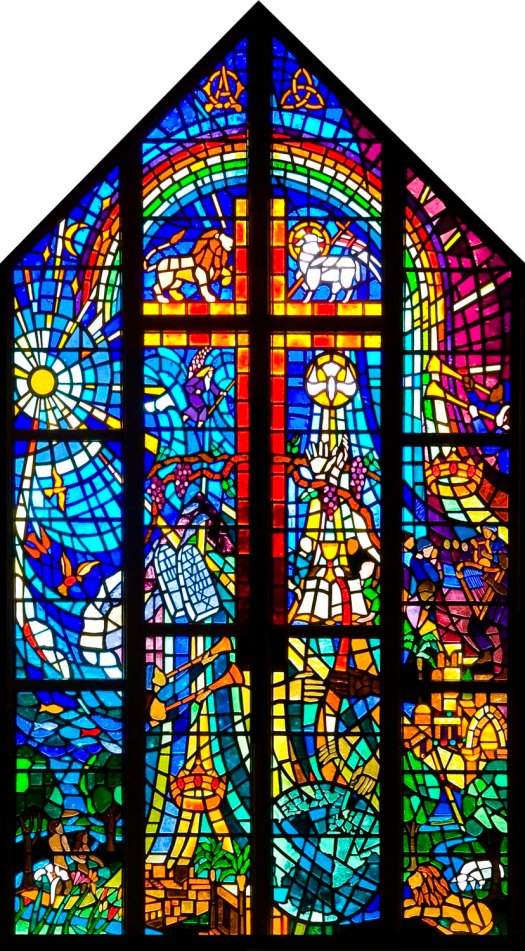
The Bible story captured in stained glass

Peninsula Bible Church, Cupertino, in California, USA, installed the stained glass window, shown below, in 2007. It is 23 feet high, and dominates the auditorium of the church. This window is not only a breathtaking piece of art. It’s also a wonderful teaching tool, telling the Bible story in a series of images through the window. At the centre, and dominating the window, is a cross. Another striking element is the rainbow that flows around the top of the cross, from the first vertical panel on the left, right through and into the final vertical panel on the right. The window was designed by Bernard Bell, a pastor of that church, who called it The Big Picture. He hopes that the window will form and shape an understanding of the great story told in the Bible in both adults and children.

Shortly after its installation, Bernard Bell preached a sermon explaining the window. He said, “Our service today is shaped around our new window. You’ve had a couple of weeks to look at this window, to figure out what is in it. It has been fun to watch you reading the window, especially to see you reading it with your kids. This window is indeed designed to be read, just like the stained glass windows of the old cathedrals in Europe. The Bible is a story, the great story of God’s involvement with the world and of human response to him. This window tells that story pictorially; it is to be read as a story. The window is structurally designed in four vertical bays, but thematically designed as five acts with a prelude. The prelude is God himself. The five acts are the five major stages in his dealings with the world: creation, Israel, Christ, church, and consummation.” Click HERE to read the rest of this sermon; it’s also available as a PDF HERE.

Bernard preached two other sermons relating to this window. A sermon entitled A Window on Advent is available in audio and written formats (including a PDF version) HERE. A sermon entitled Stories and the Story is available in audio and written formats (including a PDF version) HERE.

The window was featured in the local newspaper, the Cupertino Courier. Read the journal’s article HERE.

The Friday Briefing 4 (30 March 2018)

Crucifixion by the Romans from Wikimedia

The painting above is Crucifixion by the Romans by the Russian artist Vasily Vereshchagin (1842-1904). This magnificent painting is epic in scale – around 3 metres high and 4 metres wide! In their press release ahead of this painting’s sale (available HERE), the auction house Christie’s tells us, “The composition is undoubtedly striking: in direct contrast to traditional depictions of the Crucifixion, Vereshchagin positions Christ, illuminated, on the extreme right of the painting, placing the primary emphasis of the composition on the crowd. The viewer becomes part of the crowd, peering over people and horses to view the spectacle. A large expanse of dark sky stretches across the horizontal, the city wall looms heavy over a crowd of traders, Pharisees and a mournful group of Christ’s supporters. In the foreground, Roman soldiers with their spears and lances stand guard.”

What did the Cross achieve?

The dying of Jesus Christ

Thief or terrorist: what kind of criminal was crucified with Jesus?

The Day of Atonement

The Crossing Point of History – a video

What did the Cross achieve?

Here is J.I. Packer’s brilliant, carefully argued, penetrating defence of penal substitution – the doctrine that teaches that, on the Cross, Jesus suffered the penalty for our sin instead of us, as our Substitute. This is one of the foundational doctrines of our Christian faith. Delivered as a lecture at Tyndale House, Cambridge, in 1973, this article is now a classic. It is not, admittedly, the easiest of reads, but it is a foundational study that deserves close study. In it, Dr. Packer writes, “The notion which the phrase ‘penal substitution’ expresses is that Jesus Christ our Lord, moved by a love that was determined to do everything necessary to save us, endured and exhausted the destructive divine judgment for which we were otherwise inescapably destined, and so won us forgiveness, adoption and glory.”

Paul wrote “Christ redeemed us from the curse of the law by becoming a curse for us—for it is written, ‘Cursed is everyone who is hanged on a tree’”. In one of the footnotes in this article, Packer quotes from Luther’s comment on this verse, “Luther puts this dramatically and exuberantly, as was always his way. ‘All the prophets did foresee in spirit, that Christ should become the greatest transgressor, murderer, adulterer, thief, rebel, blasphemer, etc., that ever was . . . for he being made a sacrifice, for the sins of the whole world, is not now an innocent person and without sins . . . our most merciful Father . . . sent his only Son into the world and laid upon him the sins of all men, saying: Be thou Peter that denier; Paul that persecutor, blasphemer and cruel oppressor; David that adulterer; that sinner which did eat the apple in Paradise; that thief which hanged upon the cross; and, briefly, be thou the person which hath committed the sins of all men; see therefore that thou pay and satisfy for them. Here now cometh the law and saith: I find him a sinner . . . therefore let him die upon the cross . . .’”

Thirty years later, Dr. Packer wrote a briefer article, Penal substitution revisited, available HERE. In it, he commented: “Throughout my 63 years as an evangelical believer, the penal substitutionary understanding of the cross of Christ has been a flashpoint of controversy and division among Protestants. It was so before my time, . . . . It remains so, as liberalism keeps reinventing itself and luring evangelicals away from their heritage. Since one’s belief about the atonement is bound up with one’s belief about the character of God, the terms of the gospel and the Christian’s inner life, the intensity of the debate is understandable. If one view is right, others are more or less wrong, and the definition of Christianity itself comes to be at stake.” He concluded, “A lawyer, having completed his argument may declare that here he rests his case. I, having surveyed the penal substitutionary sacrifice of Christ afresh, now reaffirm that here I rest my hope. So, I believe, will all truly faithful believers.”

Read What did the Cross Achieve? HERE

James Innell Packer (born 22 July 1926), usually cited as J. I. Packer, is a British-born Canadian Anglican theologian. He is Board of Governors’ Professor of Theology at Regent College in Vancouver, Canada. He is regarded as one of the most important evangelical theologians of the 20th Century.

Click here to go back to table of contents

The dying of Jesus Christ

Arthur C. Custance brings a fresh look at the death of Jesus Christ in this fascinating study. He writes, “Man dies two deaths. The Saviour of man must therefore also suffer two deaths, first by dying spiritually as man dies spiritually, and then by dying physiologically as man dies physiologically. For such a Saviour both deaths are substitutionary, unique as to their nature and cause, and unique as to their effect.”

As to the first – spiritual – death, Dr. Custance explains: “When man sins, he does so by choice and he thus commits spiritual suicide. . . . . Thereafter he is, spiritually considered, a dead man: dead in trespasses and sins (Ephesians 2:1) . . . . . . . . From the God and Father of our Lord Jesus Christ he has effectively cut himself off, separated himself — as Isaiah 59:2 puts it . . . . Paul describes this spiritual death as “eternal destruction from the presence of the Lord” (2 Thessalonians 1:9, Revised Standard Version). But it may be asked, When did this kind of dying ever happen in the life of the Lord Jesus Christ? The answer is, On the cross in those three hours of darkness — as indicated when He cried out in his extreme isolation and agony of soul, “My God, My God! Why have You forsaken Me?” For in becoming an offering for our sins, He had suddenly experienced for the first time in the eternity of his being “destruction from the presence of the Lord,” a destruction which for all He knew was final. It happened not by his choice (as it is with us) but by imposition when He was made sin, when He became guilty by imputation of all the horror and frightfulness of man’s wickedness since history began with the murder of Abel. When this judgment fell upon Him, it was as though the murder, the torture, the rape, the mutilation, the degradation, and the utter cruelty of man towards man, became in effect his responsibility. . . . . We cannot really have the slightest conception of what this experience meant to One who was completely without sin.”

As to the second – physiological – death, Dr. Custance explains: “It was not, therefore, the crucifixion that really ended his life. He died ON the cross, but not FROM crucifixion. The cross was the occasion but not the cause of his dying. He was dead within less than six hours, a circumstance almost unheard of. . . . . It is therefore no wonder that the centurion in charge of the crucifixion detail was so amazed (Mark 15:39), and that Pilate also was incredulous (Mark 15:44) that He was so soon dead. Both were Romans: both probably had had considerable experience in such matters. To them it was a most exceptional circumstance. . . . . Thus in his exercise of absolute authority over his own life He did not give up his spirit in the sense that other men give up theirs. He deliberately dismissed it, and the transformation of his body from a living organism into a dead body was so immediate that the centurion was amazed.”

Read the whole article HERE

Arthur Custance’s writings can be accessed at no cost HERE. They are a wonderful storehouse of thoughtful and reverent explorations of Biblical truth, with a special focus on the interface of science and the Bible. Here is an outline of his life (as given on the Arthur C. Custance website, and available HERE): “Arthur C. Custance was born and educated in England and moved to Canada in 1928. In his second year at the University of Toronto he was converted to faith in Christ. The experience so changed his thinking that he switched courses, obtaining an honours M.A. in Hebrew and Greek. In his 13 years of formal education, he explored many facets of knowledge and was particularly interested in anthropology and origins. He completed his Ph.D. at the University of Ottawa in 1959 while serving as head of the Human Engineering Laboratories of the Defence Research Board in Ottawa (Canada) and was engaged in research work for 15 years. During that time he also wrote and published The Doorway Papers, and in retirement in 1970, he wrote 6 major books. His writings are characterized by a rare combination of scholarly thoroughness and biblical orthodoxy.”

Click here to go back to table of contents

Thief or terrorist: what kind of criminal was crucified with Jesus?

Tom Hobson writes, “’Thief’ is too mild a word in the verse where we are told that Jesus was “crucified between two thieves” (Matthew 27:38). The same is true in John 18:40, where we are told, “Now Barabbas was a robber”. The language is too mild. Not even “bandit” has enough kick to translate the word lēstēs. Barabbas and his buddies who were crucified with Jesus would be better described as revolutionaries, guerillas, pirates (the landlubber variety), or (to use a modern term) ‘terrorists’.

Dr Hobson concludes: ”How degrading, for Jesus to suffer Rome’s most hideous punishment with such dangerous, violent men! Here we have a vivid picture of the depths to which Jesus humbled himself (Philippians 2:8), from whence God highly exalted him, and gave him the name at which every knee shall bow. Let us ponder the humiliation Jesus suffered by being crucified between two terrorists, as we commemorate Good Friday and celebrate Resurrection Sunday.”

Read the whole article HERE

Click here to go back to table of contents

The Day of Atonement

The day of Atonement (described in Leviticus 16.1-34 and Numbers 29.7-11) lay at the heart of the whole Old Testament sacrificial system. On this day a final great purification offering was offered for all of Israel’s sins over the preceding year. This sacrifice consisted of a pair of goats, which, together, constituted a single purification offering. That sacrifice – and the whole Old Testament sacrificial system was fulfilled Jesus’s sacrificial death on the Cross – an event we remember this Good Friday.

In this article, Michael Morales brings a fresh and illuminating perspective on the Day of Atonement and its fulfilment by our great High Priest, Jesus Christ. He writes, “As part of the profound theology of atonement in the Old Testament, sin was understood as both deeply-seated within the heart and exceedingly defiling. Because the earth had been polluted by humanity’s sin and consequent death, the LORD God who is the fountain of life could not dwell with his people—yet this was the very purpose for which he had created the heavens and earth. The Tabernacle (and later Temple) was, therefore, a provisional ‘creation in miniature’, an architectural cosmos that would allow the holy Creator to dwell in a sacred, clean ‘house’ among his people. Again, the Tabernacle was a temporary solution during the interim before the establishment of a new (that is, newly cleansed and renovated) heavens and earth. But even during the interim, God taught and warned his people that his earthly abode, the Tabernacle, could not remain in the midst of his people when defiled by the uncleanness of their sins. Although faithful Israelites would offer sin offerings throughout the year, their own consciences surely testified to the inadequacy of their repentance, let alone remembrance, of sin. If one were to offer sin offerings (typically a young goat) for every sin committed in a single day, one would never leave the Tabernacle precincts and would become exceedingly poor in the process since livestock were a precious commodity. Many sins, then, had not been dealt with through the cleansing blood of atonement. Worse still, Israel’s sins spread their uncleanness so that the Tabernacle would steadily become defiled; without a remedy, God would need to remove his holy presence from among his people. Such a need for comprehensive forgiveness and cleansing from sin was addressed by the Day of Atonement ceremony, allowing for a fresh start annually—a new year, as it were.”

“The analogy between creation and the Tabernacle proves prophetic. If the high priest, through the blood of atonement, could cleanse God’s architectural cosmos (i.e., the Tabernacle) from sin’s defilement, then could such cleansing also be possible for creation itself? The book of Hebrews teaches precisely this point. Jesus was not a Levitical high priest, linked to the Tabernacle as a miniature copy of the cosmos. Rather, the Son of God is a high priest after the order of Melchizedek, and has accomplished creation’s Day of Atonement, cleansing God’s people and the cosmos definitively from sin’s defilement. With his own blood, Jesus entered heaven itself, the reality which the Tent’s holy of holies only copied. All of God’s people, from every era and nation, will dwell with him in glory in a new heavens and earth because of the Messiah’s work of atonement. A foretaste of that glorious life may be experienced every Lord’s Day as the church below enters through the new and living way—the person and work of the Lord Jesus Christ—into the joys of the heavenly Mount Zion (Hebrews 12.22-24).”

Read the whole article HERE

Michael Morales is Professor of Old Testament at Greenville Presbyterian Theological Seminary in Greenville, South Carolina. He is the author of Who Shall Ascend the Mountain of the Lord?: A Biblical Theology of the Book of Leviticus (see the publisher’s description for this book HERE). This is a suberb study of the book of Leviticus, and its place in the whole Bible story. I will post about it in due course.

Click here to go back to table of contents

The Crossing Point of History – a video

In this video, the eleventh in the series The Journey (available HERE) we look at Jesus’s trials and crucifixion, and His resurrection and ascension into Heaven. These events are the great turning point in the history of this world, and the key to God’s plan for us and for our world. A Leader’s Guide, to aid in group discussion after viewing the video, is available HERE. A more detailed 20-page study is available for download HERE.

Click here to go back to table of contents

Unless otherwise indicated, all Scripture quotations (apart from those in direct quotations) are from The Holy Bible, English Standard Version, published by HarperCollins Publishers. © 2001 by Crossway Bibles, a division of Good News Publishers. Used by permission. All rights reserved.

The LUMO Project Gospel videos

Image © LUMO Project

Jesus calls his first disciples – a scene from one of the LUMO Project videos.

The LUMO Project has produced a series of videos of the four Gospels, one for each Gospel. These videos have three key features that, together, contribute to these films’ stunning level of authenticity.

 Firstly, the voice-over is a narration of the Bible text – nothing is added, and nothing is removed. The actors in the film speak Aramaic, as it was spoken in Jesus’ time. But their dialogue is muted, and overlaid with voice-over narration using the unabridged Biblical text as script. John’s Gospel is available in the New International Version and the King James Versions of the Bible; the other Gospels are available in the NIV only. There are also versions available in other languages. The film is currently available in 20 languages – Afrikaans, Arabic, Bengali, Cantonese, Dutch, English, German, Hindi, Italian, Korean, Mandarin, Polish, Portuguese, Russian, Spanish, Swahili, Tagalog, Thai, Turkish and Vietnamese.

 Secondly, the scenery was shot on location in Morocco, and is faithful to the first-century Palestinian world of the Gospels. The LUMO Project used CGI to reconstruct the city of Jerusalem from a difference.

 Thirdly, and uniquely, the actors look the part of first-century Palestinian people. This adds a further level of authenticity to the videos. In the December 2002 issue of Popular Mechanics, an article by Mike Fillon, entitled The Real Face of Jesus, described how scientists and archaeologists used forensic anthropology to reconstruct what a first-century Galilean man might have looked like. The image is quite different from the Western face we typically see depicted today. In the LUMO films, Jesus is played by the British actor Selva Rasalingam. Rasalingam’s ethnicity is partly Tamil, and he looks more like the reconstructed image developed by this team of scientists and archaeologists than the typical Westernised depiction that we’re familiar with.

LUMO tells us “LUMO revolutionizes the way we experience and understand the historical Jesus. Anyone, anywhere in the world can fully experience their translation of Scripture overlaying the stunningly visual representations of the life of Christ set against the backdrop of an authentic rendition of first century Palestine during Jesus’ time.”

Justin Taylor, on the Gospel Coalition website, writes: “I am a big fan of the Lumo Project, which is seeking—for the first time—to film all four Gospels as feature films, using only the unabridged biblical text as their script.” Read his review HERE.

The Journey video series, available for free viewing or download from this site, uses – because of their authentic portrayals – many stills from the LUMO films for Jesus and the Gospel narratives.

What is the LUMO project? This very brief video explains:

Click HERE for the LUMO website and to watch a trailer.

Here’s a video explaining the project:

This is a trailer for the Gospel of John:

LUMO’s YouTube channel, with a variety of trailers and explanatory videos available is HERE.

You can buy the LUMO videos on Amazon USA and Amazon UK. Outside of the United States and Canada, the films can be downloaded from the LUMO Project website for use in churches or community group.

Read Scripture videos by The Bible Project – a great resource for teaching the Bible

The Bible Project has produced (among many other resources) a series of 71 short videos, named Read Scripture, that take you right through the Bible. They’re are a wonderful tool for teaching the Bible story – snappy, engaging, visually impacting, and theologically astute. And they’re all free – as is everything produced by The Bible Project.

These Read Scripture videos are suitable for teenagers as well as adults. They’re a great introduction to the Bible story that you could use with your family, your small group, or your whole church. I first encountered one of these videos at a church service where the preacher used the video to introduce a sermon series on the Book of Numbers. It was a brilliant way to begin that series.

Here’s the Read Scripture video on Genesis chapters 1 to11:

Other resources related to this video on Genesis 1-11 from The Bible Project are available HERE

The full set of Read Scripture videos for the Old Testament are available HERE.

Here’s the Read Scripture video on Matthew chapters 1 to 13:

Other resources related to this video on Matthew 1-13 from The Bible Project are available HERE

The full set of videos for the New Testament are available HERE.

The Bible Project is a non-profit animation studio that produces short, animated videos, podcasts, and study guides that explore the Bible’s unified story. They focus on the Bible’s overarching themes and each book’s literary design, and they are committed to understanding the Bible in its historical context. To find out more about The Bible Project, click HERE.