The Lamb is the Lord, part 3: The Throne at the Centre of Everything

Three: The Throne at the Centre of Everything
Introduction and Questions

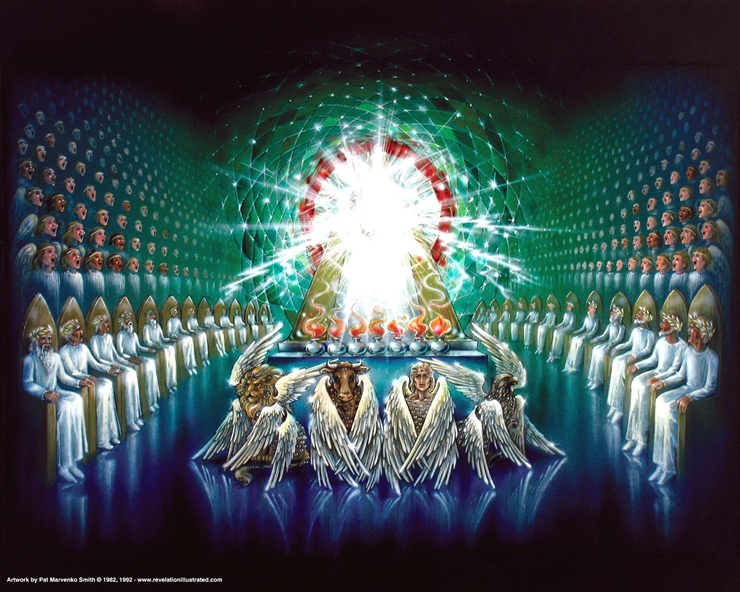
Artwork by Pat Marvenko Smith © 1982, 1992 https://revelationillustrated.com/

An artist’s impression of the awesome scene portrayed in Revelation 4:1-11.

Click the icon below to download
a 4-page PDF version of this page.

Click the icon below to download
a 12-page Reader’s Guide in PDF format.
This explores Revelation 4:1-5:14 in more detail.


“One seated on the throne”

John writes, “I looked, and behold, a door standing open in heaven!” (4:1). A voice―probably the voice of Jesus―says “Come up here, and I will show you what must take place after this.” (4:1). John, in the Spirit, sees “a throne . . . in heaven, with one seated on the throne” (4:2). In this vision, he sees the heavenly throne-room of the Lord God Almighty.

This description of God as “one seated on the throne” (with variations) is the name of God most often used in Revelation. And here in this vision, God’s throne is the centre and focus of everything that John sees. Look at verses 3 to 10 and count how many times “the throne” is mentioned. From now on, throughout the book, we’ll be seeing everything from the perspective of God’s throne. Continue reading “The Lamb is the Lord, part 3: The Throne at the Centre of Everything”

The lamb is the Lord, Part 2: Lampstands in a Darkened World

Two: Lampstands in a Darkened World
Introduction and Questions

Click the icon below to download
a 4-page PDF version of this page.

Click the icon below to download
a 16-page Reader’s Guide
This introduces the Book of Revelation
and explores Revelation 2:1-3:22 in more detail.

Introduction

The year is probably around 90-95AD. The mighty Roman Empire is almost at its greatest power and extent. At this moment in history, Almighty God speaks to an old man in exile on a little island in the Mediterranean. That man is John the Apostle. John writes, “I was in the Spirit on the Lord’s day, and I heard behind me a loud voice like a trumpet saying, ‘Write what you see in a book and send it to the seven churches, to Ephesus and to Smyrna and to Pergamum and to Thyatira and to Sardis and to Philadelphia and to Laodicea’” (1:10-11).

Continue reading “The lamb is the Lord, Part 2: Lampstands in a Darkened World”

The Lamb is the Lord, Part 1: Reality Unveiled

One: Reality Unveiled
Introduction and Questions

Click the icon below to download
a 4-page PDF of this page.

Click the icon below to download
a 16-page Reader’s Guide
This introduces the Book of Revelation
and explores Revelation 1:1-20 in more detail.

Introduction

This is the first of a seven-part series on the Book of Revelation. We’ll trace Revelation’s storyline and themes. We’ll explore its symbolism and imagery. And we’ll see what God is saying to us believers as we follow Jesus day by day.

The word ‘Revelation’ is apocalupsis in Greek―from which we get our word ‘apocalyptic’. This Greek word means ‘an uncovering’, ‘an unveiling’. In the Book of Revelation, Jesus unveils what’s really going on in Heaven and on Earth, and where human history is heading.

God’s perspective on history

There’s a famous photograph that’s entitled ‘Earthrise’ (see above). It was taken by an Apollo 8 crewmember in 1968, while in orbit around the Moon. These men were the very first humans who saw Earth as viewed from the Moon. It gave them―and all humanity―a completely new perspective on our planet.

Image courtesy of NASA/Bill Anders

‘Earthrise’―Earth above the lunar horizon. This image was taken by Apollo 8 crewmember Bill Anders on December 24, 1968, while in orbit around the Moon.

Likewise, in Revelation, God gives us a new perspective―a heavenly perspective, God’s perspective. Christ is seated “in the heavenly places” (Ephesians 1:20). We’re seated there with Him (Ephesians 2:6). We need to view everything from that viewpoint―a heavenly viewpoint. And that’s the perspective Revelation gives us.

Continue reading “The Lamb is the Lord, Part 1: Reality Unveiled”

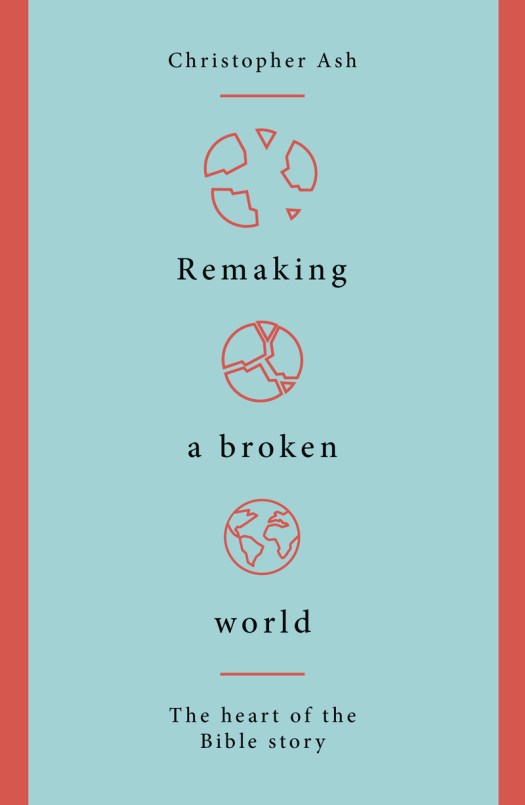
‘Remaking a Broken World: the Heart of the Bible Story’ by Christopher Ash

Remaking a Broken World overviews the Bible story. The book gives us, in the author’s words, “a fresh camera angle on the Bible story” that focuses on scattering and gathering―scattering as an aspect of God’s judgment, and gathering as an aspect of God’s redemption. The back cover of the book reads, “Our world is fractured on every level. From the family to international relations, it is hard to make and maintain harmony. How can we bring peace? This book offers a surprising, compelling answer: that the ordinary local church contains the seeds of a remade world. The most significant thing we can do is to commit ourselves to our church. Christopher Ash sweeps through the whole Bible, showing how the gathering of God’s people has always been central to God’s plan for the world. Read this to see the Bible anew, refresh your passion for your church, and find hope for a broken world—which, it turns out, is already being remade.” The writing is engaging, clear, and engages constantly with the Scriptures. In addition to the introduction and conclusion, there are nine chapters; arranged into four sections:

 Section A – A Broken World: Scattered Without God

 Section B – The Assembly of Israel: Gathering Foreshadowed

 Section C – The Assembly of Jesus: Gathering Realised

 Section D – The New Creation: Gathering Consummated

Mark Meynell, authors of a number of books, and Europe and Caribbean Director for Langham Preaching (part of Langham Partnership), provides an extensive and helpful review HERE. (He reviews the previous edition of Remaking a Broken World, hence the different cover displayed on review―the book has been revised and updated since.) Meynell writes, “The genius of Ash’s approach is to see God’s purposes expressed in the dual theme of his people being scattered and gathered. He bases this around a Bible tour of 9 places: Eden, Babel, Sinai, Jerusalem, Babylon, Golgotha, Pentecost, Church, and New Creation . . . . And once it’s pointed out, you see it everywhere – there’s a thrilling section, for example, in which Ash picks up the post-exilic context of prophetic hope (pp96-102). . . . . this is a genuinely biblical melodic line. This alone makes this book an important contribution to growing library of popular level biblical theology. But it is no academic curiosity – it has huge pastoral significance, . . . . it provocatively places the very idea of the community of God, and in particular the local church, centre stage.” Meynell concludes, “All in all, this is a wonderful read – stimulating, engaging, passionate, credible. I’m going to be recommending it left right and centre.”

Remaking a Broken World is published by The Good Book Company and is very reasonably priced (at the time of writing, it was £6.79 for the paperback and £4.79 for the ebook). If you buy the ebook, you get the book in three formats―PDF, epub and mobi. Another feature is that the PDF is printable―this format doesn’t have printing disabled. So if obtaining the paperback is difficult, or if you want both an ebook and a printed copy, you can buy the ebook and then print the PDF. The publisher’s page for the book is HERE―the page includes a free excerpt that you can download.

Christopher Ash is writer in residence at Tyndale House in Cambridge, United Kingdom, and a full-time preacher, speaker, and writer. He previously served as the director of the Proclamation Trust’s Cornhill Training Course and as a minister and church planter. He and his wife, Carolyn, are members of St. Andrew the Great Church in Cambridge, and have four children and seven grandchildren. He has written numerous books.

Friday Briefing 21 (4 June 2021)

How Does the Cross of Christ Make Sense of the Kingdom of God? Jeremy Treat writes, “Countless books on the kingdom hardly mention Christ’s cross. Volumes on the cross ignore Jesus’ message of the kingdom. The polarization of these two biblical themes leads to divergent approaches: cross-centered theology that focuses on the salvation of sinners or kingdom-minded activism that seeks to change the world. . . . . It’s as if we are left with a choice between either a kingdom without a cross or a cross without a kingdom; this false dichotomy truncates the gospel and cripples the church.” But these two themes are wonderfully integrated in Scripture. Treat explains how.

Mourning the death of a dwelling place Hayden Hefner writes, “Several years ago, my wife and I purchased our first home. Several weeks from now, we will lock the front door for the last time. . . . . . . . locking the front door for the last time will feel like a sort of death. It is the fading away of a physical reminder. It is the death of a dwelling place. But, he writes, ”The death of an earthly dwelling place reminds us we have a new and better homecoming . . . .

A tale of two liturgies Matt Merker writes, “We should see the church’s worship service—the whole thing, not just the sermon—as a mass discipling activity. . . . . Since the gathering is such a powerful corporate discipling tool, we should treat liturgy with care. ”

One Thing I Did Right in Ministry: “I Started a Book Table” Tom Ascol writes, “One of the first things that I did when I became pastor of the church I now serve was to start a book table where good books at discounted prices were made available to our congregation.” Ascol explains how books have strengthened discipleship in his congregation.

How Does the Cross of Christ Make Sense of the Kingdom of God?

Jeremy Treat writes, “Unfortunately today, many Christians either cling to the cross or champion the kingdom, usually one to the exclusion of the other. Countless books on the kingdom hardly mention Christ’s cross. Volumes on the cross ignore Jesus’ message of the kingdom. The polarization of these two biblical themes leads to divergent approaches: cross-centered theology that focuses on the salvation of sinners or kingdom-minded activism that seeks to change the world. Whole churches or movements are built on one idea or the other. It’s as if we are left with a choice between either a kingdom without a cross or a cross without a kingdom; this false dichotomy truncates the gospel and cripples the church.“ Treat asks how these two central themes of Scripture came to be pitted against each other and comments, “We need a better way forward than “kingdom versus cross.” And it’s not enough to merely seek “kingdom and cross,” as if these were two competing values that need to be held in tension. The key is not balance, but integration. And that’s exactly what we find in Scripture, an unfolding narrative that weaves together atonement and kingdom like a crown of thorns, fit for a crucified king.” After briefly tracing this narrative, he concludes, “The kingdom comes in power, but the power of the gospel is Christ crucified.”

Read the whole article HERE. This article was published in the August 2019 issue of the 9Marks Journal, an issue entitled The Heart of the Gospel: Penal Substitutionary Atonement. This issue contains 23 articles, including J.I. Packer’s classic lecture entitled What did the Cross Achieve: the Logic of Penal Substitution. You can download the entire issue free of charge, either using the link on the left-hand side of the page containing Treat’s article, or from the page HERE. Dr Jeremy Treat is the author of The Crucified King: Atonement and Kingdom in Biblical and Systematic Theology (the publishers page is HERE) and Seek First: How the Kingdom of God Changes Everything (the publishers page is HERE).

Click here to go back to table of contents

Mourning the death of a dwelling place.

“Several years ago, my wife and I purchased our first home. Several weeks from now, we will lock the front door for the last time. If I’m being honest, the thought of selling our little home makes me sad. This house has been the backdrop and base camp for some of the most memorable and formative moments of our life together. . . . . . . . locking the front door for the last time will feel like a sort of death. It is the fading away of a physical reminder. It is the death of a dwelling place. He comments, “having a home is a good thing. Home is God’s idea. . . . . We were not made for walking away from home.” In his conclusion, he writes, ”The death of an earthly dwelling place reminds us we have a new and better homecoming—one not subject to peeling paint, weather damage, or financial foreclosure, but designed and built by the Lord (Hebrews 11:10).”

Read the whole article HERE.

Click here to go back to table of contents

A tale of two liturgies.

Justin Taylor shares an excerpt from Matt Merker’s book Corporate Worship: How the Church Gathers as God’s People (published by Crossway; the publisher’s page is HERE).

Matt Merker explains, “Many theologians have called the order of service a “liturgy.” The Greek term leitourgia referred to work done for the good of the public. When used in the context of a church gathering, “liturgy” refers to the “work” or ministry of exaltation and edification for which God gathers his people—or better, that God himself performs in and through his people.” He writes, “For me, liturgy refers to the order of the worship service, particularly how it reveals and reinforces the nature of the service itself. ” Merker points out: “We should see the church’s worship service—the whole thing, not just the sermon—as a mass discipling activity. . . . . Since the gathering is such a powerful corporate discipling tool, we should treat liturgy with care.” Merker shows how this works in practice by taking two contrasting orders of service, from the gatherings of two different churches. These churches have congregations of the same size, use the same musical instruments and have the same theological beliefs. But their liturgies are different, in ways that are significant. His first example is an order of service typical of many evangelical churches. The second is an example of a gathering at a Presbyterian church in Brazil. Merker then notes four weaknesses of his first example. One of these relates to prayer and the public reading of Scripture. Merker comments, “this order of service leaves two of the most essential elements of corporate worship out to dry: prayer and Scripture reading. There is no other Scripture reading in the service, aside from what the pastor might read in his sermon. And the prayers serve as transitions, not as substantive elements of worship in their own right.”

The message to take away is this: if key elements of the order of service are missing, or if the order of service is disjointed or theologically weak, the worship service is less glorifying to God, less effective in building up believers, and less able to communicate the Gospel message to unbelievers in the congregation. Through the prayers, the Scriptures being read, the preaching, the hymns and songs, through baptism and the Lord’s Supper, we should, as Merker writes, “strive to fill our services with the life-giving water of the Word of God.”

Read the whole article HERE.

Click here to go back to table of contents

One Thing I Did Right in Ministry: “I Started a Book Table”.

Tom Ascol writes, “One of the first things that I did when I became pastor of the church I now serve was to start a book table where good books at discounted prices were made available to our congregation. . . . . . . . within a matter of months we had a table full of good titles for sale as a fixture in our foyer. Within a year or two, the “Book Table” became a line item in our budget and the church adopted a policy that if anyone who wanted one of the books but could not afford to pay, he or she could have it in exchange for a promise to read it. I often recommend books both publicly and in private conversations. When someone takes my recommendation I try to follow up in a few weeks to ask what they think of the book, what they are learning or if the book has raised any questions for them. That has led to some very fruitful conversations and opportunities for ministry.”

Ascol concludes, “Through the years I have seen good books supplement the ongoing preaching and teaching ministry of the church, encourage personal and spiritual growth, help with counseling, equip for ministry and help people develop a growing love for truth. . . . . So I would encourage every pastor to start a book table if one doesn’t already exist in the church he is serving. That is one thing that, by God’s grace, I did right early in my ministry.”

Read the whole article HERE.

Click here to go back to table of contents

Free ebooks from DesiringGod.org

Desiring God has a wealth of resources available, including many books, available HERE. The great majority are by John Piper, but some are by other authors and editors. Most of the books are available as free ebooks in multiple formats, including PDF. The others are available for purchase (some have samples available as PDFs). All the PDFs available are printable (in other words, printing is not disabled). Here is just a small selection of the books available as free ebooks. Under each title is the link to the page where you can read more about the book, and download the ebook. Unless otherwise stated, the books are by John Piper. You can find out more about Desiring God HERE.

Alive to Wonder: Celebrating the Influence of C.S. Lewis

Brothers, We Are Not Professionals: A Plea to Pastors for Radical Ministry

Counted Righteous in Christ: Should We Abandon the Imputation of Christ’s Righteousness?

Designed for Joy: How the Gospel Impacts Men and Women, Identity and Practice edited by Jonathan Parnell and Owen Strachan.

Don’t Waste Your Life (A Study Guide is also available from the download menu for this book.)

Expository Exultation: Christian Preaching as Worship

Finally Alive: What Happens When We Are Born Again

For the Fame of God’s Name: Essays in Honor of John Piper edited by Sam Storms and Justin Taylor.

Habits of Grace: Enjoying Jesus Through the Spiritual Disciplines by David Mathis. A Study Guide is available HERE.

Let the Nations Be Glad! The Supremacy of God in Missions (third edition)

Not by Sight: A Fresh Look at Old Stories of Walking by Faith by John Bloom.

A Peculiar Glory: How the Christian Scriptures Reveal Their Complete Truthfulness

Providence

The Romantic Rationalist: God, Life, and Imagination in the Work of C. S. Lewis edited by John Piper and David Mathis.

Still Not Professionals: Ten Pleas for Today’s Pastors with contributions by John Piper, Daniel L. Akin, Thabiti Anyabwile, Mike Bullmore, Sam Crabtree, Raymond C. Ortlund, R. C. Sproul, Jeff Vanderstelt, and Douglas Wilson.

Think: The Life of the Mind and the Love of God

This Momentary Marriage: A Parable of Permanence

What Jesus Demands from the World

‘Christ Will Be My Hideaway’: a new song for lockdown, based on Psalm 91

Here is a new song written by Bob Kauflin and Tim Chester, with a small team of others. It’s based on Psalm 91, which begins, “He who dwells in the shelter of the Most High will abide in the shadow of the Almighty. I will say to the LORD, “My refuge and my fortress, my God, in whom I trust.”” (Psalm 91:1-2). The song’s strong theology, combined with its tuneful and singable melody, make it ideal for congregational singing. Bob Kauflin writes: “Christ Will Be My Hideaway is a congregational song for a pandemic or any time really. It’s based on Psalm 91, which is filled with encouraging, soul-strengthening promises from God that lift our eyes above our circumstances to see his providential, wise, powerful care.” The video below is a version that may be useful for online church gatherings:

Click HERE for Bob Kauflin’s blog post about this song, where you can find the lyrics, chord chart and lead sheet. Click HERE for Tim Chester’s blog post.

CREDITS the Scripture quotation is from The ESV® Bible (The Holy Bible, English Standard Version®), copyright © 2001 by Crossway, a publishing ministry of Good News Publishers. Used by permission. All rights reserved.

Seven Suggestions for Enjoying the Bible More Consistently

This is the season when some of us may be beginning Bible reading plans for the coming year. But why do so many of us struggle to enjoy our Bibles consistently? In this short video, Dr Peter Mead gives us seven simple and helpful guidelines for feasting on God’s word, the Bible.

Alongside his other roles, Peter Mead is the director of Cor Deo, a ministry training programme in Chippenham, England. He is the author of a number of books, including The Little Him Book, Pleased to Dwell, Lost in Wonder, and Foundations. He is also the author of the preaching blog BiblicalPreaching.net.

‘Pursuing God’s Heart Yourself’ – a series of videos by Peter Mead

In four series of short videos, Peter Mead takes us through seven basic principles that will help us to understand and learn from the Bible. He applies these seven principles as he guides us through the books of Ruth, Titus and Jonah, and the book of Psalms (taking Psalms 3-8 and 11 as examples). The series on the Psalms also includes four additional videos, entitled Why Did God Give Us Psalms?, Real Truth in a World of Lies, Real Hurt, and The Psalms and Jesus. Peter’s aim is to enable these seven principles to become part of the way we approach the Scriptures and feast on its riches. He says, “My aim, my goal, my prayer is that as you look at God’s word, spending time studying it, thinking about it, applying these principles, . . . you’ll get to know Him better, . . . you’ll be stirred to love him more, and . . . you’ll find yourself feasting on God’s word.” The video below is the introduction to the whole series:

Here are the first videos in each of the four series, on the books of Ruth, Titus, Jonah, and Psalms respectively. At the top of each video, to the right-hand side, there’s a menu icon (the one with three horizontal lines and an arrow). Click this menu icon to access the complete playlist for that series.

Dr Peter Mead is the director of Cor Deo, a ministry training programme in Chippenham, England. He is also part of the leadership team of Trinity Chippenham, a church Peter helped to plant back in 2014. Peter is a lecturer for Union School of Theology. He studied at Multnomah Biblical Seminary before getting his Doctor of Ministry degree under Haddon Robinson at Gordon-Conwell Theological Seminary in the area of expository preaching. Peter is the author of a number of books, including The Little Him Book, Pleased to Dwell, Lost in Wonder, and Foundations. He is also the author of the preaching blog BiblicalPreaching.net.

Christmas briefing

Image © Lumo Project through Free Bible Images All rights reserved

At this Christmas season, I thought it might be helpful to gather together four previously published posts relevant to Jesus’s birth.

Why was Jesus’ birth announced to shepherds?

Have you ever wondered why Jesus’ birth was announced to shepherds? In his commentary on Luke’s Gospel, I. Howard Marshall writes, “the motif that God reveals the birth of the Saviour to ordinary, lowly people, is undoubtedly present.” God’s angelic army announced the Saviour’s birth to humble shepherds, not to those of wealth and status. But there are two other possible reasons why shepherds were privileged with the news of the Saviour’s birth. Read the whole article HERE.

The Christmas army of angels

In his book, ‘A Not-So-Silent Night: the Unheard story of Christmas and Why It Matters’ Verlyn D. Verbrugge writes, “One of the most familiar elements of the Christmas story in Luke 2 is the appearance of the angel to the shepherds. That angel was soon joined by a “great company of the heavenly host . . . praising God and saying, ‘Glory to God in the highest, and on earth peace to men on whom his favor rests’” (Luke 2.13– 14 NIV). . . . . The word that Luke uses for “host” is the Greek word ‘stratia’, a word that in classical Greek almost invariably denotes an army or a company of soldiers. On occasion the word could be used as an alternate for the Greek word ‘strateia’, which denotes a military expedition. In either case, the word has strong military connotations.” But why is this military connation significant? Read the whole article HERE.

’Once more: Jesus was not born in a stable’ by Ian Paul

Dr. Ian Paul writes, “. . . Jesus wasn’t born in a stable, and, curiously, the New Testament hardly even hints that this might have been the case. So where has the idea come from?” Dr Paul tells us why oxen and asses are traditionally placed in the nativity scene. He explains the meanings of the Greek word in Luke 2.7 that’s translated “inn” in the ESV and the King James Version (but translated “guest room” in the NIV). And he takes us back to the first-century setting of the narrative, including the culture of the time and the actual design of Palestinian homes. Dr Paul draws on resources by other writers and provides links to two sermons, one by himself, another by Stephen Kuhrt, that retell the Christmas story in way that is faithful to its first-century Palestinian background. Read the whole article HERE.

’4 reasons to preach the genealogies at Christmas (really!)’ by David Thommen

Have you ever studied – or preached on – one of Jesus’ genealogies? David Thommen has. He writes, “I will never forget the zeal, the excitement, and the anticipation of my first Christmas sermon. . . . . . . . I wanted to preach something that I had never heard from the pulpit for Christmas, or any other time for that matter. . . . . When one of my elders asked me what I would be preaching on, I confidently proclaimed: “The genealogy from Matthew 1”. His response was different than I expected. “Why would you do that? You never preach the genealogies.” Convinced that all Scripture is profitable (2 Timothy 3.16-17), I soldiered forward undeterred. I pondered, in light of the rather unexpected response, why does the genealogy at the beginning of Matthew matter to the Christian at Christmas?” He shows us four reasons why it matters. Read the whole article HERE.

Unless otherwise indicated, all Scripture quotations (apart from those in direct quotations) are from The Holy Bible, English Standard Version, published by HarperCollins Publishers. © 2001 by Crossway Bibles, a division of Good News Publishers. Used by permission. All rights reserved.