
Three: The Throne at the Centre of Everything
Introduction and Questions
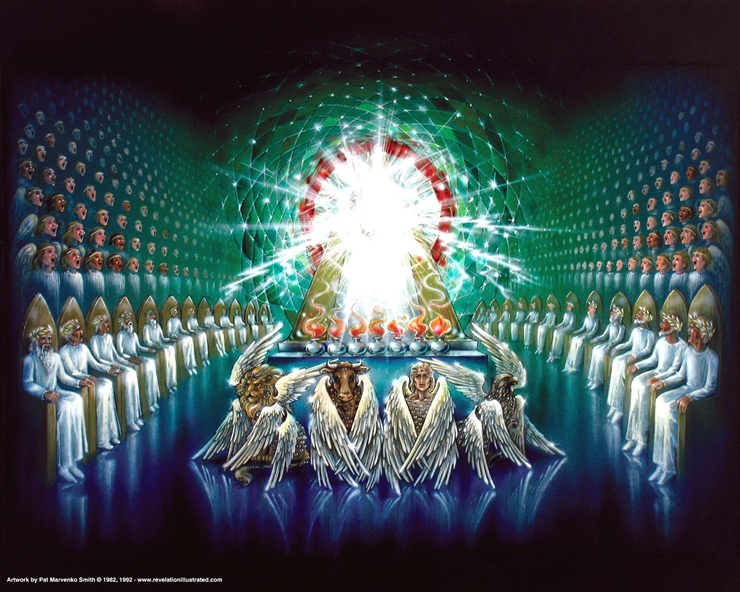
Artwork by Pat Marvenko Smith © 1982, 1992 https://revelationillustrated.com/
An artist’s impression of the awesome scene portrayed in Revelation 4:1-11.
Click the icon below to download
a 4-page PDF version of this page.

Click the icon below to download
a 12-page Reader’s Guide in PDF format.
This explores Revelation 4:1-5:14 in more detail.
“One seated on the throne”
John writes, “I looked, and behold, a door standing open in heaven!” (4:1). A voice―probably the voice of Jesus―says “Come up here, and I will show you what must take place after this.” (4:1). John, in the Spirit, sees “a throne . . . in heaven, with one seated on the throne” (4:2). In this vision, he sees the heavenly throne-room of the Lord God Almighty.
This description of God as “one seated on the throne” (with variations) is the name of God most often used in Revelation. And here in this vision, God’s throne is the centre and focus of everything that John sees. Look at verses 3 to 10 and count how many times “the throne” is mentioned. From now on, throughout the book, we’ll be seeing everything from the perspective of God’s throne.
God has “the appearance of jasper and carnelian” (4:3). Together, these two stones reflect God’s radiant, majestic glory. Around God’s throne, John sees “a rainbow that had the appearance of an emerald” (4:3). It recalls the rainbow we read about in Genesis 9. This rainbow was God’s covenant sign ”that . . . never again shall there be a flood to destroy the earth” (Genesis 9:11). God’s judgment on that wicked world was His mercy. From the waters of that flood, a new cleansed world emerged―a world that would never be again be destroyed by a flood. Perhaps this rainbow symbolises the same truth. God’s judgments on our wicked world―judgments we see later in the book―are God’s mercy. A new and perfect―and eternal―world will follow.
From God’s throne come ”flashes of lightning, and rumblings and peals of thunder” (4:5). This recalls the dramatic scenes at Mount Sinai described in Exodus 19:16–24 and 20:18-21. It pictures the awesome power of the presence of our holy God.

Image courtesy of Austin Schmid at Unsplash (Unsplash licence)
Around God’s throne, John sees “a rainbow that had the appearance of an emerald” (4:3). It recalls the rainbow we read about in Genesis 9. This rainbow was God’s covenant sign (Genesis 9:11): “that . . . never again shall there be a flood to destroy the earth” (Genesis 9:11).
Before God’s throne are “seven torches of fire, which are the seven spirits of God” (4:5). These torches symbolise the Holy Spirit; “the seven spirits of God” can also be translated “the sevenfold Spirit of God”.
In front of God’s throne is what looks like “a sea of glass, like crystal” (4:6). In the Bible, the sea can symbolise evil and chaos. This crystal sea may well picture God’s sovereign authority that stills all the forces of evil and chaos. It may also simply picture God’s awesome, transcendent holiness.
Twenty-four elders
Around God’s throne are “twenty-four thrones” on which “twenty-four elders” are sitting. They’re “clothed in white garments, with golden crowns on their heads” (4:4). In 1 Chronicles we read how King David organised the priests into 24 divisions (1 Chronicles 24:1-19). Just as these priests served and worshipped God in the Temple, so these elders seem to act as priests in serving and worshipping God here in the heavenly Temple. And these elders sit on thrones, indicating a royal status. Jesus has “made us a kingdom, priests to his God and Father” (1:6): these elders seem to represent us, God’s people, in our priestly service and royal authority.
Four living creatures
Right next to the throne, and around it, John sees “four living creatures, . . . the first . . . like a lion, the second . . . like an ox, the third . . . with the face of a man, and the fourth . . . like an eagle in flight” (4:6-7). Each has six wings, and they’re “full of eyes” (4:6,8).
These remarkable creatures are undoubtedly the same as ‘cherubim’, which we meet in several places in the Old Testament. They also seem to be the same as the seraphim that Isaiah saw in his vision (Isaiah 6:1-7). We first meet cherubim “at the east of the garden of Eden” (Genesis 3:24). Cherubim were present in the Tabernacle and Temple, for example, on the mercy seat in the Most Holy Place (Exodus 25:17 22). Ezekiel the prophet saw them (1:4-28, 10:1-22). Now John sees them.
These “four living creatures” have been interpreted in a number of ways. One view is that they represent perfect creation―including mankind―in God’s presence.
Worthy are You to receive glory!
The living creatures and the elders join their voices in praise to God (4:8-11). This is the first of seven scenes of heavenly worship in Revelation. Their worship never ceases. It’s a glorious, ceaseless, symphony of praise!
The seven-sealed scroll

Image © Steve Creitz at ProphecyArt.com
Then John sees “in the right hand of him who was seated on the throne a scroll written within and on the back, sealed with seven seals” (5:1). A mighty angel cries out: “Who is worthy to open the scroll and break its seals?” (5:2).
No-one is found worthy. Convulsed by grief, John weeps bitterly (5:4). But an elder says to him, “Weep no more; behold, the Lion of the tribe of Judah, the Root of David, has conquered, so that he can open the scroll and its seven seals” (5:5). These two titles are from two key Messianic prophecies of the Old Testament (Genesis 49:9-10 and Isaiah 11:1,10). Jesus Christ is “the Lion of the tribe of Judah, the Root of David”. He’s the Messiah―the One appointed by God to save God’s people, defeat the enemies of God and of His people, and rule the world with righteousness and justice. As Messiah, He has conquered Satan and all the forces of evil (see Revelation 12:7-12). That victory gives Him the power and authority to “open the scroll and its seven seals”. But what is written on the scroll? And why does His victory empower Jesus to unroll the scroll and inspect what’s written on it?

One of the 24 elders said to John, “behold, the Lion of the tribe of Judah, the Root of David, has conquered, so that he can open the scroll and its seven seals” (Revelation 5:5)
The Lamb, slain and standing
Then something quite remarkable and unexpected happens. John sees “between the throne and the four living creatures and among the elders” not a lion, but “a Lamb standing, as though it had been slain” (5:6). For the first time in the book, we see Jesus as the Lamb. This is the name used most often for Jesus in Revelation―hence our title The Lamb is the Lord. The image of Jesus as the Lamb is the key to understanding the whole book. This symbol of the Lamb draws primarily on two Old Testament passages: (1) the Passover lamb (Exodus 12.1-14,21-28, and see 1 Corinthians 5:7), and (2) Isaiah 52:13-53:12, especially 53:7. Both passages foreshadow Jesus’s sacrificial death for us.
The Lamb has “seven horns”―emblems of power and status (5:6). He has “seven eyes, which are the seven spirits of God sent out into all the earth” (5:6). As we’ve seen, this is a name of the Holy Spirit.
A new song in Heaven
The Lamb takes the scroll “from the right hand” of him who sits on the throne (5:7). We now witness the second scene of heavenly worship in Revelation (5:8-14).
The living creatures and the elders fall down before the Lamb; the elders hold harps ”and golden bowls full of incense, which are the prayers of the saints” (5:8). And the living creatures and elders sing a new song, “Worthy are you to take the scroll and to open its seals, for you were slain, and by your blood you ransomed people for God from every tribe and language and people and nation” (5:9). Jesus paid the ransom price to release us from sin’s penalty and power. The price he paid was His blood, in other words, His sacrificial death―a price beyond calculation (compare 1:5).
Finally, the living creatures and the elders sing, “you have made them a kingdom and priests to our God, and they shall reign on the earth” (Revelation 5:10, echoing 1:6). As kings, we’ll reign “forever and ever” in the new creation (Revelation 22:5). But we already reign. Christ is seated “in the heavenly places, far above all rule . . . .”, and we’re seated with Him (Ephesians 1:20-21, 2:6). And we serve as priests―both now (Hebrews 13:15-16) and in the world to come (see 22:3, where “worship” can also be translated “serve”).
Then John hears the voices of millions of angels worshipping the Lamb. And he hears “every creature in heaven and on earth and under the earth and in the sea, and all that is in them” add their voices in an outpouring of praise to “him who sits on the throne and to the Lamb” (5:13). The four living creatures add their “Amen!” (5:14). And the elders fall down and worship.

Photo courtesy of LUMO Project and made available by FreeFreeBibleimages
“Then . . . I heard . . . the voice of many angels, numbering myriads of myriads . . .” (Revelation 5:11).
Before answering these questions, it would be good to read Revelation 4:1-5:14.
Question 1
Why do you think God shows us this heavenly vision at this particular point in the book?
Question 2
John sees “in the right hand of him who was seated on the throne a scroll written within and on the back, sealed with seven seals” (5:1). What do you think might be written in this scroll?
Question 3
When the Lamb has taken the scroll, the four living creatures and the twenty-four elders fall down before Him, “each holding a harp, and golden bowls full of incense, which are the prayers of the saints” (5:8). What do you think God’s people might have been praying?
CREDITS ► Text copyright © 2022 Robert Gordon Betts ► Unless otherwise indicated, all Scripture is taken from the ESV® Bible (The Holy Bible, English Standard Version®), copyright © 2001 by Crossway, a publishing ministry of Good News Publishers. Anglicized English Standard Version copyright © 2002 by Crossway. Used by permission. All rights reserved. The ESV text may not be quoted in any publication made available to the public by a Creative Commons license. The ESV may not be translated in whole or in part into any other language. ► Scripture quotations marked ‘NIV’ are taken from The Holy Bible, New International Version (Anglicised edition). Copyright © 1979, 1984, 2011 by Biblica (formerly International Bible Society). Used by permission of Hodder & Stoughton Publishers, an Hachette UK company. All rights reserved. ‘NIV’ is a registered trademark of Biblica (formerly International Bible Society). UK trademark number 1448790.
 Creation to New Creation - a Bible Overview