
Two: Lampstands in a Darkened World
Introduction and Questions

Click the icon below to download
a 4-page PDF version of this page.

Click the icon below to download
a 16-page Reader’s Guide
This introduces the Book of Revelation
and explores Revelation 2:1-3:22 in more detail.
Introduction
The year is probably around 90-95AD. The mighty Roman Empire is almost at its greatest power and extent. At this moment in history, Almighty God speaks to an old man in exile on a little island in the Mediterranean. That man is John the Apostle. John writes, “I was in the Spirit on the Lord’s day, and I heard behind me a loud voice like a trumpet saying, ‘Write what you see in a book and send it to the seven churches, to Ephesus and to Smyrna and to Pergamum and to Thyatira and to Sardis and to Philadelphia and to Laodicea’” (1:10-11).
Included in the Book of Revelation are special messages to each of these seven churches. But remember that the messenger would have delivered the whole Book of Revelation to each church. So the believers in each church were to read, and heed, all seven messages and the whole of the book.
Why did God send messages to these particular seven churches? The key reason is this: God chose these seven churches to represent all churches over the whole period of Church history. The challenges and conditions they experienced reflect those that―to varying degrees and in various ways―the whole Church worldwide would experience during this age.
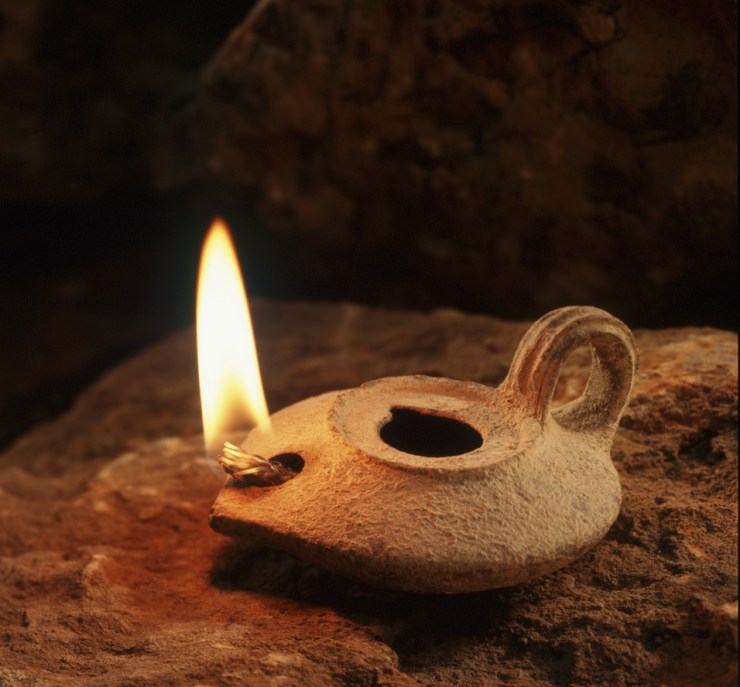
An oil lamp of an ancient design, one of the kinds that would have been used in the apostle John’s day. Each of the seven churches is symbolised as a golden lampstand (Revelation 1:20)―a stand upon which an oil lamp like this one would be placed. God intended each church to carry the light of His presence and truth in a darkened world around.
The plan of each message
All seven messages follow a similar pattern:
► Jesus commands John to write to each church.
►Jesus begins each message by telling them something about Himself―usually drawn from the vision of Him in the first chapter.
►Jesus tells the church what He knows about them.
►Where necessary, Jesus corrects the church, calls them to repent, and tells them how He’ll judge them if they don’t repent.
►He brings encouragement to faithful believers.
►Jesus says, “He who has an ear, let him hear what the Spirit says to the churches”.
►Jesus makes a wonderful promise to “the one who conquers”. The word conquer can also be translated as overcome or be victorious. It’s a key word in Revelation.
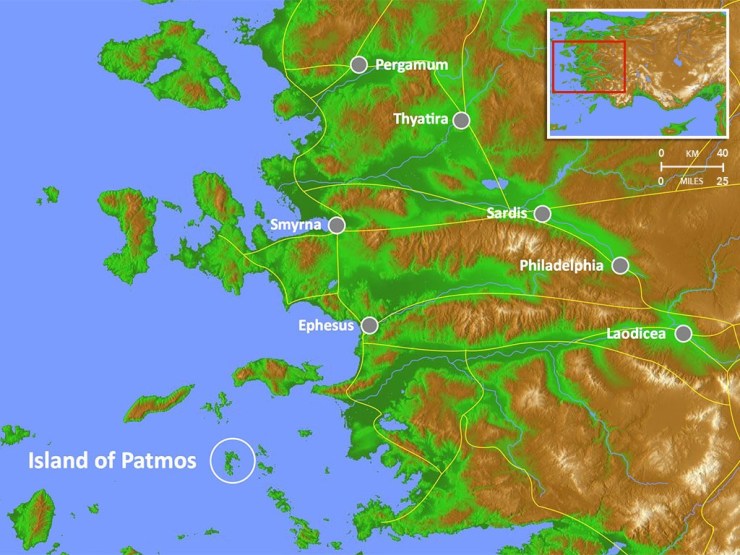
Image created by FreeBible Images using Accordance Bible Map software (CC BY-NC-SA 4.0)
Map showing the seven cities of Asia Minor, where the seven churches of Revelation were located. It also shows the position of the island of Patmos. The seven churches are addressed in the order that a messenger might travel to deliver the book to each church.
In the midst of a hostile world
These churches were in a world full of idolatry―worship of the Emperor and of pagan gods. And their cities were awash with sexual immorality. A visitor to these cities would have seen the temples and the altars―see the artist’s impression of the Temple of Artemis below. But they wouldn’t have seen any church buildings. To the outside world, local churches were all but invisible. Yet the churches were lampstands. They were to be alight with the presence of God, shining out into a darkened world. They were to be colonies of Heaven on Earth.
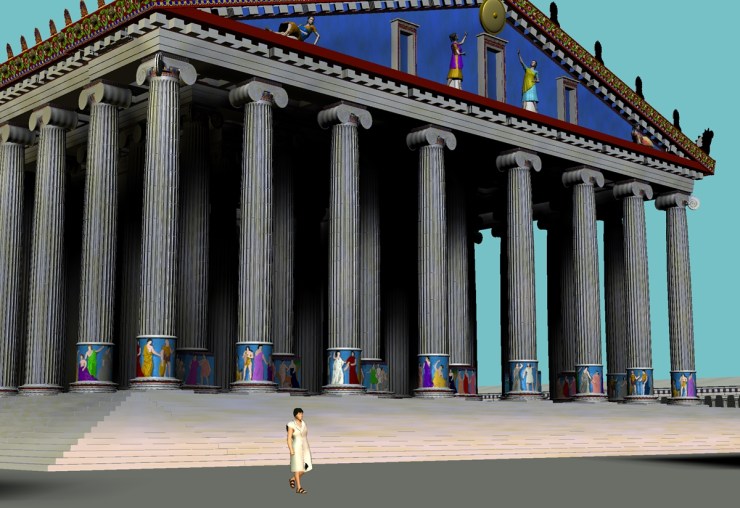
Digital reconstruction of the Artemis temple, west side courtesy of Cafeennui at Wikimedia Commons (CC BY-SA 3.0)
An artist’s impression of the west end of the Temple of Artemis in Ephesus. It was one of the ‘Seven Wonders of the Ancient World’, and would have been familar to the believers in Ephesus at the time Revelation was written.
In that Roman world, Christians were seen as disloyal, subversive and dangerous. Faithful believers faced harassment from the authorities, and from the society around them. And some faced opposition from Jews. Though persecution was, at that time, local and sporadic, there was the possibility that you might have to suffer and even die for Christ. A man called Antipas had indeed paid that ultimate price (2:13). Jesus said: “If the world hates you, know that it has hated me before it hated you. . . . . If they persecuted me, they will also persecute you.” (John 15:18–20).
We in the Western world today may not live surrounded by temples and idols. Of course, Christians in other cultures may well do. We do, however, have a secular, humanistic and materialistic society―a society that imposes subtle and not-so-subtle pressure on believers to conform to its ways.
Deceivers in the churches
But believers didn’t only face pressure from the world. They also faced pressure from within the churches. We’re told about those “who call themselves apostles and are not” (2:2), “Nicolaitans” (2:6,15), those “who hold the teaching of Balaam” (2:14), and a false prophetess referred to as “Jezebel” (2:20). Very probably, all these deceivers were encouraging believers to compromise―for example by going to feasts where pagan gods were honoured, and participating in Emperor worship. In this way, they could make life a lot easier for themselves. And at least some of these false teachers were also condoning “sexual immorality”. That refers to spiritual immorality―in other words, idolatry―and to immoral sexual behaviour.
Behind all this false teaching, of course, was Satan, “the deceiver of the whole world” (Revelation 12:9). So how do churches―and individuals―stop themselves from being deceived? Rule number one is this: know what the real thing looks like! We need to know the truth. Paul wrote: “All Scripture is breathed out by God and profitable for teaching, for reproof, for correction, and for training in righteousness” (2 Timothy 3:16). And, as we learn, we need to practise the truth―in all that we think and say and do.
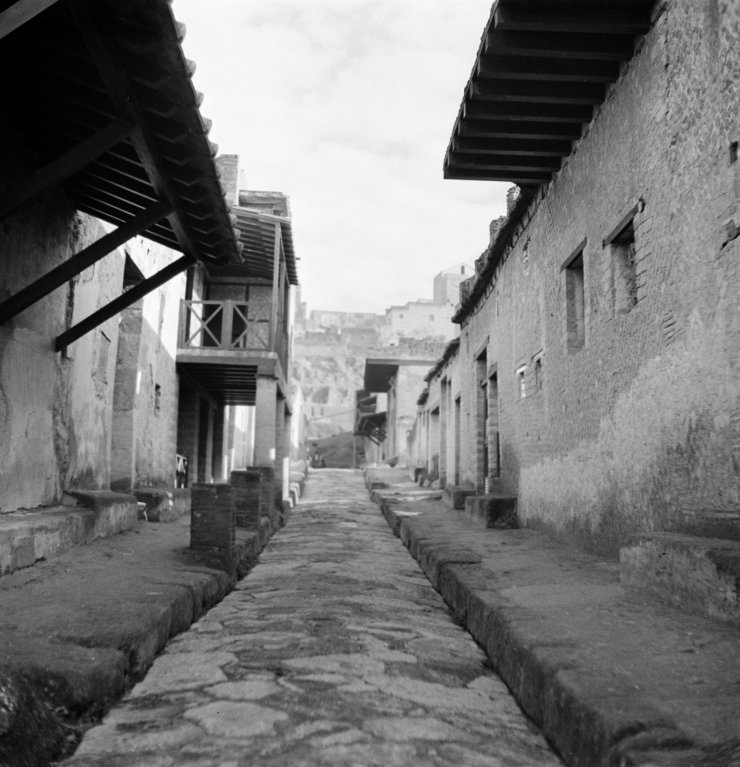
Image from Wikimedia Commons
A photo of an ancient street in the Roman town of Herculaneum. The city was buried by the eruption of Mount Vesuvius in AD 79. Excavations have revealed the remarkably preserved ruins of the city, one of the streets of which is shown here. The eruption was 10 to 15 years before Revelation was likely written; so this view takes us right back to the days of the early church.
Two sickly churches, two dead churches
Jesus knew all about these churches. To each church, He says, “I know”. Jesus sees beneath the surface, to their inner condition. Five are not in a healthy condition. Two of those five are dead.
Jesus said some very complimentary things about the churches in Pergamum and Thyatira. But in both cases there was a “But” (2:14,20). False teachers were at work. Two churches were in an even worse state. The church in Sardis had “the reputation of being alive”; but they were actually “dead”. A little life survived; but even that was ”about to die”. The church in Laodicea was in the worst condition of all. Jesus could find nothing to commend about it. The church had become thoroughly at home in the world around them. Jesus was blunt: this church made Him sick!
After His resurrection, Jesus said to His disciples “make disciples of all nations, . . . teaching them to observe all that I have commanded you” (Matthew 28:19-20). But the churches in Laodicea, Sardis, Pergamum, and Thyatira had, to varying degrees, allowed the world to make disciples of them, to teach them.
A loveless orthodox church
The church at Ephesus had a different problem. This church seemed to be a shining beacon in a dark city. But Jesus tells them, “you have abandoned the love you had at first” (2:4). Was this their love for Jesus or love among themselves? Probably both. Their relationship with God had cooled. Their love for His people had faded.
Two faithful churches
But the churches in Smyrna and Philadelphia received no rebuke from our Lord. In the midst of persecution and trouble, they had remained faithful to Him. And if they continued faithful, they’d receive a ”crown” (2:10, 3:11). This crown is a wreath of honour awarded, for example, to victors in the games or in battle. These churches no doubt felt weak and embattled in a world that despised them. That’s certainly how the world saw them. But that’s not how God saw them. Both received our Lord’s commendation. And that, in the end, is the only thing that matters.
God’s resistance movement
During the Second World War, resistance networks worked behind enemy lines to wage war against the occupying Nazi forces. Believers, too, are a resistance movement. John writes, “the whole world lies in the power of the evil one” (1 John 5:19). But Satan has no right to be here―Satan and his forces are an occupying power. It is Jesus who has all authority in heaven and on earth (Matthew 28:18).
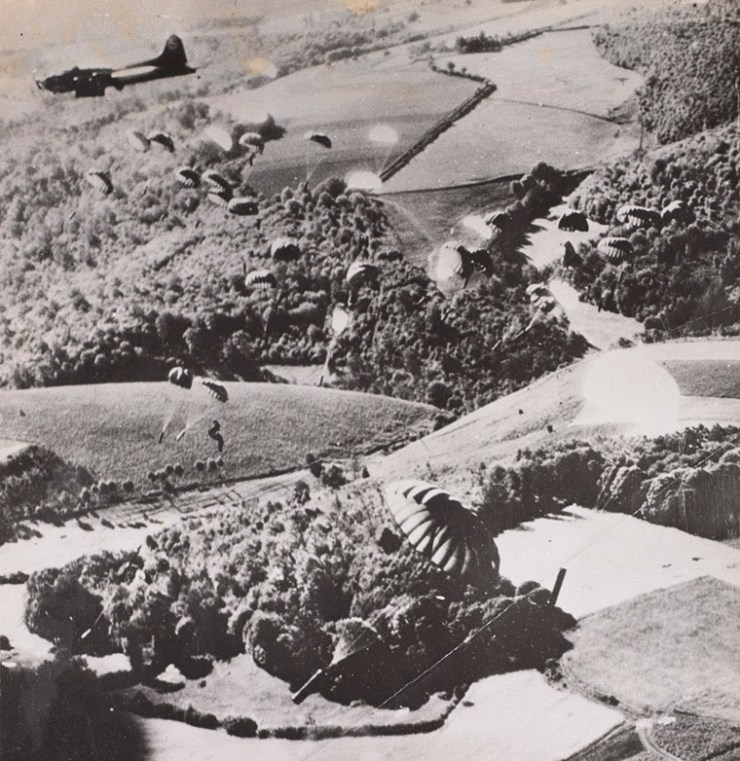
Image courtesy of the National Army Museum
Photo of dropping supplies by parachute to the French resistance during World War II, in 1944. We believers live in enemy-occupied territory. We’re to be God’s resistance movement, a counterculture in the midst of the culture of this world.
We are to be our Lord’s resistance fighters. We are a counterculture that challenges the culture of this world. We’re to bear witness to Jesus in our words and our lives. We’re to withstand and overcome Satan and his forces. We’re to play our part in plundering Satan’s kingdom and making “disciples of all nations” (Matthew 28:19). And in so doing, we will suffer. But God calls His people to be faithful to Him.
Our Lord’s promises
Only two churches were fully faithful to our Lord. Yet Jesus did not give up on any of these seven churches. They were precious to Him. He loved them (compare Ephesians 5:25–27). He wanted to present all seven churches to Himself in glorious splendour, holy and pure.
To each church, Jesus makes a wonderful promise to “the one who conquers”. Astonishingly, He gives His most amazing promise to the very worst church! To the church in Laodicea, He says, “The one who conquers, I will grant him to sit with me on my throne, as I also conquered and sat down with my Father on his throne” (3:20–21). And that word “throne” introduces us to what we see in the very next chapter.
If you have time, please read Revelation 2:1-3:22.
Question 1
Did anything especially impact you as you read through these seven messages to the churches in Asia?
Question 2
The Book of Revelation is sent to local churches. John writes, “John to the seven churches that are in Asia”, rather than, as Jude does, “Jude . . . to those who are called, beloved in God the Father and kept for Jesus Christ”. Why does God write this book to churches rather than to believers in general?
Question 3
Taken as a whole, what were the most pressing challenges that faced these seven churches in Asia? What do you think are the most pressing challenges for churches today?
CREDITS ► Text copyright © 2022 Robert Gordon Betts ► Unless otherwise indicated, all Scripture is taken from the ESV® Bible (The Holy Bible, English Standard Version®), copyright © 2001 by Crossway, a publishing ministry of Good News Publishers. Anglicized English Standard Version copyright © 2002 by Crossway. Used by permission. All rights reserved. The ESV text may not be quoted in any publication made available to the public by a Creative Commons license. The ESV may not be translated in whole or in part into any other language. ► Scripture quotations marked ‘NIV’ are taken from The Holy Bible, New International Version (Anglicised edition). Copyright © 1979, 1984, 2011 by Biblica (formerly International Bible Society). Used by permission of Hodder & Stoughton Publishers, an Hachette UK company. All rights reserved. ‘NIV’ is a registered trademark of Biblica (formerly International Bible Society). UK trademark number 1448790. ► Image on page 2 of an artist’s impression of the Temple of Artemis in Ephesus copyright © Cafeennui : commons.wikimedia.org and described as ‘Reconstruction done in Poser software of the west end of the temple of Artemis.’ Image published at https://commons.wikimedia.org/wiki/File:Temple_of_Artemis_Ephesus.png and made available under a Creative Commons Attribution-Share Alike 3.0 Unported licence (viewable at https://creativecommons.org/licenses/by-sa/3.0/deed.en). ► Image on page 3 of a street in Pompeii © BiblePlaces.com.
 Creation to New Creation - a Bible Overview

