
Five: The War of the Worlds
Introduction and Questions
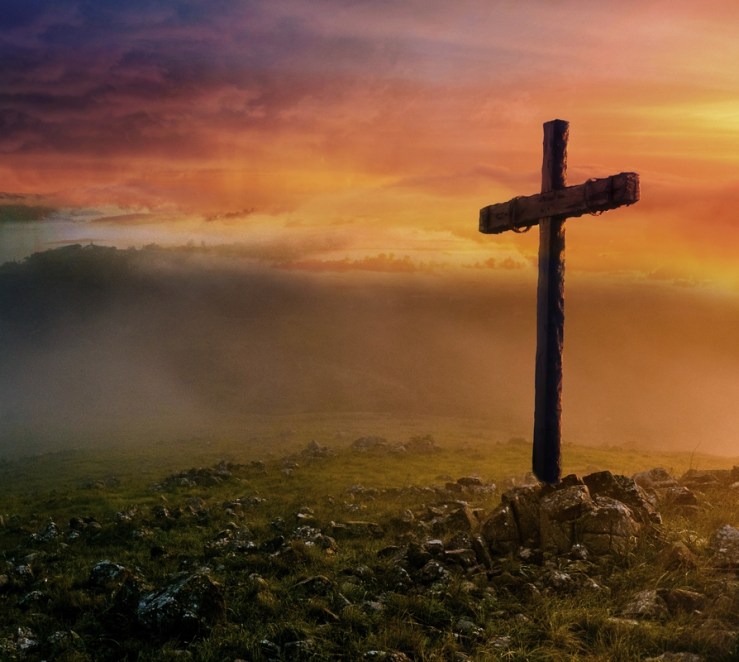
Image from Lightstock
The decisive event of God’s plan of salvation is the Cross―see Revelation 12:7-12. Through His death and resurrection, Jesus defeated Satan and all the forces of evil.
Click the icon below to download
a 4-page PDF version of this page.

Click the icon below to download
a 16-page Reader’s Guide
This explores Revelation 12:1-14:20 and 15:2-4 in more detail.
Victory over the dragon
Revelation 12:1 to 15:4 is ‘a story within the story’. It leads us through the whole Bible story from before the birth of Jesus to His coming again at the end of this age and the great Day of Judgment. This section is the heart of the whole book.
A “great sign” appears in heaven―“a woman clothed with the sun, with the moon under her feet, and on her head a crown of twelve stars” (12:1). This woman cries out “in birth pains” (12:2). Who is this woman? She seems to symbolise the nation of Israel, from which Jesus the Messiah was born.
Another sign appears in heaven. To our shock, it’s “a great red dragon, with seven heads and ten horns”. It bears ”seven crowns” on its heads (12:3 NIV). This dragon is none other than “that ancient serpent, who is called . . . Satan, the deceiver of the whole world” (12:9). With a great swish of its tail this dragon sweeps down “a third of the stars of heaven” and casts them ”to the earth” (12:4). Then the murderous dragon waits, ready to devour the woman’s child. Tragedy seems inevitable.
The woman bears “a male child”―Jesus, destined “to rule all the nations with a rod of iron” (12:5). But Jesus is “caught up to God and to his throne” (12:5): He ascends to His Father in Heaven. The dragon fails to devour Him.
How did this happen? The next few verses explain. They tell of war in Heaven: ”Michael and his angels” do battle against ”the dragon and his angels” (12:7). All the battles of the world taken together pale into insignificance before this great battle. Satan, the dragon, is ”defeated” (12:8)! He’s “thrown down to the earth, and his angels . . . with him” (12:9). There’s “no longer any place for them in heaven” (12:8). A jubilant voice rings out, “Now the salvation and the power and the kingdom of our God and the authority of his Christ have come” (12:10). The voice continues: “for the accuser of our brothers has been thrown down . . . .” (12:10).
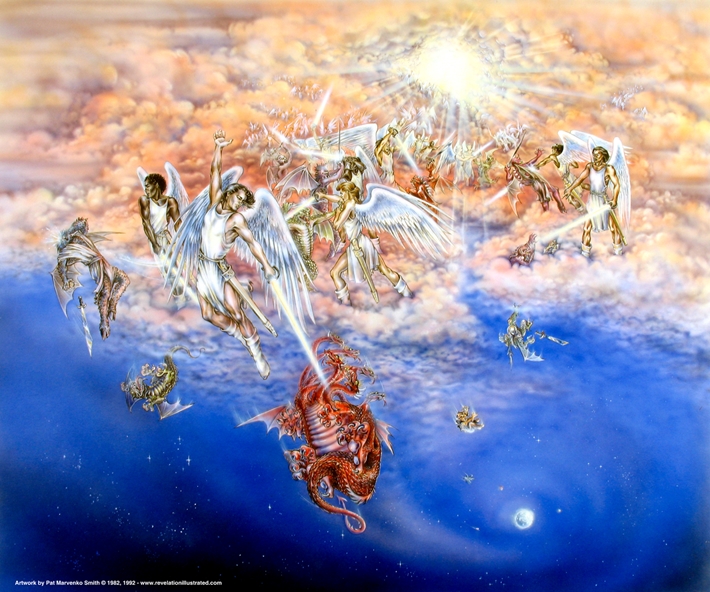
Artwork by Pat Marvenko Smith © 1982, 1992 at RevelationIllustrated.com
“Now war arose in heaven, Michael and his angels fighting against the dragon. And the dragon and his angels fought back, but he was defeated, and there was no longer any place for them in heaven. And the great dragon was thrown down, . . . and his angels were thrown down with him.” (Revelation 12:7-9).
How was Satan defeated? The decisive blow was Jesus’s death. Satan, “the accuser”, has no more right to accuse God’s people. Why? Because God has justified us! On the Cross, Jesus endured the penalty for our sins. So God has declared us believers ‘not guilty’! And He grants us “the free gift of righteousness” (Romans 5:17). Now we’re in right relationship with God. And so, as Paul asks, “Who shall bring any charge against God’s elect? It is God who justifies” (Romans 8:33). Satan has no legal case against us any more! God’s people ”have conquered” Satan “by the blood of the Lamb”―by what Jesus achieved for them on the Cross.
And God’s people have conquered Satan by their faithful lives and by their faithful witness to Jesus. They’ve conquered him ”by the word of their testimony, for they loved not their lives even unto death” (12:11).
The dragon’s final campaign
Satan is now a defeated foe. Little time is left to him (12:12), and he is desperate. Like an ensnared and raging beast, he tries to inflict as much damage as he can before he meets his doom.
He pursues the woman (12:13), who now represents God’s New Testament people. But she “was given the two wings of the great eagle so that she might fly . . . into the wilderness” (12:14). There she has ”a place prepared by God” (12:6), a place where she’s “to be nourished for 1,260 days” (12:6). The dragon spews out a torrent of water―a stream of slander, lies and deceit, oppression and persecution―“to sweep her away with a flood” (12:15). But in the midst of tribulation, God protects and provides for His people. Satan can ultimately do us no harm at all.
Enraged with the woman, the dragon goes off ”to make war on the rest of her offspring, on those who keep the commandments of God and hold to the testimony of Jesus” (12:17). Who are these offspring? Most probably, they’re individual believers.
The dragon calls a terrifying monster from out of the sea; it has “ten horns and seven heads, with ten crowns on its horns, and on each head a blasphemous name” (13:1 NIV). This horrific beast seems to picture every government or economic power that has ever asserted itself against God and His people. In John’s day that power was the Roman Empire. There have been many others; such powers, of course, exist today. Shortly before Jesus’s coming, it seems that a single individual―the final Antichrist―will emerge, heading up a dominant global power that unleashes the final and most terrible persecution of God’s people.
This beast acts as Satan’s ‘christ’. It’s a counterfeit ‘christ’. It slanders God, and demands worship. It “was allowed to make war on the saints and to conquer them” (13:7). But behind all the events of history is the hand of God. God is in complete control. Like a chained animal, Satan and all his forces can go so far, but not a millimetre further.
Another beast appears; it rises “out of the earth” (13:11). It has “two horns like a lamb”. But this is no lamb―it speaks ”like a dragon” (13:11). We’ve met this beast in the last session: it’s “the false prophet” (16:13). It mimics the Holy Spirit. The Holy Spirit glorifies Christ (John 16:14); this false prophet “makes the earth and its inhabitants worship the first beast”―Satan’s false ‘christ’ (13:12). The Holy Spirit guides us into truth (John 16:13); the false prophet performs “great signs”, by which ”it deceives those who dwell on earth” (13:13-14).
The beast from the earth causes everyone “to be marked on the right hand or the forehead” with ”the name of the beast or the number of its name” (13:16-17). What is that number? We’re given a clue: “it is the number of a man, and his number is 666” (13:18). In 7:2-8, we saw 144,000 sealed “with the seal of the living God” on “their foreheads”. People either bear the seal of God or the mark of the beast. Which will it be?
The followers of the Lamb
We now find ourselves in the pure, clear air of “Mount Zion”, God’s “holy mountain” (for example, Psalm 48:1-3). There John sees ”the Lamb”. With Him are His people: “144,000 who had his name and his Father’s name written on their foreheads” (14:1). We’ve met these ‘144,000’ before (7:2-8).
John hears heavenly voices “singing a new song” (14:3). We’ve heard “a new song” before (5:9)―that song is most probably the one we hear now. Who is singing? Probably the ‘144,000’. They’ve been ”redeemed from mankind as firstfruits for God and the Lamb”. They’re undefiled and “follow the Lamb wherever he goes” (14:4). They are the pure Bride of Christ, ”a radiant church, . . . holy and blameless” (Ephesians 5:27 NIV).
Three angels’ messages
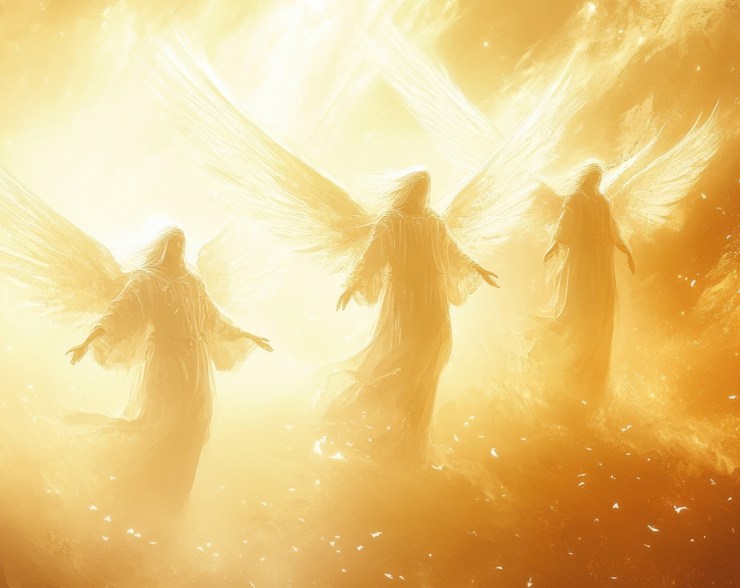
Image from Lightstock
John sees three angels, each with a vital message for this world.
John sees three flying angels. The first has “an eternal gospel to proclaim to those who dwell on earth . . . .” (14:6). The second angel cries “Fallen, fallen is Babylon the great” (14:8)―the city that symbolises godless human civilisation. A third angel adds, “If anyone worships the beast and its image and receives a mark on his forehead or on his hand, he also will drink the wine of God’s wrath . . . .” (14:9-10). Judgment is coming. Our merciful God is warning unrepentant sinners of what awaits them. He’s sending out an urgent call to repent and receive His offer of salvation through Jesus Christ.
John pauses to call God’s people to “patient endurance” (14:12 NIV), echoing 13:10 NIV. Our patient endurance will be rewarded; a voice from heaven tells John: “Write this: Blessed are the dead who die in the Lord from now on” (14:13). The Spirit Himself adds, “Blessed indeed, . . . “ (14:13).
The harvest of the Earth
Earth’s harvest is ripe. The time for reaping has come. John sees “a white cloud”; on it “one like a son of man” is seated, wearing “a golden crown” (14:14). King Jesus comes to judge the Earth. With ”a sharp sickle” (14:14), He reaps the Earth. This seems to be a grain harvest―almost certainly symbolising the harvest of God’s people. Then an angel gathers “the grape harvest of the Earth” and throws it ”into the great winepress of the wrath of God” (14:19). Out of the winepress flows, not wine, but ”blood” (14:20). On the great day of judgment, will people be ‘grain’ or ‘grapes’? Will they be citizens of New Jerusalem? Or will they be thrown into His winepress to be trodden in God’s wrath “outside the city”?
The song of the conquerors
Seven angels ”with seven plagues” emerge from God’s heavenly sanctuary. Then John sees “what appeared to be a sea of glass mingled with fire” (15:2). Beside this sea are “those who had conquered the beast and its image and the number of its name” (15:2). They remained faithful to their Lord―through tribulation, for some even through death. Now we see them victorious! Just listen to this glorious song of praise that these conquerors sing! It’s ”the song of Moses, . . . and the song of the Lamb” (15:3). The song of Moses celebrated the exodus from Egypt. The “song of the Lamb” celebrates a new exodus―an exodus accomplished through Jesus’s death and resurrection.
Judgment on a sin-soaked world
With this glorious song of praise ringing in our ears, we’re again taken back in time. The “seven angels” are given “seven golden bowls full of the wrath of God” (15:7). God now unleashes another set of judgments upon a sin-soaked world. We saw those judgments in the previous session.
Then, after these judgments, one of these seven angels says to John, “Come, I will show you the judgment of the great prostitute . . . .” (17:1). Now begins the final destruction―step by step―of all the forces of evil. That’s what we’ll look at in the next session.
If you have time, please read Revelation 12:1-14:20 and 15:2-4.
Question 1
We read that God’s people “have conquered” Satan “by the blood of the Lamb” (12:11). How exactly do they conquer him by the Lamb’s blood? Passages that are helpful here include Revelation 1:5 and 5:9-10, and Colossians 2:13-15. We read that they have also conquered Satan “by the word of their testimony, for they loved not their lives even unto death” (12:11). What is “the word of their testimony”, and how does it defeat Satan?
Question 2
In 12:14-16 we read that God gives wings to the woman (who symbolises God’s people), so she can fly into the wilderness―a place where God nourishes and protects her. But then in 12:17 we learn, to our shock, that the beast from the sea is allowed to “conquer” God’s people (13:7). How can we reconcile God’s protection of His people, with their conquest by this beast?
Question 3
In 7:2-8 we see 144,000 sealed with “the seal of the living God . . . on their foreheads” (compare 14:1 and 22:4). In 13:16 we that the second beast ’s mark, that is, “the name of the beast or the number of its name” (13:17), is applied to “the right hand or the forehead”. The seal of God and the mark of the beast seem to be direct opposites of each other. What do you think the seal and the mark might be?
CREDITS ► Unless otherwise indicated, all Scripture is taken from the ESV® Bible (The Holy Bible, English Standard Version®), copyright © 2001 by Crossway, a publishing ministry of Good News Publishers. Anglicized English Standard Version copyright © 2002 by Crossway. Used by permission. All rights reserved. The ESV text may not be quoted in any publication made available to the public by a Creative Commons license. The ESV may not be translated in whole or in part into any other language. ► Scripture quotations marked ‘NIV’ are taken from The Holy Bible, New International Version (Anglicised edition). Copyright © 1979, 1984, 2011 by Biblica (formerly International Bible Society). Used by permission of Hodder & Stoughton Publishers, an Hachette UK company. All rights reserved. ‘NIV’ is a registered trademark of Biblica (formerly International Bible Society). UK trademark number 1448790.
 Creation to New Creation - a Bible Overview