
Four: Crashing Waves of Judgment
Introduction and Questions
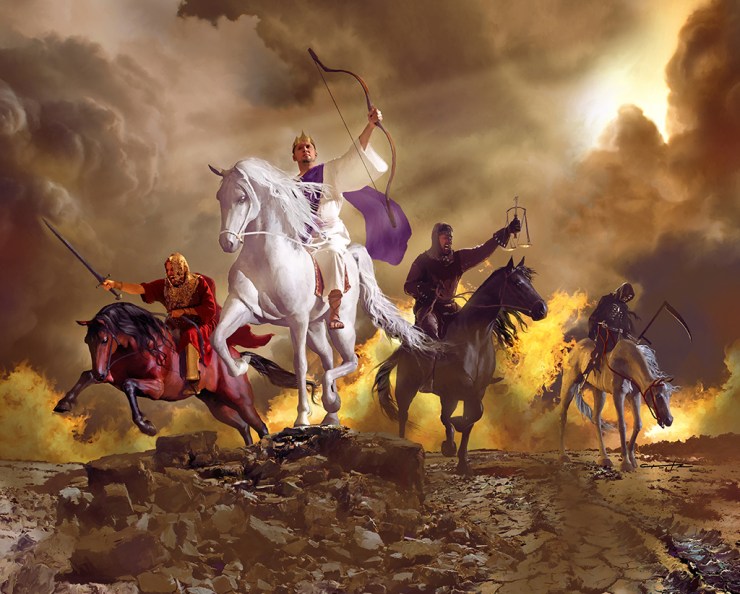
Image © Steve Creitz at ProphecyArt.com
An artist’s depiction of the four horsemen who bring the judgments unleashed by the opening of the first four seals of the scroll (Revelation 5:1-8)―the ‘four horsemen of the apocalypse’.
Click the icon below to download
a 4-page PDF of this page.

Click the icon below to download
a 16-page Reader’s Guide
This explores Revelation 6:1-11:19, 15:1 and 15:5-16:21 in more detail.
Three sets of seven judgments
We now arrive at perhaps the most challenging―and at times, disturbing―section of Revelation. Perhaps this is the section of the course you’ve been anticipating most!
The Lamb begins to open the scroll―the scroll He took “from the right hand of him who was seated on the throne” (Revelation 5:7). Three series of seven judgments sweep across the Earth. The first set is heralded by the opening of the seals (6:1-17, 8:1,3-5); the second by the blowing of seven trumpets (8:2, 8:6-9:21), and the third by the emptying of seven bowls (15:1, 15:5-16:21).
When do these judgments occur? There are a number of views:
● One view sees the judgments as taking place primarily in the first century AD.
●Another view sees the judgments as taking place in the order described, one set after the other, through history from the first century AD to Christ’s return.
●A third view sees them all taking place in the future, during a brief time before Jesus’s Second Coming.
●A fourth view sees all three sets of judgments as all taking place during the whole period between from Pentecost to our Lord’s return, in other words, parallel, rather than one after the other.
Overall, the fourth view seems most plausible. It seems that we’re seeing God’s judgments three times, but each time from a different camera angle. But it’s also clear that, overall, the judgments get more severe. These various judgments may occur multiple times during these “last days”. So at any one time in history, for example, one division of society may be suffering more limited judgment, whilst a nation in another part of the world may be suffering devastating judgment.[1][2] But as the Lord’s return draws near, they’ll doubtless become more universal, impacting the whole world. All three sets of judgments end with Christ’s return and the Day of Judgment. This is supported by the fact that they all end in a storm, a sign of God’s all-powerful presence here on Earth (Revelation 8:5, 11:19 and 16:18).
Revelation doesn’t give us a precise timetable. But we do know that history is moving ever more swiftly to the time when ”all the tribes of the earth will mourn, and they will see the Son of Man coming on the clouds of heaven with power and great glory” (Matthew 24:30).
And remember what we saw in the previous sessions. God is seated on the throne of the Universe. Behind all the events of history is the hand of God.
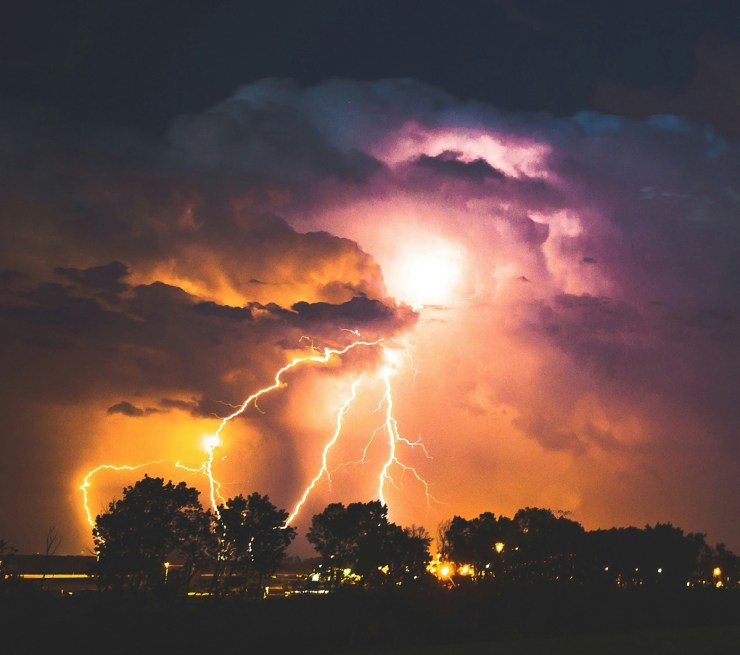
Image courtesy of Max LaRochelle at Unsplash (Unsplash licence)
All three sets of judgments end in a storm, signalling Christ’s return to Earth and the Day of Judgment (Revelation 8:5, 11:19 and 16:18).
God’s purposes in judgment
These judgments are described in symbolic language. We don’t know exactly how they impact this world.
Firstly, God allows mankind to go their own way. In Romans 1:24,26,28 we read that God “gave . . . up” sinners to pursue their sin. Here in Revelation, God does the same. He isn’t simply allowing sin to take its course. He’s actively handing over mankind to this downward spiral of chaos and destruction, and demonic oppression. And when mankind have their own way, they will destroy themselves. Always. But God allows that inevitable downward spiral to go only so far. God restrains evil so that many, many people have the opportunity to repent and be saved.
Secondly, God dispenses―in various ways and on various occasions―direct judgment on this rebellious world.
And as we read through these chapters, we see an escalation of these judgments’ impact. The trumpet judgments are more severe than the seal judgments; the bowl judgments are more severe than the trumpet judgments. And within the trumpet judgments, the fifth and sixth are more severe than the first four; the fifth bowl judgment is more severe than the first four. God is increasing the pressure on a world that’s turned its back on Him.
What is God doing here? He’s ravaging every means by which mankind can live securely and comfortably without Him. God is bringing people to their senses, driving home the fact that He is God, that He has first claim on their lives, that they cannot live apart from Him. God is full of mercy. We see this time and again in Revelation. God wants people to repent from their sin, and cry out to Him for salvation. As Peter writes: “The Lord is not slow to fulfill his promise as some count slowness, but is patient toward you, not wishing that any should perish, but that all should reach repentance” (2 Peter 3:9).
And through these judgments, God speaks to His churches. Remember what God said to those churches who were compromising with this world. He called them to repent (2:16, 21-22, 3:3,19). This world―the world they were consorting with―is under God’s judgment. It is facing eternal ruin. Will they share its ruin?
The place of God’s people
But in the midst of all these judgments, what’s happening to God’s people? And what are they doing?
●We see “144,000” who are sealed “from every tribe of the sons of Israel” (7:1-8).
●We see “a great multitude” who’ve passed triumphantly through tribulation, ”standing before the throne and before the Lamb” (7:9) and crying out “Salvation belongs to our God who sits on the throne, and to the Lamb!” (7:10). They “have washed their robes and made them white in the blood of the Lamb” (7:14), and serve God “day and night in his temple” (7:15). The Lamb “will be their shepherd” (7:17).
●In the hand of a “mighty angel” is “a little scroll”, open (10:1-2). A voice tells John to take and eat it. John finds that it’s sweet to taste, but bitter to digest. Then John is commanded to prophesy “about many peoples and nations and languages and kings” (10:11).
●John is commanded to measure “the temple of God . . . and the altar and those who worship there”, but not “the court outside the temple” (11:2). As we’ll see, these all symbolise God’s people. And “the holy city”―another symbol of God’s people―is trampled by “the nations” (11:2).
●We see “two witnesses”―another symbol for God’s people (11:3). They warn the nations of God’s judgment, and proclaim the gospel of Jesus Christ. And God confirms their message with judgments. The beast―symbolising godless powers―kills them. But God resurrects them. And, in the wake of an earthquake, it seems their testimony bears fruit―many people are “terrified” and give “glory to the God of heaven” (Revelation 11:13).
●And God’s people pray. We see “under the altar the souls of those who had been slain for the word of God and for the witness they had borne” (6:9). They’re praying, “O Sovereign Lord . . . how long before you will judge and avenge our blood on those who dwell on the earth?” (6:10). They’re not seeking personal revenge; they’re calling for God to bring justice. And before the trumpet plagues are unleashed, an angel is ”given much incense to offer with the prayers of all the saints on the golden altar before the throne, and the smoke of the incense, with the prayers of the saints, rose before God . . . .” (8:3-4). Surely, they’re praying what our Lord taught us to pray: “Our Father in heaven, . . . . Your kingdom come, your will be done, on earth as it is in heaven” (Matthew 6:9–10).
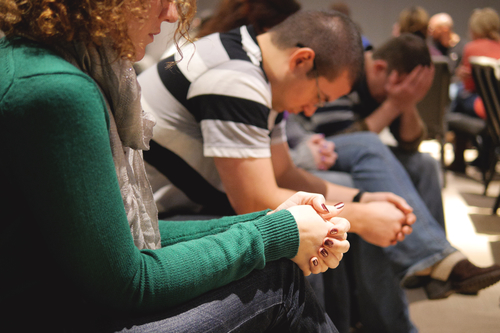
The prayers of God’s people play a key role in the events we see in these chapters of Revelation.
Armageddon
And, as this age draws to a close, Satan and his forces lure “the kings of the whole world” to the final, decisive battle against God. They march to the place called “Armageddon” (16:14,16). This name has passed into language and legend as the apocalyptic battle of the end times. The battle of Armageddon is the final assault of the forces of evil on God’s people at the end of this age. We don’t know how this battle will play out in earthly terms. It must inevitably involve violence in its outworking―God’s people will doubtless suffer physical persecution, and even death. But it’s essentially a spiritual battle. Here in 16:12-16, we don’t see the battle itself. But we do see the preparations for the battle. We see the actual battle in 19:11-21 and again in 20:7-10.
If you have time, please read Revelation 6:1-11:19, 15:1-16:21.
Question 1
What impacts you most as you read through these chapters?
Question 2
There are a number of images of God’s people in these chapters. What are they? Why does God give us multiple images of His people? What do you think each image shows us about them?
Question 3
What is “the great tribulation” (7:14)?
Question 4
In John’s Gospel, we read: “For God so loved the world, that he gave his only Son, that whoever believes in him should not perish but have eternal life.” (John 3.16). Yet, here in Revelation, we see God sending these plagues on the earth. How do we reconcile this with God’s love? (7:14)?
CREDITS ► Text copyright © 2026 Robert Gordon Betts [1] See The Overcomers: Discovering Hope in the Book of Revelation, Second Edition, pages 131-132. Published by Jordan Publishing, Anderson, Indiana, undated. [2] See Our God Reigns! An Amillennial Commentary on Revelation by Sam Storms, pages 213-217. Published by Mentor, an imprint of Christian Focus Publications Ltd., Fearn, Ross-shire, Scotland, United Kingdom, in 2024. ► Unless otherwise indicated, all Scripture is taken from the ESV® Bible (The Holy Bible, English Standard Version®), copyright © 2001 by Crossway, a publishing ministry of Good News Publishers. Anglicized English Standard Version copyright © 2002 by Crossway. Used by permission. All rights reserved. The ESV text may not be quoted in any publication made available to the public by a Creative Commons license. The ESV may not be translated in whole or in part into any other language. ► Scripture quotations marked ‘NIV’ are taken from The Holy Bible, New International Version (Anglicised edition). Copyright © 1979, 1984, 2011 by Biblica (formerly International Bible Society). Used by permission of Hodder & Stoughton Publishers, an Hachette UK company. All rights reserved. ‘NIV’ is a registered trademark of Biblica (formerly International Bible Society). UK trademark number 1448790.
 Creation to New Creation - a Bible Overview