
Six: Destruction and Death to the Devil’s Domain
Introduction and Questions
Click the icon below to download
a 4-page PDF of this page.

Click the icon below to download
a 16-page Reader’s Guide
This introduces the Book of Revelation
and explores Revelation 17:1-20:15 in more detail.
A tale of two cities
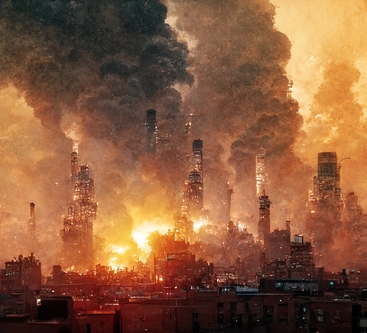
Image from Lightstock
Babylon―symbolising godless civilisation under Satan’s domination―will be destroyed. We read, “For this reason her plagues will come in a single day, death and mourning and famine, and she will be burned up with fire; for mighty is the Lord God who has judged her” (18:8).
In part 4, we saw three sets of seven judgments unleashed upon this world. In the final judgment, an angel emptied his bowl “into the air” and God declared “It is done!” (16:17). There was a storm and earthquake―a sign of God’s presence on Earth. The ”great city was split into three parts, and the cities of the nations fell, and God remembered Babylon the great, to make her drain the cup of the wine of the fury of his wrath” (16:19).
Now, from 17:1 to the end of Revelation, that city Babylon and her counterpart, New Jerusalem, dominate our vision. Babylon symbolises mankind’s godless civilisation under Satan’s domination and in rebellion against God. New Jerusalem symbolises God’s perfect world where He reigns.
Babylon and the beast
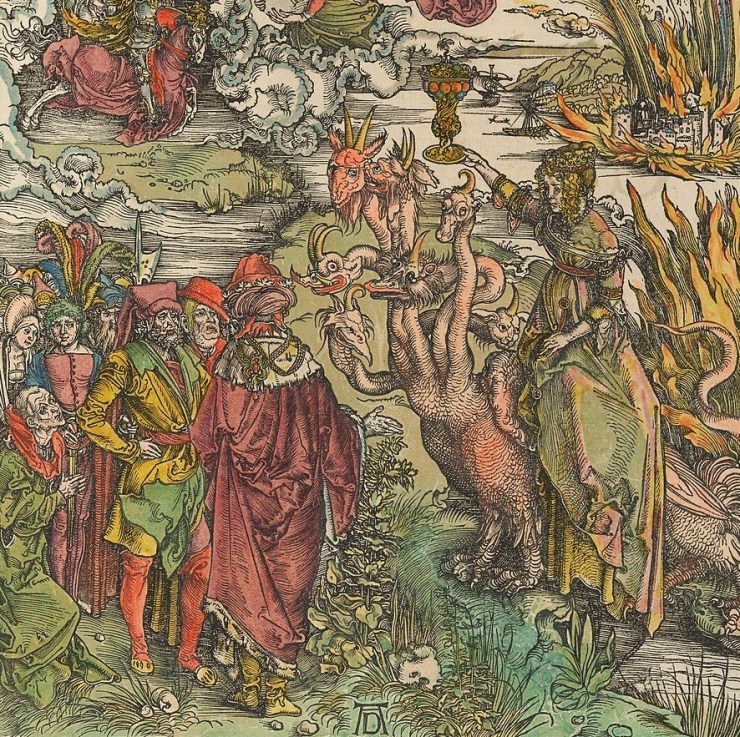
Illustration from Apocalipsis cu[m] figuris, Nuremburg: 1498, by Albrecht Dürer (1471-1528). Image on Wikimedia. Credit: Typ Inc 2121A, Houghton Library, Harvard University.
John writes, “I saw a woman sitting on a scarlet beast that was full of blasphemous names, and it had seven heads and ten horns” (17:3). This is a detail from a woodcut illustration by Albrecht Durer in the book Apocalipsis cu[m] figuris, published in Nuremburg in 1498.
John sees “a woman sitting on a scarlet beast” (17:3). She bears a name: “Babylon the great, mother of prostitutes and of earth’s abominations” (17:5). The beast she’s sitting on ”was full of blasphemous names, and it had seven heads and ten horns” (17:3). This scarlet beast is, without doubt, the beast from the sea (13:1-2)―Satan’s counterfeit ‘christ’. The woman sits on the beast; she’s in league with it.
That beast seems to picture every regime and power that has ever opposed God and His people. It seems to represent the state, that is political and military power. The woman seems to represent godless civilisation―civilisation that’s birthed, nourished and protected by political and military power.
The woman and the beast collaborate to persecute God’s people. The beast is “allowed to make war on the saints and to conquer them” (13:7): Babylon is drunk with their blood (17:6).
An angel explains the mystery of this woman and the beast. This beast imitates Christ; it also imitates God. As we’ve said, it seems to picture every godless regime and power. But we’re also shown what must surely be a final regime―one that will be headed up, it seems certain, by the Antichrist. This final regime is pictured as “ten kings” (17:12). They seem to symbolise a global alliance of powers that forms Antichrist’s powerbase. These kings “will make war on the Lamb” (17:14). But “the Lamb will conquer them for He is Lord of lords and King of kings” (17:14). The Lamb is accompanied by those who “are called and chosen and faithful” (17:14). It seems certain that this is the last battle that’s fought at our Saviour’s Second Coming. We’ll learn more about this battle shortly.

ID 36330368 © Flynt | Dreamstime.com
The Antichrist’s regime is supported by “ten kings” (17:12) who seem to symbolise a global alliance of powers.
But meanwhile, before that battle, we see Satan’s kingdom convulsed by civil war. Evil always bears the seeds of its own destruction. And so it is here. The ten horns on the beast, along with the beast itself, ”will hate the prostitute” and utterly destroy her. They’ll “make her desolate and naked, and devour her flesh and burn her up with fire” (17:16). It seems that the political and military power destroys the very civilisation that it brought into being. Throughout history, civilisation has been―and continues to be―laid waste by war and conflict. The final climactic destruction of civilisation will, no doubt, occur at the end of the age. It seems we’re seeing that final destruction here.
But, once again, behind these scenes is the hand of Almighty God (17:17). Godless civilisation is ripe for God’s judgment. But it’s Satan’s forces which execute God’s justice upon it. Evil is serving the purposes of God.
Babylon’s judgment will be swift and total. Her plagues “will come in a single day, death and mourning and famine, and she will be burned up with fire” (18:8). Gathered round her funeral pyre are the mourners: ”the kings of the earth” (18:9), “the merchants of the earth” (18:11) and ”all shipmasters and seafaring men, . . . and all whose trade is on the sea” (18:17). Babylon persecuted God’s people. God has now “avenged on her the blood of his servants” (19:2). God has answered the prayers of His people.
The marriage of the Lamb has come!

Image from Lightstock
“Blessed are those who are invited to the marriage supper of the Lamb” (19:9).
Heaven’s courts are filled with a jubilant roar of praise. Then John hears “what seemed to be the voice of a great multitude, . . . .” roaring and thundering, “the marriage of the Lamb has come, and his Bride has made herself ready” (19:6-7). Radiant in clean and shining white, the Bride is ready to be married to the Lamb. This marriage supper symbolises the perfect, eternal fellowship of Christ with His people―and through Him, with the Triune God.
The last battle
Babylon is now a smoking ruin. The marriage of the Lamb has come; His Bride is ready. But the beast and its followers are still at large. The false prophet still deceives. The dragon still threatens. Before the Lamb and His Bride can celebrate their marriage, the last battle must be fought.
John sees heaven open. On a white warhorse sits a mighty Warrior. He is, of course, Jesus Christ. On His head “are many crowns” (19:12 NIV). “On his robe and on his thigh” is written: ”King of kings and Lord of lords” (19:16, echoing 17:14). He’s called “The Word of God” (19:13). From His mouth comes “a sharp sword with which to strike down the nations” (19:15). Following Him on white horses are ”the armies of heaven” (19:14), clad ”in fine linen, white and pure” (19:14)―these seem certain to be God’s people. It seems we’re seeing the battle at Armageddon (see 16:16)―the last battle, the one we saw in 17:12-14.
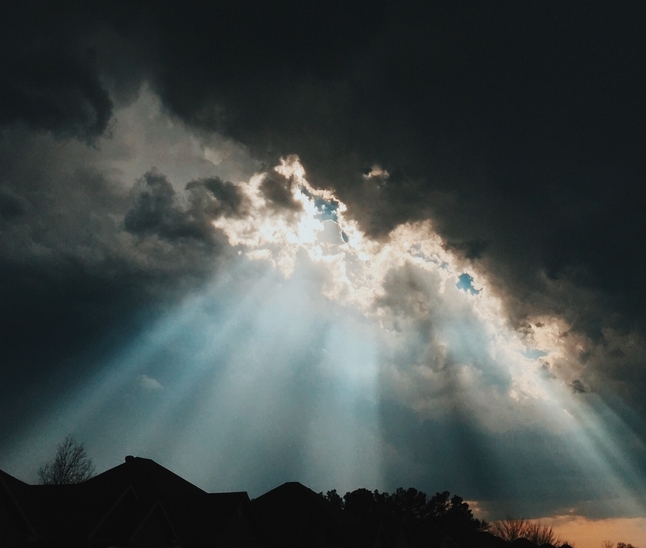
Image from Lightstock
The battle of Armageddon is essentially a spiritual battle. It’s symbolised by the preview in 17:12-14, and the battles in 19:11-21 and 20:7-10. It takes place “on the great day of God the Almighty” (16:14), the day when Jesus returns.
How is this great and final battle fought? Seemingly, not on a battlefield, but in a lawcourt; not with weapons of steel, but with truth and error. Satan, the beast and the false prophet are deceivers: they’re defeated by the truth―by the One who is “the truth” (John 14:6), the One who is “The Word of God” (19:13). The beast and the false prophet are captured and “thrown alive into the lake of fire that burns with sulphur” (19:20). The worldly regimes and the belief systems that supported them are destroyed. And with His sword―His word of judgment―Jesus slays “the kings of the earth with their armies” (19:19-21). And “all the birds were gorged with their flesh” (19:21).
The Millennium
An angel seizes Satan and binds him ”for a thousand years” (20:2). He throws him ”into the Abyss” (20:3 NIV), locks it and seals it over him. Thus begins one of the most debated passages in the whole Bible. There are a number of views. They’re outlined briefly in the full notes. We’ll take the view that seems in greatest harmony with the rest of the Bible.
When does “the thousand years” begin? It begins when the angel “threw” Satan “into the Abyss”. This seems to reflect what we read in 12:9: there we saw that Satan “was thrown down to the earth”, along with his angels. Revelation 12:7-10 records what happened at the Cross. It seems likely that 20:1-3 is giving us another angle on this event. If so, then we can conclude that Jesus bound Satan at the Cross.
But Satan is still very active. So how exactly is he bound? Firstly, Satan is ultimately powerless to thwart the gospel outreach to the nations. Secondly, Satan can’t yet gather the nations for the final attack on God’s people―in other words, for the battle of Armageddon. He can come out “to deceive the nations . . . to gather them for battle” only after the Millennium (20:8).
After the thousand years “Satan will be released from his prison” (20:7). He springs into action “to deceive the nations that are at the four corners of the earth, Gog and Magog, to gather them for battle” (20:8). This vast and menacing horde besieges “the camp of the saints and the beloved city” (20:9). It seems certain that we’re seeing the battle of 17:12-14 and 19:11-21 again, the last battle, the one that’s fought when Jesus returns to Earth at the end of this age. What we read here completes the account.
In 19:20-21 we saw the beast and the false prophet thrown into the lake of fire, and the kings of the Earth and their armies killed. Here in 20:7-10, the nations are consumed by fire from heaven, and Satan himself is thrown into the “lake of fire and sulphur where the beast and the false prophet were”.
What are God’s people doing during the thousand years? John sees ”thrones”; sitting on them are“those to whom the authority to judge was committed” (20:4). John also sees “the souls of those who had been beheaded for the testimony of Jesus and for the word of God, and those who had not worshipped the beast . . . .” (20:4). These seem most likely to be all faithful believers―not just the martyrs. All of them “loved not their lives even unto death” (12:11).
They “came to life and reigned with Christ” for the ‘thousand years’. Their coming to life is ”the first resurrection”. Over them ”the second death has no power”. They are ”blessed and holy”. And what a blessed and holy calling they have! They’ll be ”priests of God and of Christ”, and reign with Christ for a thousand years (20:4-6).
What is “the first resurrection”? Perhaps it’s the “resurrection” of believers who die before Jesus’s return―this ”resurrection” being their entrance into His presence in Heaven. Perhaps it’s believers’ bodily resurrection at His coming―if so, we’re looking ahead to the new creation. Perhaps it’s new birth―after all, we have “passed from death to life” (John 5:24), and we serve and share Christ’s rule here and now. What we do know is that they’re “with Christ” (20:4, see 20:6). And, in the end, that’s all that really matters. But perhaps the key thing to learn is this: Satan is imprisoned and bound. In contrast, God’s people―whom Satan and his forces once attacked, live and reign with Christ. They, and not Satan, are the victors.
The last judgment
A ”great white throne” appears, “and him who was seated on it” (20:11). The great and final judgment of the world has come. John sees “the dead . . . standing before the throne” (20:12). Books are “opened” (20:12). Then ”another book” is opened―“the book of life” (20:12). Everyone is judged ”by what was written in the books, according to what they had done” (20:12).
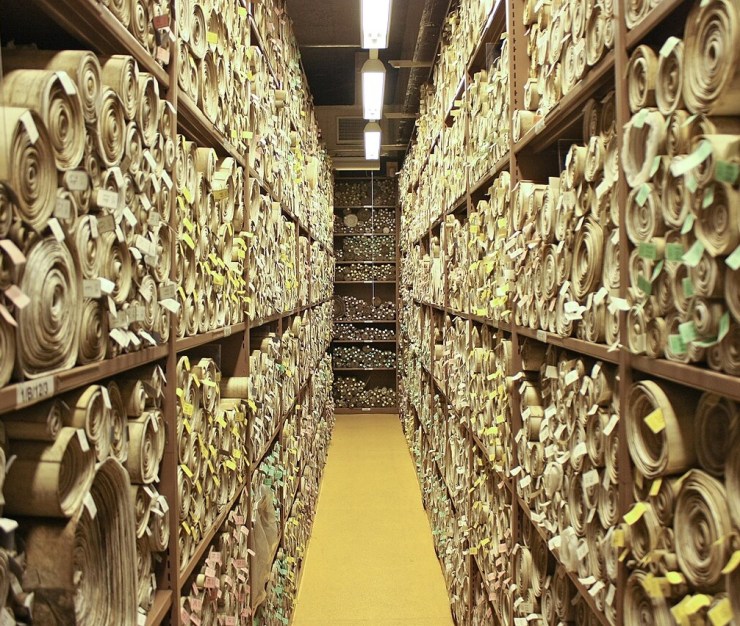
Acts of Parliament housed in the Victoria Tower, Palace of Westminster © Jeroen on Wikimedia (CC BY 2.0)
John writes, “I saw the dead, . . . standing before the throne, and books were opened. Then another book was opened, which is the book of life. And the dead were judged by what was written in the books, according to what they had done.” The books that John saw were scrolls. The scrolls in this image are records of Acts of Parliament of the government of the United Kingdom.
”Death and Hades” are “thrown into the lake of fire” (20:14). Anyone whose name is not “in the book of life, . . . was thrown into the lake of fire” (20:15). This fiery lake is ”the second death” (20:14). It is spiritual death.
A new Heaven and Earth
Then John sees “a new heaven and a new earth . . . .” (21:1). Satan’s city Babylon has collapsed into ruins (18:1-19:5). New Jerusalem comes down “out of Heaven from God” (21:2) to fill the Earth. It endures for all eternity. Thus begins the final, glorious vision of the book. We’ll explore this vision in our final part.
If you have time, please read Revelation 17:1-20:15.
Question 1
The woman on the beast is called “Babylon the great, mother of prostitutes and of earth’s abominations” (17:5). Why is Babylon pictured as an immoral and promiscuous woman? (See the description of her in 18:1-24.)
Question 2
Jesus is called “The Word of God” (19:13). This name is very significant in helping us to understand the final battle described in 19:11-21. Why is this?
Question 3
The angel bound Satan for a thousand years (20:2) “and threw him into the pit, and shut it and sealed it over him, so that he might not deceive the nations any longer, until the thousand years were ended” (20:3). In what ways is Satan bound today, and how does that encourage us in our own daily walk with Jesus and in our work for Him? Such Scriptures as Revelation 12:7-12, Matthew 28:18-20, John 12:31-33, Ephesians 1:20-22, Colossians 2:13-15, 1 Peter 5:8-9 are helpful here.
CREDITS ► Text copyright © 2022 Robert Gordon Betts ► Unless otherwise indicated, all Scripture is taken from the ESV® Bible (The Holy Bible, English Standard Version®), copyright © 2001 by Crossway, a publishing ministry of Good News Publishers. Anglicized English Standard Version copyright © 2002 by Crossway. Used by permission. All rights reserved. The ESV text may not be quoted in any publication made available to the public by a Creative Commons license. The ESV may not be translated in whole or in part into any other language. ► Scripture quotations marked ‘NIV’ are taken from The Holy Bible, New International Version (Anglicised edition). Copyright © 1979, 1984, 2011 by Biblica (formerly International Bible Society). Used by permission of Hodder & Stoughton Publishers, an Hachette UK company. All rights reserved. ‘NIV’ is a registered trademark of Biblica (formerly International Bible Society). UK trademark number 1448790.
 Creation to New Creation - a Bible Overview
![Illustration from Apocalipsis cu[m] figuris, Nuremburg: 1498, by Albrecht Dürer (1471-1528).](https://commons.wikimedia.org/wiki/File:Houghton_Typ_Inc_2121A_-_D%C3%BCrer,_Apocalypse,_43.jpg)
